


 Home /
What Is the Backlash of a Planetary Gearbox?
Right Angle Geared Motor: Matching Electrical Supply, Variable Speed and Braking
Oct 26, 2026
Planning a Bevel Reducer Installation: Turn Shaft Requirements Into a Practical Drive Layout
Oct 26, 2026
Choosing an Overhead Crane Gearbox by Its Hoisting or Travel Function
Oct 26, 2026
Replacing an Industrial Worm Gearbox: What to Keep and What to Reassess
Oct 25, 2026
Backlash in a planetary gearbox is the angular play at the output when the input is held and the output is reversed — lost motion, measured in arcminutes or arcseconds. It comes from designed tooth clearance, and its size depends on the unit's precision grade and on how many planetary stages it has. Small backlash supports accurate positioning; larger backlash is normally acceptable in continuous-duty industrial drives.
Key takeaways
- Planetary gearbox backlash is lost motion at the output, stated in arcminutes or arcseconds; 1 arcminute equals 1/60 of a degree, or 0.0167 degrees, according to Sesame Motor Corp.
- Backlash cannot be engineered to zero: clearance is needed for a lubricant film and for thermal growth of steel, which expands by roughly 11–13 µm per metre per °C, according to Lily Bearing.
- Accepted values depend on the job — about 10–15 arcminutes for standard industrial drives, 3–5 arcminutes for precision positioning and 1–3 arcminutes for high-speed testing, according to Cotta.
- Total backlash accumulates across stages, so a two- or three-stage reducer is looser than a single-stage unit built to the same precision grade.
- Where a drive runs one direction under steady load — conveying, mixing, pumping-type duty — paying for a tighter grade usually buys nothing.
What Is Backlash in a Planetary Gearbox?
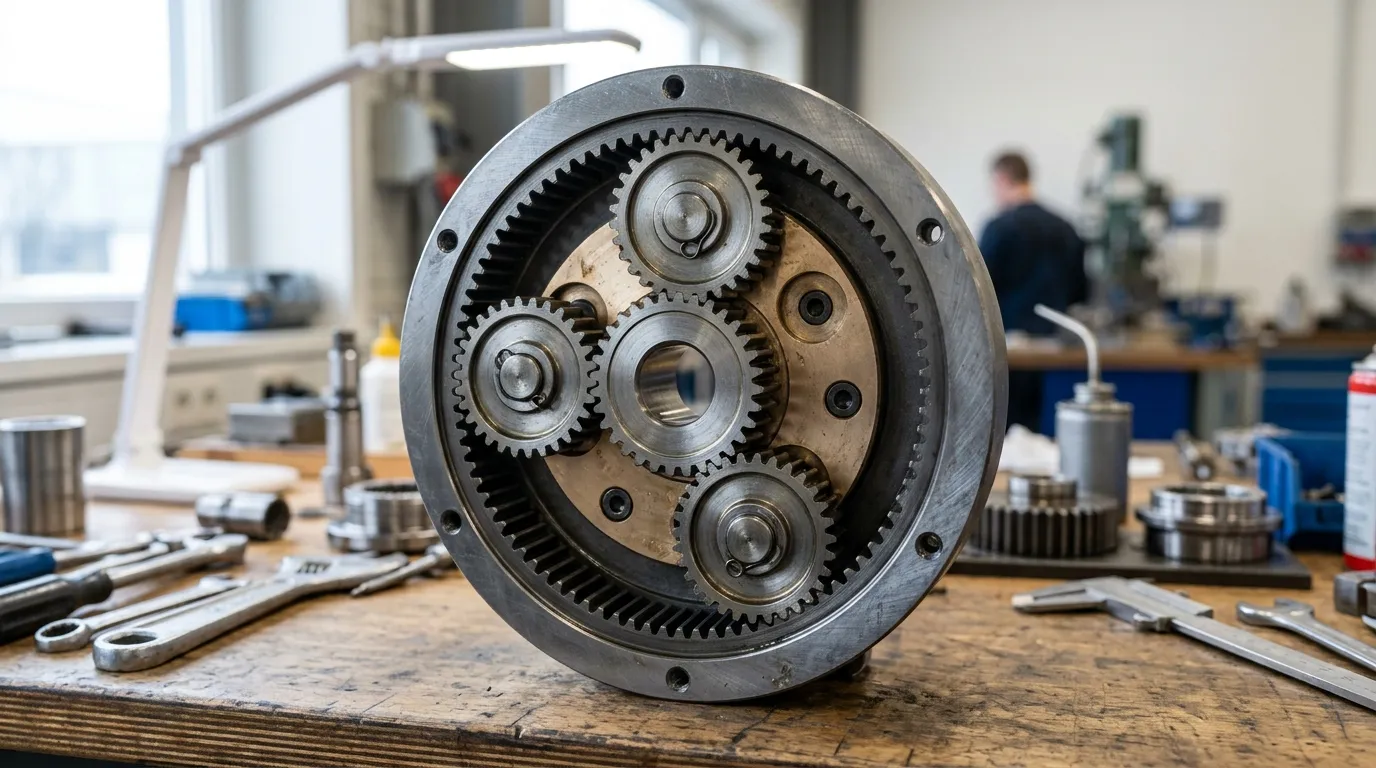
Backlash is the small angular clearance between meshing gear teeth that lets the output move before it re-engages when rotation reverses. It is designed into the gearbox rather than being a defect in itself, and it prevents teeth from jamming while leaving room for lubrication and thermal expansion, according to Sesame Motor Corp.
In a planetary gearbox the clearance appears at several meshes at once: sun gear to planet gears, planet gears to the ring gear, and the planet carrier to the output. A technical analysis published by Patsnap Eureka notes that backlash in planetary units occurs across the sun–planet, planet–ring and carrier interfaces, which is why a multi-stage planetary reducer behaves differently from a single gear pair.
It helps to separate two things that are often used interchangeably. Backlash is the physical clearance in the mesh; lost motion is the effect a user feels at the output, the angle the output travels before load is transmitted again. Transmission error is broader still — the deviation between ideal and actual output rotation across a full turn, which Apex Dynamics describes as a better overall indicator of gear quality than backlash alone.
[DIAGRAM: Annotated planetary stage showing sun gear, planet gears, ring gear and carrier, with the backlash gap exaggerated at one tooth mesh and labelled as angular play at the output.]
Backlash Units: Arcminutes and Arcseconds
Gearbox backlash is quoted as an angle, not a distance, so datasheets use arcminutes and arcseconds. One arcminute is 1/60 of one degree, or 0.0167 degrees, and one arcsecond is 1/60 of an arcminute, according to Sesame Motor Corp. Precision planetary gearboxes are commonly specified in arcminutes, while the tightest servo grades are quoted in arcseconds.
Linear equivalents such as millimetres appear only when the mesh is measured at a known radius, because the same angular play produces a larger physical gap as the radius grows. Lily Bearing gives a general reference of 0.05–0.3 mm of linear backlash for an industrial spur gear pair, a figure that varies with module and centre distance rather than being a fixed specification.
| Unit | Value | Relationship | Where it appears |
|---|---|---|---|
| Arcminute | 1/60 of a degree (0.0167°) | Base unit for gearbox backlash | Standard and precision planetary datasheets |
| Arcsecond | 1/60 of an arcminute | Used for the tightest grades | High-precision servo planetary units |
| Degree | 60 arcminutes | Conversion only | Engineering calculations |
| Millimetre (linear) | Application-dependent | Requires a known radius or centre distance | Measured tooth gap, not a catalogue rating |
How Is Planetary Gearbox Backlash Measured?
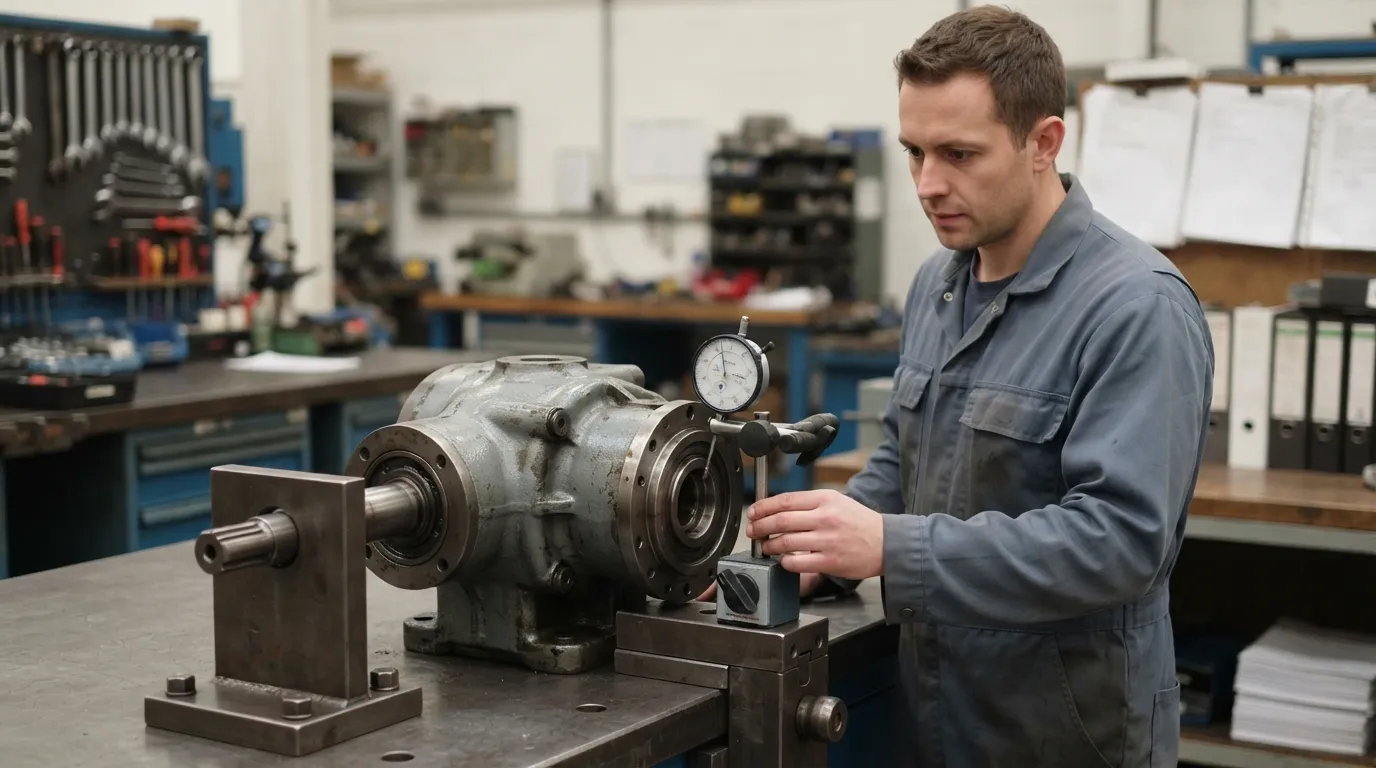
Backlash is measured by locking the input shaft, loading the output in one direction, then reversing the load and reading the angular displacement before the output re-engages. Apex Dynamics describes this method and notes that the test load is typically 1–2% of the gearbox's nominal torque capability, which is low enough to avoid torsional windup distorting the result.
- Lock the input shaft so the sun gear cannot rotate.
- Apply load to the output in one direction, at roughly 1–2% of nominal torque.
- Zero the measuring instrument at the output.
- Reverse the load direction.
- Read the angular movement before the output re-engages, in arcminutes or arcseconds.
Two conditions can make the same gearbox appear to have different backlash. A no-load reading captures the built-in clearance alone, while a loaded reading adds elastic windup from shafts, bearings and the gear teeth themselves. For this reason Apex Dynamics recommends stating the load condition alongside the number, or the comparison means little.
There is also no single international standard test method for gearbox backlash. Sesame Motor Corp states that no international standard governs the test procedure, so values from different suppliers are only comparable when the measuring conditions match.
What Is a Normal or Acceptable Backlash?
There is no single acceptable backlash figure — it depends on what the drive has to do. Cotta's application-based reference gives roughly 10–15 arcminutes for standard industrial gearboxes, 3–5 arcminutes for precision positioning and 1–3 arcminutes for high-speed testing.
Catalogue grades are usually grouped more coarsely than that. Sesame Motor Corp lists precision planetary grades as ≤1, ≤3, ≤5 and ≤7 arcminutes, noting that smaller backlash generally means higher precision and a higher relative price. Lily Bearing describes the precision planetary market as spanning sub-1-arcminute ultra-precision units through to roughly 3–5 arcminutes for standard grade products.
| Application | Typical backlash | Why this value |
|---|---|---|
| Continuous industrial drive | 10–15 arcminutes | Reversal error does not affect the process |
| Precision positioning | 3–5 arcminutes | Bidirectional accuracy matters, but cost still counts |
| High-speed testing and indexing | 1–3 arcminutes | Small reversal dead band is required for accuracy |
| Grade band | Typical backlash | Typical fit |
|---|---|---|
| Ultra-precision | Below 1 arcminute | Servo axes where reversal error is critical |
| Standard precision | Around 3–5 arcminutes | General positioning and indexing duty |
| General industrial | Broader, application-dependent | Steady one-direction plant drives |
The practical rule is to choose the loosest grade that still meets the error budget at the load. Buying three arcminutes when fifteen would do adds cost without changing the process.
Why Backlash Cannot Be Zero
A gearbox cannot be built with zero backlash, because clearance has to exist for lubrication and thermal growth. According to Sesame Motor Corp, backlash prevents teeth from sticking and provides space for the lubricant film and for expansion as the unit heats up.
Steel expands by approximately 11–13 µm per metre per °C, so a 60 °C temperature rise measurably grows both the teeth and the centre distances between them, according to Lily Bearing. A mesh that starts perfectly tight at 20 °C can bind at operating temperature. Centre distance interacts with backlash in the same way: Lily Bearing notes that on gears with a 20° pressure angle, a 0.1 mm increase in centre distance adds approximately 0.073 mm of backlash.
What Causes Backlash — and What Causes Too Much of It
Some backlash is designed in at manufacture; extra backlash comes from wear, tolerance and thermal effects. The distinction matters because a rising backlash reading over service life is a wear signal, not a design change.
Design and build contributions:
- Tooth thickness tolerance in the gears themselves.
- Runout, pitch deviation, pressure angle deviation and helix angle deviation, which Apex Dynamics identifies as contributors that together produce transmission error.
- Assembly tolerance in the carrier, shafts and housing.
- Centre distance inaccuracies in the housing bores.
Wear and operating contributions:
- Tooth flank wear and pitting after long service.
- Bearing wear, which changes shaft position and therefore mesh clearance.
- Thermal growth that increases centre distance at operating temperature.
- Lubricant film thickness changing between cold start and steady state.
How Backlash Affects Positioning Accuracy
Backlash appears as a dead band each time a drive reverses, so it damages bidirectional positioning far more than it affects motion in one direction. A servo axis that must approach a position from either side can land in a slightly different place depending on which direction it came from.
The error grows with distance from the axis. According to Santram Engineers, 1 arcminute of backlash can create nearly 3 mm of deviation at a 10 m radius. The same arithmetic at a 1 m radius gives about 0.29 mm, because the deviation scales with radius: 0.0167 degrees of play at 1 m is roughly 0.29 mm, and at 10 m it is roughly 2.9 mm.
That scaling is why the same gearbox grade can be perfectly adequate on one machine and unusable on another. A packaging axis indexing a small pulley tolerates a fraction of the error that a long boom or a large rotary table would see.
How Number of Stages Affects Total Backlash
Each planetary stage adds its own clearance, so total backlash in a multi-stage reducer is larger than in a single stage built to the same grade. Since backlash exists at the sun–planet, planet–ring and carrier interfaces, a two-stage unit puts roughly twice as many meshes in series as a single-stage unit, and a three-stage unit adds more again.
Stage count and ratio are linked, because higher ratios are reached by stacking stages rather than by one very large reduction. A planetary gearbox ratio page explains how that stacking works and how ratio and stage count are calculated together.
When Backlash Matters — and When It Does Not
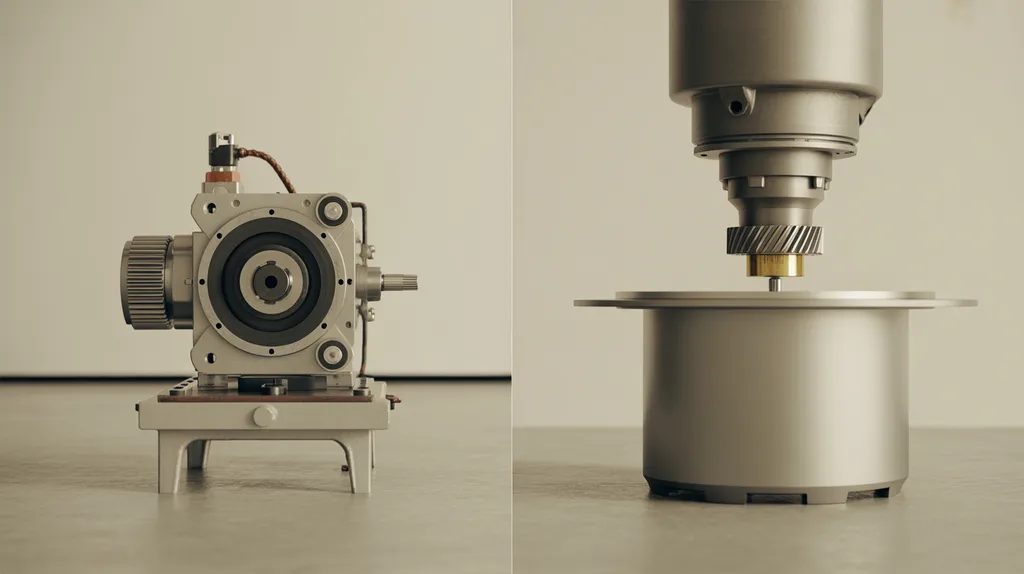
Backlash matters when the drive must hold or reverse position precisely, and it usually does not matter in continuous-duty industrial drives running one direction under load. Cotta's reference band of 10–15 arcminutes for standard industrial service reflects how much clearance plant drives normally carry without any loss of function.
Positioning duty is where the dead band turns into a real cost. Robotics, CNC indexing, packaging registration and any axis that approaches a target from both directions all depend on reversal error being small. A summary of planetary gearbox applications shows how widely these duties differ, from servo positioning axes to bulk plant drives.
| Drive duty or application | Does backlash affect performance? | What to do |
|---|---|---|
| Servo positioning and indexing | Yes — reversal error is direct position error | Specify a precision grade and check the error budget |
| Robotics | Yes — short reversal moves dominate | Use a tight grade and account for stage count |
| Packaging registration | Yes, where the print or cut position must repeat | Set an allowed dead band at the roller, then derive the angle |
| Conveying and material handling | Rarely — motion is one direction under load | Standard backlash is normally acceptable |
| Mixing and plastics or rubber machinery | Rarely — process depends on torque, not position | Standard backlash is normally acceptable |
| Mining, cement, power and ports | Rarely — steady loads, no fine positioning | Standard backlash is normally acceptable |
On the continuous-duty side, the mesh clearance simply is not in the process loop. A helical geared motor driving a conveyor or a paddle mixer transmits torque in one direction, and the small play at reversal never reaches the product.
Low-Backlash and Zero-Backlash: What You Are Trading
Tighter backlash costs more and is not automatically the better choice. Sesame Motor Corp notes that smaller backlash generally means higher precision and a higher relative price, and the trade-off does not stop at the catalogue: tighter tolerances also mean tighter fits, more careful mounting and greater sensitivity to centre distance error on site.
Zero backlash in the strict sense is not achievable in a geared transmission, because clearance is needed for lubrication and thermal growth. What suppliers call zero-backlash or near-zero units are very tight grades, sometimes with preload or a different mechanism altogether. In a 2024 article, Design World cited one manufacturer describing a high-precision planetary unit at under 6 arcseconds with a 20,000-hour operating claim, against 6,000 hours for a standard cycloidal design — a vendor comparison rather than a general rule.
Where reversal accuracy is the dominant requirement, it is worth comparing architectures rather than just grades. A planetary gearbox vs harmonic drive comparison sets out how the two handle backlash, stiffness and torque, and a planetary vs cycloidal gearbox comparison covers impact loads and shock resistance alongside backlash behaviour.
How to Choose a Backlash Grade
Choose the loosest grade that still meets the application's reversal error budget. Working from the load backwards is faster than comparing grades first.
- Define the acceptable positioning error at the load, in millimetres or in degrees of output rotation.
- Convert that error into an allowable angular backlash at the output radius.
- Check whether the drive actually reverses during the cycle. If it does not, backlash does not enter the accuracy calculation.
- Count the stages needed to reach the required ratio, then allow for backlash accumulating across those stages.
- Compare grades and prices only after steps 1–4, and confirm the measurement conditions behind any quoted figure.
If the answer points to a full selection exercise rather than a single grade, the guidance in how to choose planetary gearbox covers torque, service factor, mounting and ratio together.
Mingye builds heavy-duty planetary reducers and industrial geared motors for plant drives that run under steady load, and matches backlash grade to the duty rather than to a universal target.
Frequently Asked Questions
Can you backdrive a planetary gearbox?
Backdrivability depends on the reduction ratio, internal friction and the load torque applied, not on backlash alone. Backlash only sets how far the output moves freely before the teeth re-engage in the opposite direction. A high-ratio, low-friction unit may backdrive under load even though its backlash value is small.
Does backlash increase over time?
Yes. Tooth flank and bearing wear gradually remove material from the contacting surfaces, and centre-distance changes from wear or thermal cycling add to the as-built value. A backlash reading that climbs across service intervals is a useful wear indicator, and it is normally checked with the same method and load condition used for the original reading.
How do you reduce backlash?
Reducing backlash means tighter manufacturing tolerances and a higher precision grade, fewer planetary stages for the same ratio where possible, and correct mounting with accurate centre distances. Zero is not achievable because clearance is required for lubrication and thermal expansion, so a practical target is the loosest grade that still meets the positioning requirement.
Is backlash the same as lost motion?
No, though they are closely related. Backlash is the physical clearance between meshing teeth inside the gearbox. Lost motion is the resulting effect at the output — the angle the load travels before torque is transmitted after a direction change. Transmission error is a wider measure of how closely actual output rotation tracks the ideal.
How much backlash is acceptable?
Acceptable backlash depends on the duty. Cotta's reference bands are roughly 10–15 arcminutes for standard industrial service, 3–5 arcminutes for precision positioning and 1–3 arcminutes for high-speed testing. The working rule is to pick the loosest grade that still keeps reversal error inside the machine's positioning tolerance.
[DIAGRAM: Measurement setup with the input locked, the output loaded in one direction and then reversed, showing the measured displacement as an arcminute angle.]
[DIAGRAM: Chart converting 1, 3, 5 and 10 arcminutes of backlash into linear deviation at 1 m and 10 m output radius.]
Share on Social:


Contact Us
In This Article
Right Angle Geared Motor: Matching Electrical Supply, Variable Speed and Braking
Oct 26, 2026
Planning a Bevel Reducer Installation: Turn Shaft Requirements Into a Practical Drive Layout
Oct 26, 2026
Choosing an Overhead Crane Gearbox by Its Hoisting or Travel Function
Oct 26, 2026
Replacing an Industrial Worm Gearbox: What to Keep and What to Reassess
Oct 25, 2026