


 Home /
How to Choose a Planetary Gearbox?
Rubber Internal Mixer Gearbox: Read the Batch Load Profile, Not Just Motor kW
Oct 22, 2026
Hot Industrial Gearbox Coupling After Cold Alignment: What to Check
Oct 22, 2026
Hydraulic Slewing Drive Won't Rotate: Separate Motor, Brake and Gearbox Faults
Oct 22, 2026
Calender Roll Gap Changes: What Must the Drive Coupling Accommodate?
Oct 22, 2026
To choose a planetary gearbox, work in this order: define output torque and peak torque, select the gear ratio and input speed, set the backlash and stiffness requirement, confirm mounting and shaft interface, then verify the service factor for the real duty cycle. Decide first whether you need a heavy-duty industrial planetary reducer or a precision servo planetary gearbox, because those two classes prioritize different specifications.
Key takeaways
- Planetary gearbox selection follows a fixed order: output torque, then ratio and input speed, then backlash and stiffness, then mounting and interface, then service factor.
- Output torque can be calculated as (P × 9546) / N, and rated torque equals that calculated output torque multiplied by the service factor, according to Top Gear Transmission.
- Heavy-duty industrial planetary reducers and precision servo planetary gearboxes are different selection problems, not one product class.
- Peak torque, duty cycle and inertia matching often decide the final size, not continuous torque alone.
- Planetary efficiency is typically 95–98%, comparable to helical units at up to 98% and well above worm gearboxes at 50–70%, according to Industrial Gearbox Supply.
What Is a Planetary Gearbox and How Does It Work?
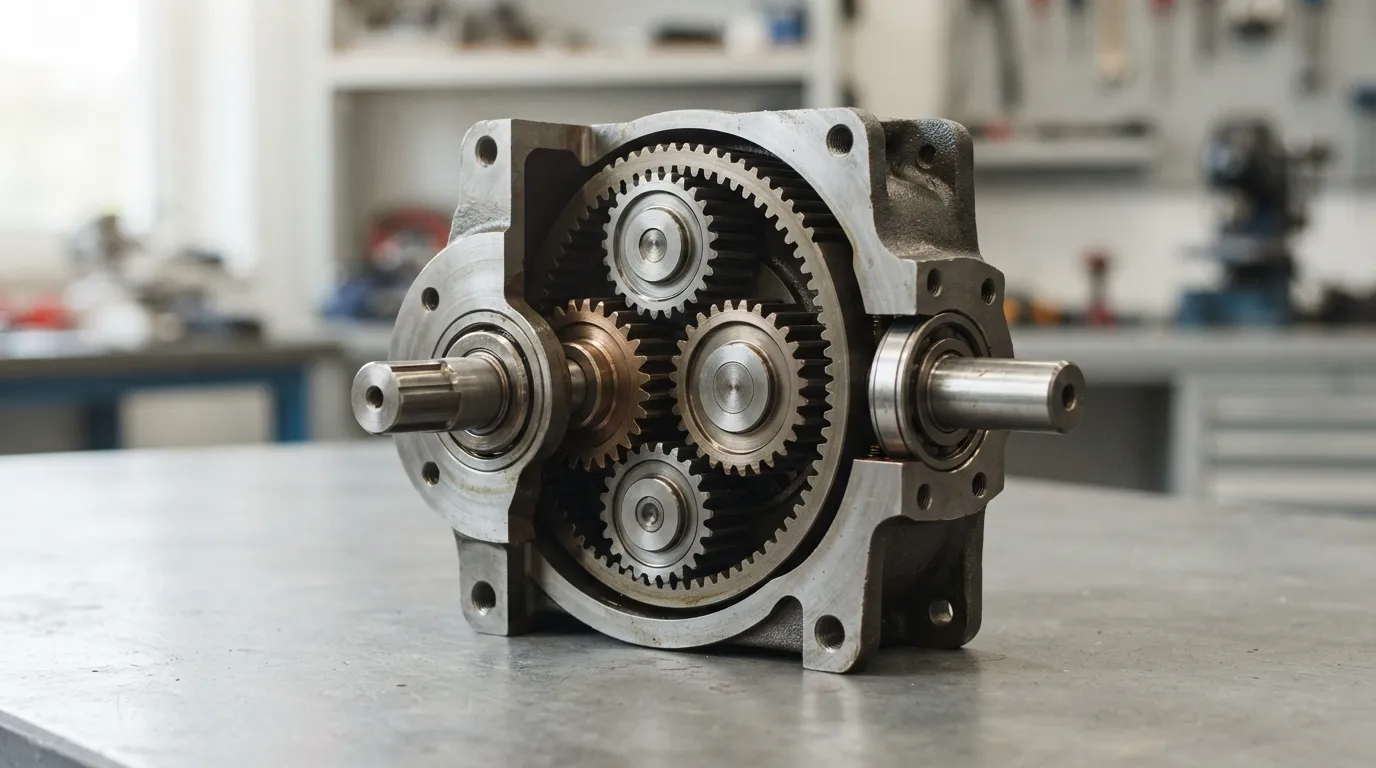
A planetary gearbox is a speed reducer in which planet gears orbit a central sun gear inside a ring gear, with a carrier delivering the output. Load is shared across several planet gears at once, which is why planetary units deliver high torque density inside a compact frame.
[DIAGRAM: Annotated planetary stage cutaway — sun gear, planet gears, carrier, ring gear, input shaft and output shaft labelled.]
The main parts are the sun gear, the planet gears, the carrier, the ring gear, and the input and output shafts, according to Top Gear Transmission. According to AssunMotor (2024), that arrangement distributes load across multiple planet gears, giving high torque density, a compact envelope and smooth power transfer.
Reduction can be built up in stages. According to Machine Design (updated 28 February 2023), a simple planetary gear set can provide reductions as high as 10:1, while compound planetary gears or stages arranged in series provide greater reductions, with total reduction being the product of the individual stages.
Heavy-Duty Industrial Reducer or Precision Servo Gearbox?
Choose a heavy-duty industrial planetary reducer when the controlling factors are continuous torque, shock load, duty cycle and thermal capacity. Choose a precision servo planetary gearbox when the controlling factors are positioning accuracy, backlash and torsional stiffness. Making this choice first prevents the most common mistake in planetary gearbox selection: sizing a precision unit for an industrial duty cycle, or paying for precision the machine cannot use.
| Attribute | Heavy-duty industrial planetary reducer | Precision servo planetary gearbox |
|---|---|---|
| Primary selection driver | Continuous torque, duty cycle, shock load | Position accuracy, backlash, stiffness |
| Backlash emphasis | Functional backlash only | 8–15 / 5–8 / ≤3 / ≤1 arcmin classes |
| Typical verification | Thermal rating, overhung load | Inertia ratio, torsional stiffness |
| Mounting emphasis | Foot or flange mounting, shaft and load connection | Motor flange, frame size, shaft fit |
| Typical applications | Mixing, conveying, mining, cement, ports | Robotics, CNC, servo axes, automation |
The two classes also differ in how much supporting data a buyer should demand. According to TriQuench India, CNC planetary gearbox buyers should compare gear ratio, rated torque, peak torque, backlash, efficiency, mounting flange and shaft size rather than relying on a single headline specification.
How Do You Choose a Planetary Gearbox? Step by Step
Size the planetary gearbox in six steps, and do not skip the service factor and thermal check at the end. Most over-sized or under-sized units fail there, not at the ratio calculation.
Step 1 — Define Output Torque and Peak Torque
Start with the torque the driven machine actually needs in continuous operation, then add the peak torque produced by starts, jams or reversing. According to Top Gear Transmission, output torque can be calculated as (P × 9546) / N, where P is power in kilowatts and N is output speed in rpm, and rated torque is that calculated output torque multiplied by the service factor.
Peak torque deserves its own check. According to Sango Automation, peak torque in servo indexing applications often runs at 2.0–3.0 times continuous rated torque, and a service factor of 1.25–2.0 is applied depending on shock severity. When the driven machine sees frequent shock loading, sizing on continuous torque alone leaves the gearbox under-specified. For shock-loaded industrial duty, planetary gearbox high torque ratings are the relevant figure to compare.
Step 2 — Set the Gear Ratio and Input Speed
Divide the input speed by the required output speed to get the ratio, then select the nearest available ratio and confirm the resulting output speed is acceptable. Forcing an exact ratio is not the goal; matching the machine is.
According to Sango Automation, a 3,000 rpm motor driving a 150 rpm output requires a 20:1 ratio, and if the available ratios are 16:1 and 25:1, the correct move is to select 25:1 and verify that the resulting 120 rpm output is acceptable. According to Machine Design, compound planetary gears or stages in series multiply the stage reductions, which is how higher overall ratios are reached in a compact unit. Gear ratio also sets how much torque multiplication the unit provides, which is why it is usually reviewed on the same page as torque — see planetary gearbox ratio for the calculation in more depth.
Step 3 — Decide Backlash and Torsional Stiffness
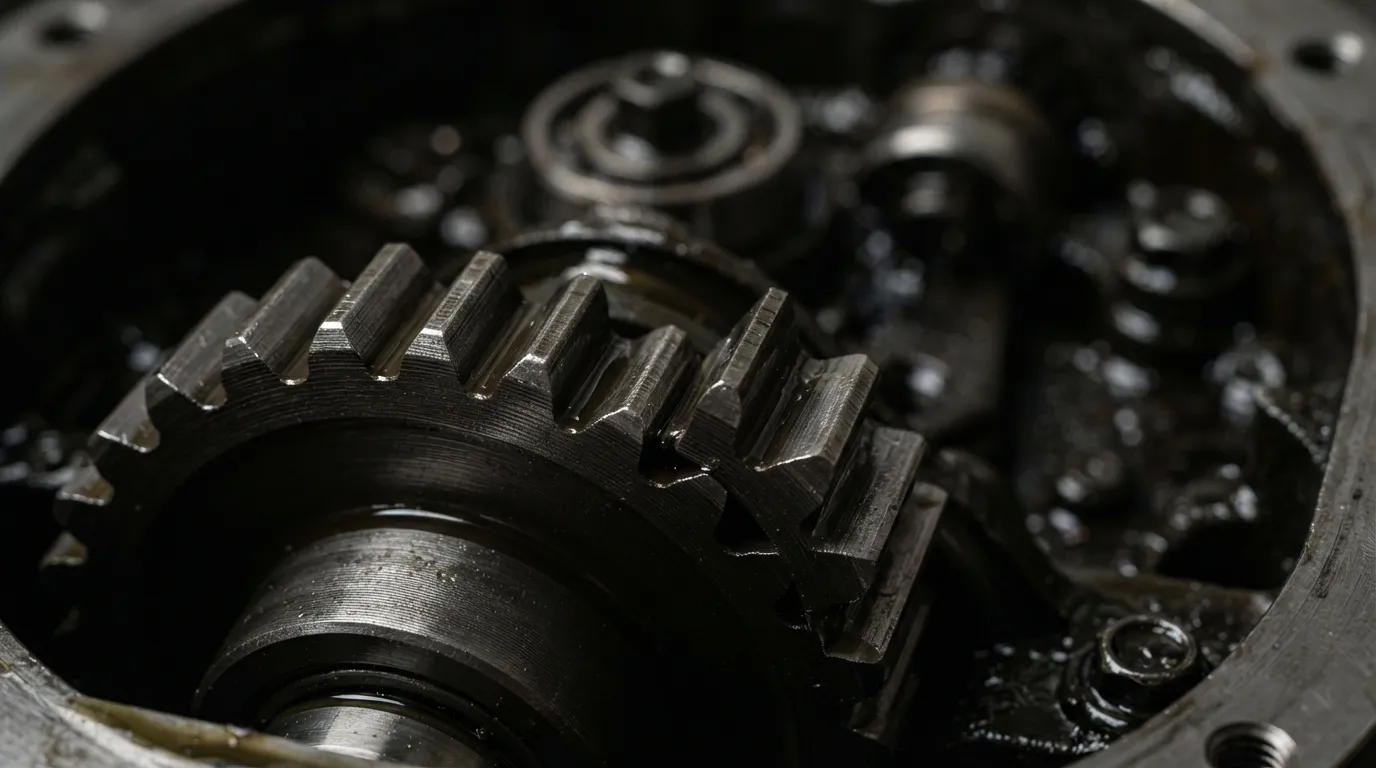
Specify the loosest backlash class that still holds your positioning tolerance. Backlash is the small amount of rotational play between meshing gears before load is transmitted; tighter classes cost more, and buying precision the machine does not need adds cost without improving the process.
| Class | Backlash | Typical use |
|---|---|---|
| Standard | 8–15 arcmin | General industrial drive |
| Low Backlash | 5–8 arcmin | Standard servo positioning |
| Precision | ≤3 arcmin | CNC, indexing |
| Ultra-Precision | ≤1 arcmin | High-accuracy positioning |
Backlash class values from Sango Automation.
Backlash is not the only source of positioning error. According to Sango Automation, torsional stiffness converts applied torque into elastic angular error: at 200 N·m applied torque and 20 N·m/arcmin stiffness, the elastic error is 10 arcmin, which can exceed backlash alone. For any application where stopping position matters, check both.
[DIAGRAM: Bar chart comparing backlash alone against backlash plus elastic angular error from torsional stiffness, using the 200 N·m and 20 N·m/arcmin example.]
Step 4 — Confirm Mounting, Shaft and Motor Interface
Match the gearbox to the machine and to the motor before ordering. The interface is a specification, not an afterthought, and it is the point where a correctly sized unit can become unusable.
Confirm five items: mounting type (foot or flange), output shaft design and diameter, input flange pattern, motor frame size, and shaft fit or hollow input arrangement. According to Kavitsu, mounting type and environmental protection are core buyer-guide factors, alongside material quality and service support.
Step 5 — Apply the Service Factor and Check Thermal Rating
Rated torque is the calculated output torque multiplied by the service factor, and the thermal rating must still cover continuous operation at your actual ambient temperature and input speed. A unit that passes the torque check can still fail the thermal check.
According to Top Gear Transmission, thermal rating is the continuous power that can be transmitted with splash lubrication at a maximum oil temperature of 90°C, an ambient temperature of 25°C and an input speed of 1440 rpm. If the site runs hotter, slower or with a heavier duty cycle than those conditions, the catalogue thermal figure does not transfer directly.
Step 6 — Verify Overhung Load and Collect the Data
Check the radial load carried by the output shaft, then gather the datasheet values that let a supplier confirm the selection. According to Top Gear Transmission, overhung load in newtons is calculated as [(19,100,000 × P) / (d × n)] × Fc, where load connection factors include 1 for a chain sprocket, 1.06 for a gear, 1.5 for a sprocket, 2.5 for a V-belt and 3.5 for a friction wheel.
Planetary Gearbox Selection Checklist
Run this verification list before sending an enquiry. Every unchecked row is a specification risk that usually surfaces after installation rather than before.
| Check | What to confirm | Risk if skipped |
|---|---|---|
| Continuous torque | Rated torque × service factor meets requirement | Overheating, shortened life |
| Peak torque | Covers start, jam and reversing loads | Gear or bearing damage |
| Ratio and output speed | Nearest available ratio is acceptable | Machine runs off-spec |
| Backlash class | Tightest class actually required, not tightest available | Cost with no benefit |
| Mounting and interface | Flange, shaft, frame size and fit | Unit cannot be assembled |
| Thermal rating | Ambient, input speed and lubrication match site | Continuous-duty failure |
| Overhung load | Radial load multiplied by connection factor | Bearing and shaft damage |
Complementary checklist items from Kavitsu include required torque range, suitable gear ratio, correct mounting type, environmental protection, material quality, service support and warranty, spare parts availability, budget and lifecycle cost. The last two matter because industrial gearbox price reflects not only purchase cost but how long the unit runs before it needs attention.
How Does a Planetary Gearbox Compare With Helical and Worm Types?
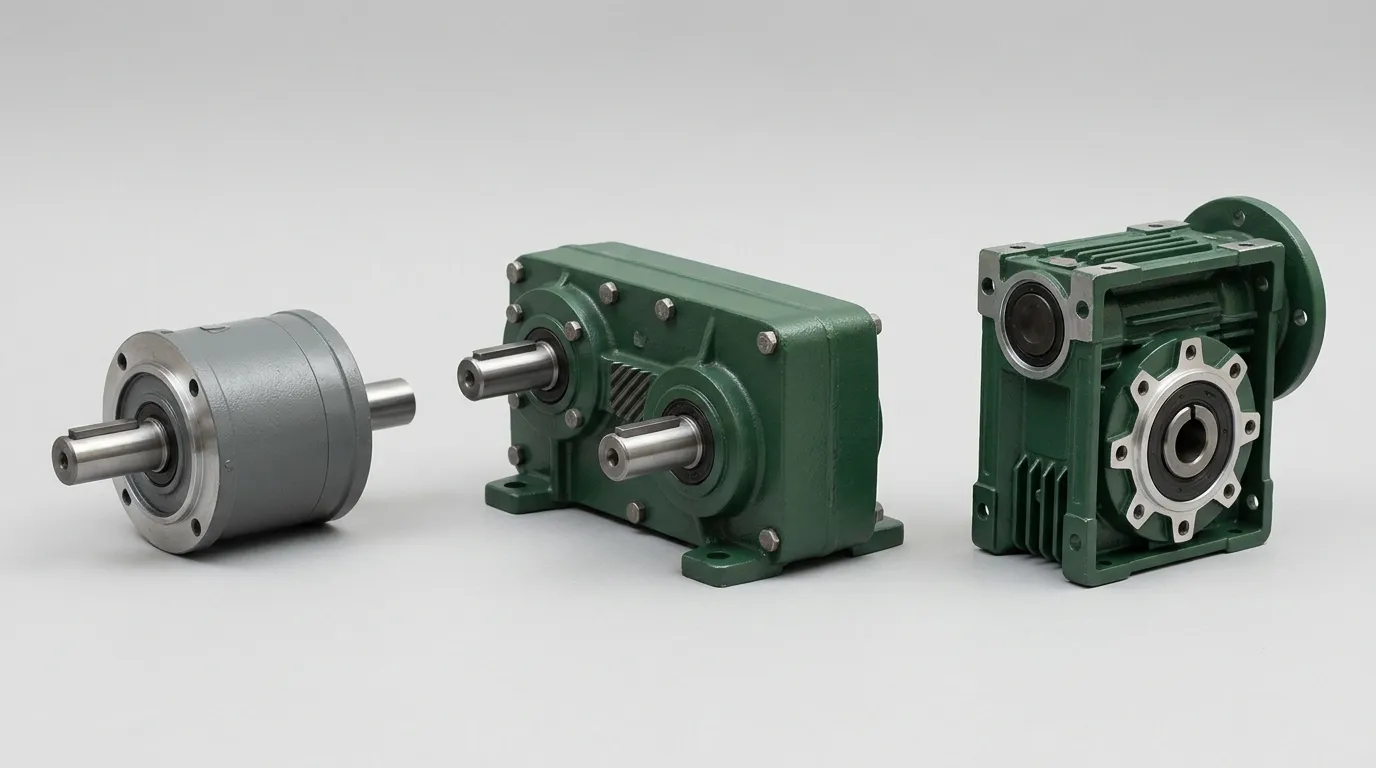
A planetary gearbox offers high efficiency and high torque density in a compact, in-line frame; helical gearboxes suit high-power parallel-shaft duty; worm gearboxes suit high-ratio, low-speed duty. The comparison is about fit, not about one type being universally better.
| Type | Efficiency | Torque density | Typical selection driver |
|---|---|---|---|
| Planetary | 95–98% | High, compact frame | Torque density, in-line mounting, backlash control |
| Helical | Up to 98% | High, longer frame | High power, parallel-shaft layouts |
| Worm | 50–70% | Lower | High ratio, low speed, compact right-angle drive |
Efficiency figures from Industrial Gearbox Supply.
Efficiency is one input among several. Ratio range, backlash requirement, mounting direction, service factor and thermal behaviour also decide the type, and planetary vs helical gearbox compares the two most commonly confused options in detail.
Common Planetary Gearbox Selection Mistakes
Most wrong selections come from sizing on continuous torque only, ordering ultra-low backlash by default, or treating every planetary gearbox as the same class of product. Each mistake has a simple correction.
- Sizing on continuous torque alone. Add peak torque at 2.0–3.0 times continuous for indexing duty, and apply a service factor of 1.25–2.0 based on shock severity (Sango Automation).
- Ignoring inertia matching. According to Sango Automation, reflected load inertia falls by the square of the gear ratio; a responsive servo guideline is 1:1 to 5:1, and ratios above 10:1 increase settling time and instability risk.
- Buying ultra-precision backlash by default. Specify the loosest class that meets tolerance; medium classes are far cheaper than ultra-precision.
- Checking backlash but not stiffness. Elastic angular error from torsional stiffness can exceed backlash, so both are needed for positioning duty.
- Skipping the thermal rating. A torque-adequate unit can still overheat in a hot plant running continuous duty.
- Choosing ratio without checking output speed. The nearest available ratio, not the exact calculated ratio, is what the machine will actually run at.
- Ignoring the mounting interface. Flange pattern, frame size and shaft fit decide whether the unit installs.
- Assuming one quality language fits all suppliers. Gear quality is classified under AGMA classes Q3 to Q15, with higher numbers indicating tighter tolerances, and ISO 1328 and DIN standards are also widely used (GreatTaiwanGear, 2026).
What to Send a Supplier Before You Order
Send seven data points with your enquiry: continuous output torque and peak torque; required output speed and available input speed; target gear ratio or range; backlash class; mounting type plus shaft, flange and frame details; duty cycle and ambient conditions; and load type including overhung load. A supplier given those seven items can confirm or correct the selection instead of quoting a catalogue number.
Two further details make the reply more useful: material quality expectations and required environmental protection, plus service support, warranty and spare-part expectations, all of which Kavitsu lists as buyer-guide factors. It also helps to state where the gearbox is used, since duty in mixing, conveying, packaging, mining or cement service changes how the unit is loaded — planetary gearbox applications shows how these duty profiles differ.
Mingye designs and manufactures heavy-duty planetary reducers alongside more than 20 other gear motor and reducer series at its own CNC-equipped factory in Jinshan District, Shanghai, on modular, standardized designs. For OEM projects, Mingye offers customization of mounting dimensions and transmission ratios, so interface data and duty-cycle information sent at the enquiry stage can be reviewed against a standard or adapted design, with normal delivery in 7–15 days.
Frequently Asked Questions
How do you calculate a planetary gearbox output torque?
Use output torque = (P × 9546) / N, where P is power in kilowatts and N is output speed in rpm, then multiply by the service factor to get rated torque. Confirm peak torque separately for starting, jam and reversing duty, because peak loads often exceed the continuous rating.
What specifications should I compare between planetary gearboxes?
Compare gear ratio, rated torque, peak torque, backlash class, efficiency, torsional stiffness, mounting flange, output shaft size and thermal rating. A single headline torque figure does not show whether the unit suits your duty cycle, ambient conditions or positioning requirement.
Is a lower-backlash planetary gearbox always better?
No. Backlash classes run from Standard at 8–15 arcmin to Ultra-Precision at ≤1 arcmin, and tighter classes cost more. Specify the loosest class that still holds your positioning tolerance, and check torsional stiffness as well, since elastic error can exceed backlash.
What is the difference between planetary and helical gearboxes in efficiency?
Planetary gearboxes are typically 95–98% efficient and helical units up to 98%, while worm gearboxes run at 50–70%, according to Industrial Gearbox Supply. Efficiency alone should not decide the type, because mounting direction, ratio range, backlash and duty cycle also matter.
What should I send a supplier when requesting a planetary gearbox?
Send output and peak torque, required output speed, input speed or motor data, target ratio, backlash class, mounting and shaft details, duty cycle and ambient conditions, and load type including overhung load. Those seven items let the supplier confirm the selection rather than quote blind.
Share on Social:


Contact Us
Rubber Internal Mixer Gearbox: Read the Batch Load Profile, Not Just Motor kW
Oct 22, 2026
Hot Industrial Gearbox Coupling After Cold Alignment: What to Check
Oct 22, 2026
Hydraulic Slewing Drive Won't Rotate: Separate Motor, Brake and Gearbox Faults
Oct 22, 2026
Calender Roll Gap Changes: What Must the Drive Coupling Accommodate?
Oct 22, 2026