


 Home /
Planetary Gearbox vs Worm Gearbox: Key Differences
Right Angle Geared Motor: Matching Electrical Supply, Variable Speed and Braking
Oct 26, 2026
Planning a Bevel Reducer Installation: Turn Shaft Requirements Into a Practical Drive Layout
Oct 26, 2026
Choosing an Overhead Crane Gearbox by Its Hoisting or Travel Function
Oct 26, 2026
Replacing an Industrial Worm Gearbox: What to Keep and What to Reassess
Oct 25, 2026
Planetary gearboxes deliver roughly 95–98% efficiency, high torque density and low backlash in an inline layout, while worm gearboxes offer right-angle output, single-stage ratios from 5:1 to 100:1, and self-locking at low lead angles — but at lower efficiency and under tighter thermal limits. Choose planetary for compact high-torque or servo positioning; choose worm when you need right-angle output, high single-stage reduction, or holding torque without a separate brake.
Planetary vs Worm Gearbox at a Glance
Planetary gearboxes are inline, high-efficiency, high-torque-density units; worm gearboxes are right-angle, high-single-stage-ratio units that can self-lock but run hotter and less efficiently.
The two designs solve different problems. A planetary reducer packs a large torque capacity into a short axial length and keeps losses low. A worm reducer trades efficiency for a 90° shaft turn, a large reduction in one stage, and the possibility of holding a load without a brake.
| Criterion | Planetary Gearbox | Worm Gearbox |
|---|---|---|
| Efficiency | About 95–98%, up to 98% per stage | About 40–90%, commonly 50–70% |
| Torque density | High; load shared across several planet gears | Lower for the same frame size |
| Gear ratio range | 3:1 to over 1000:1 by stacking stages | 5:1 to 100:1 in a single stage |
| Self-locking | None inherent | Possible when lead angle is small, typically below about 5° |
| Shaft layout | Inline / coaxial | Right-angle, normally 90° |
| Backlash | Typically low; suited to positioning | Often quoted in degrees rather than arcminutes |
| Input speed / servo fit | Good match for servo motors running 2000–3000 RPM or higher | Input speed limited, especially at high ratios |
| Heat and duty cycle | Rolling contact, runs cooler | Sliding contact generates friction and heat; thermal rating often limits continuous duty |
| Cost | Higher for the same torque | Generally lower in moderate-duty sizes |
| Best-fit applications | Robotics, CNC, servo positioning, compact high-torque drives | Right-angle conveyors, moderate-duty handling, holding applications |
What Is a Planetary Gearbox and How Does It Work?
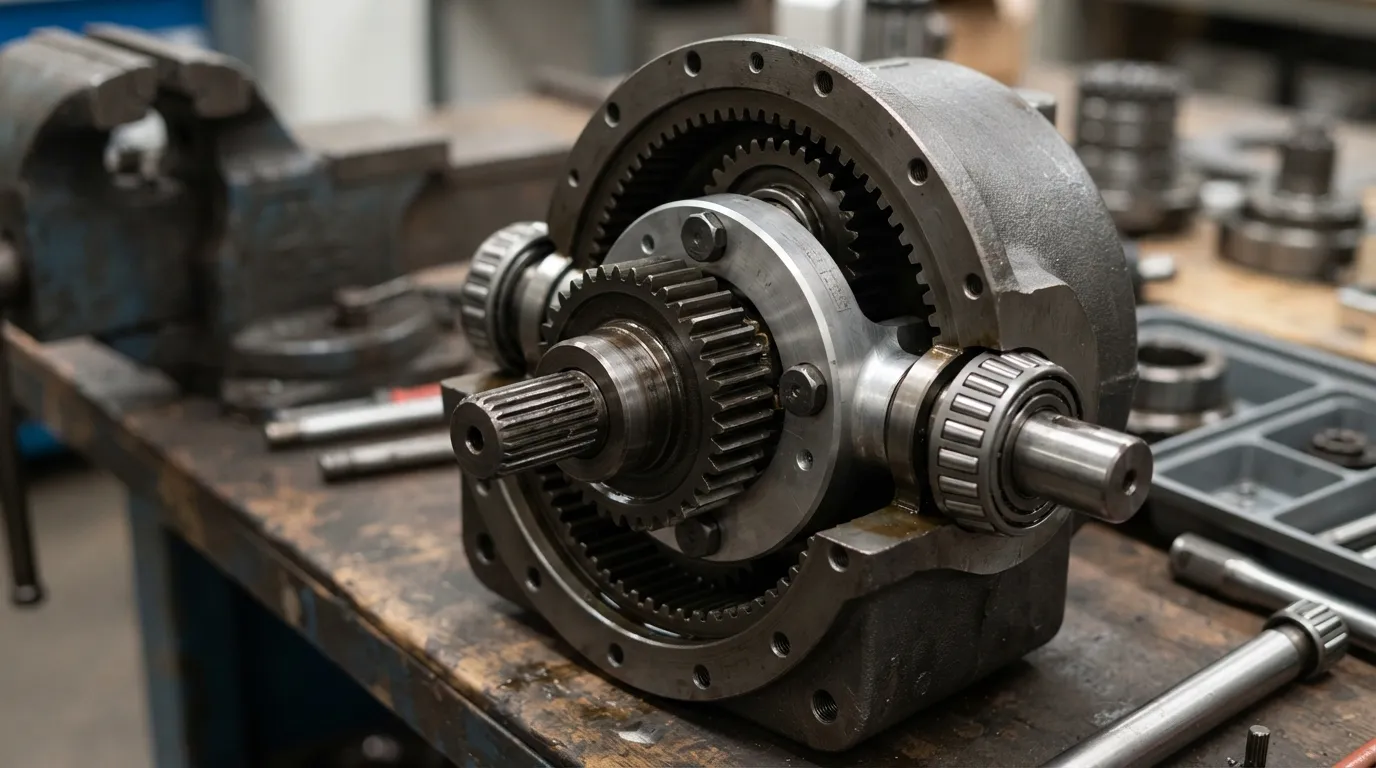
A planetary gearbox, also called an epicyclic gearbox, uses a central sun gear, several planet gears, a ring gear and a carrier; the multiple planet gears share the transmitted load, which is why torque density is high.
According to SLW Motor, the load sharing across several planet gears is the key mechanical reason a planetary unit can be compact while carrying a heavy torque. The gears roll against each other rather than sliding, which keeps friction losses low and supports the high efficiency figures quoted for this design. A planetary gearbox is also known as an epicyclic gearbox and is chosen for high torque density, compact size and high efficiency, according to Skysmotor.
[DIAGRAM: Cutaway of a planetary gear set showing sun gear, planet gears, ring gear and carrier, with input and output arrows]
What Is a Worm Gearbox and How Does It Work?
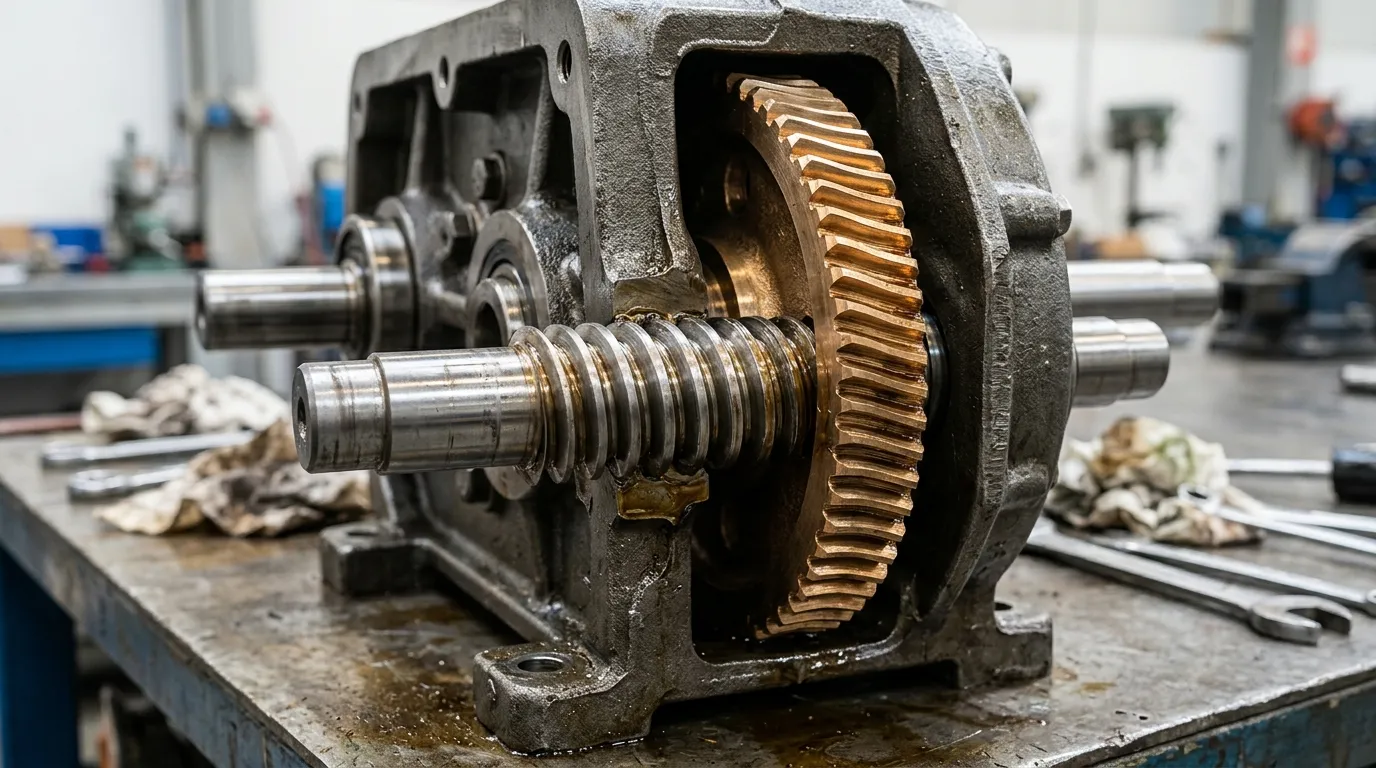
A worm gearbox uses a screw-shaped worm meshing with a worm wheel; the input and output shafts are normally positioned at 90°.
According to SLW Motor, this screw-and-wheel arrangement is what gives the worm reducer its right-angle output. Torque is transmitted through sliding contact, so the worm screw rubs across the wheel teeth rather than rolling over them. A single-start worm driving a 40-tooth worm wheel produces a 40:1 reduction, according to PlanetDrivePro — one full turn of the worm advances the wheel by a single tooth. That geometry explains both the strength of the design (large reduction in one stage) and its weakness (friction and heat).
Efficiency: Planetary vs Worm Gearbox
Planetary gearboxes run about 95–98% efficient, while worm gearboxes typically run 40–90% depending on lead angle, materials and lubrication, with many common units in the 50–70% range.
Industrial Gearbox Supply lists typical efficiency values of 95–98% for planetary, 50–70% for worm and 90–98% for helical units. TANHON reports worm gear efficiency from 40% to 90% depending on lead angle, materials and lubrication, and planetary efficiency up to 98% per stage, with overall efficiency dropping slightly as more stages are added.
| Gearbox type | Typical efficiency | Main reason |
|---|---|---|
| Planetary | About 95–98%; up to 98% per stage | Rolling contact between gears; load shared across planet gears |
| Worm | About 40–90%; commonly 50–70% | Sliding contact between worm screw and worm wheel |
The gap matters in continuous duty. Every percentage point of lost efficiency becomes heat inside the housing, so a worm reducer at 60% efficiency rejects far more energy than a planetary unit doing the same work. On a conveyor or mixer running two or three shifts, that difference shows up in energy cost and in lubricant life, not just in a catalog figure.
Torque Density and Compactness
Planetary gearboxes offer higher torque density and a more compact envelope for a given torque; worm gearboxes are compact in a different way — they save space by turning the drive 90°.
According to Industrial Gearbox Supply, planetary gearboxes are ideal when space is limited but high torque and precision are required, while worm gearboxes are more compact and self-locking but have lower efficiency. In practice, a machine designer choosing between them is trading axial length against layout. A planetary reducer adds length along the drive axis but keeps the motor in line with the load. A worm reducer adds little axial length and instead redirects the drive, which can free up space around a machine frame or a mixing vessel.
Gear Ratio Range: One Stage vs Multiple Stages
Worm gearboxes give high ratios in a single stage, while planetary gearboxes reach very high overall ratios by stacking stages.
According to TANHON, worm gears offer ratios of roughly 5:1 to 100:1 in one stage, while planetary gears cover 3:1 to over 1000:1 depending on the number of stages. That difference changes the design conversation. A worm unit can deliver a 60:1 reduction in one compact right-angle housing. A planetary unit reaches the same ratio with two stages, and each additional stage costs a small amount of efficiency.
| Gearbox type | Single-stage ratio | Multi-stage ratio | Efficiency cost of extra stages |
|---|---|---|---|
| Planetary | About 3:1 upward | Over 1000:1 with stacked stages | Small loss per stage |
| Worm | Roughly 5:1 to 100:1 | Not normally stacked | Losses are already high in one stage |
If a machine needs both a very high ratio and high efficiency, the usual answer is a planetary or helical unit rather than a multi-stage worm train.
Self-Locking: What It Is and When It Applies
Worm gears can self-lock when the lead angle is small — typically below about 5° — so the load cannot back-drive the motor; planetary gears have no inherent self-locking.
According to TANHON, the self-locking behavior of a worm drive depends on the lead angle, with small angles (typically less than 5°) producing the effect. This is a genuine advantage in holding applications such as a raised gate, an inclined conveyor or a positioning axis that must stay put when power is removed. Planetary gears do not have this property: a planetary reducer can be back-driven, which is why such axes normally rely on a motor brake.
Self-locking is not a safety brake. Whether a specific worm unit actually holds depends on the ratio, lead angle, friction between the materials in contact, lubrication, vibration and the load itself. A designer who needs guaranteed load holding for personnel safety should treat self-locking as one input among several and confirm the behavior with the gearbox supplier for the exact ratio and duty.
Heat, Thermal Rating and Duty Cycle
Worm gearboxes use sliding contact, which generates friction and heat, so their thermal rating — not just their output torque — often limits continuous duty; planetary gearboxes use rolling contact and run cooler for the same load.
According to PlanetDrivePro, worm reducers create friction and heat through sliding contact, and the thermal rating should be checked rather than output torque alone. This is one of the most common oversights in gearbox selection. A worm unit can be mechanically strong enough for a load and still overheat at that load if the duty cycle does not allow it to cool. Long run times, poor ventilation, high ambient temperature and heavy enclosures all push the unit closer to its thermal limit.
A worked comparison makes the point. If a 1.5 kW motor drives through a 60%-efficient worm reducer, roughly 0.6 kW of the input energy leaves the gearbox as heat rather than shaft power. Through a 96%-efficient planetary reducer, that figure is closer to 0.06 kW. The mechanical duty is identical; the heat load is ten times higher in the worm case, which is why thermal derating and lubrication checks belong in the selection checklist for any worm drive running continuously.
Shaft Layout: Inline vs Right-Angle
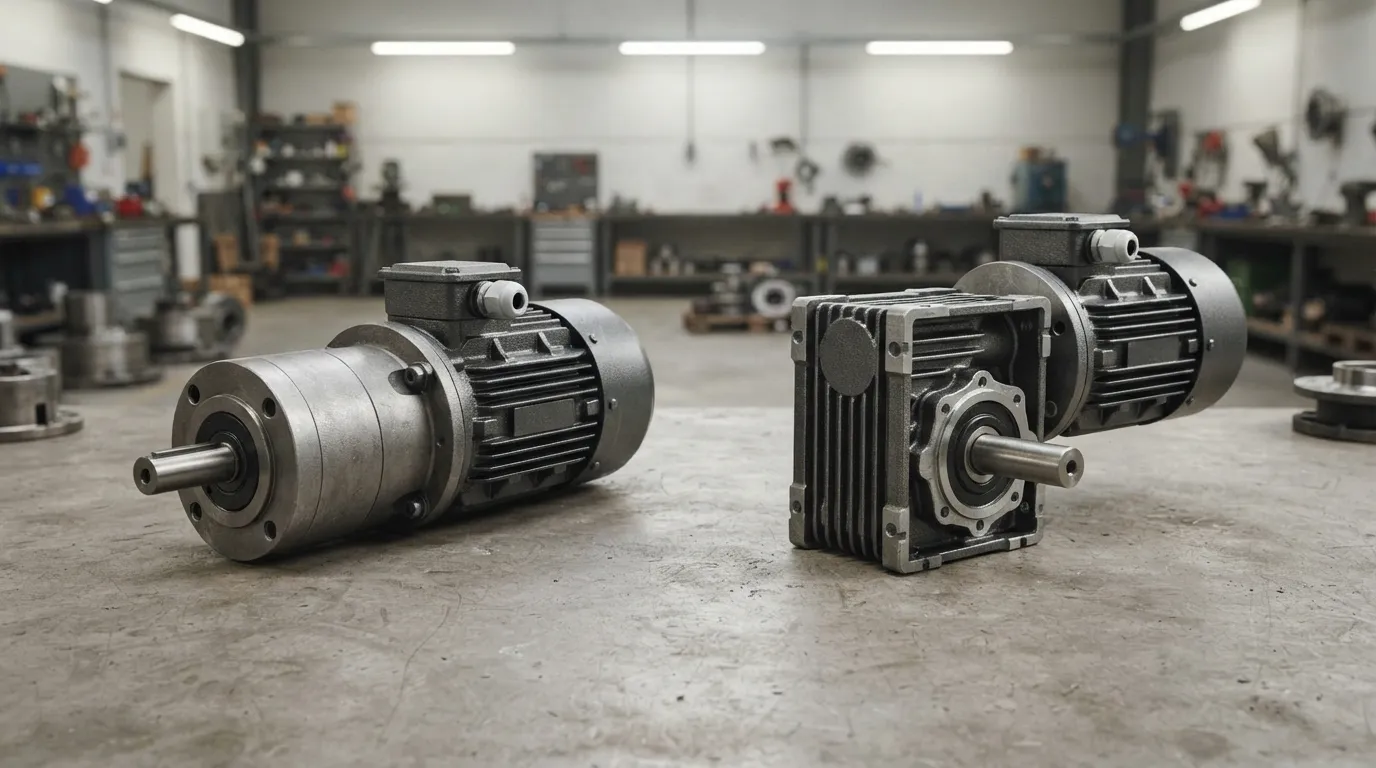
Planetary gearboxes are inline and coaxial, while worm gearboxes place the input and output shafts at 90°.
According to SLW Motor, worm gearboxes normally position the input and output shafts at 90° because of the screw-and-wheel geometry. That single fact drives many machine layouts. A right-angle worm reducer lets a motor sit alongside a conveyor or beside a tank rather than projecting out from the driven shaft. An inline planetary reducer keeps the motor and load on the same axis, which simplifies coupling and avoids the radial loads that a right-angle arrangement can introduce. Neither layout is better in the abstract — the machine frame decides.
Backlash and Servo Positioning
Right-angle worm reducers often state backlash in degrees rather than arcminutes, while planetary reducers suit servo positioning where low backlash matters.
According to PlanetDrivePro, standard right-angle worm gear reducers often have backlash measured in degrees rather than arcminutes. One degree is 60 arcminutes, so the practical positioning error at the output of a worm reducer can be far larger than at the output of a precision planetary unit at the same ratio. For open-loop indexing this may be acceptable. For closed-loop servo positioning, it usually is not.
Input speed is the second constraint. According to PlanetDrivePro, servo motors often run at 2000 to 3000 RPM or higher, and worm reducers face input-speed limits, particularly at high ratios. A planetary reducer handles that input speed comfortably and is therefore the more common choice on servo axes where the motor must turn fast while the output turns slowly and precisely.
Which Is Better for Lifting and Hoisting?
For holding a raised load without a separate brake, a self-locking worm gearbox has an advantage; for high-torque, high-shock lifting that uses a brake, a planetary or cycloidal reducer fits better.
According to TANHON, worm self-locking occurs when the lead angle is small, typically below about 5°. That makes a worm reducer attractive for light holding duties where adding a brake is awkward or costly. The limits are the ones already described: heat under continuous duty and the fact that self-locking is a design condition rather than a guaranteed safety function.
Where the load is heavy, the duty is severe, or shock loads are present, a braked planetary reducer or a cycloidal pinwheel reducer is usually the more suitable mechanical choice. A cycloidal vs worm gearbox comparison covers that alternative in more detail.
Decision Rule: How to Choose Between Planetary and Worm Gearboxes
Choose planetary for compact, high-torque, high-efficiency, low-backlash or inline drives; choose worm for right-angle mounting, high single-stage ratios, self-locking holding, or lower-cost moderate-duty drives.
Work through the following checks in order. The first three usually settle the choice before cost enters the discussion.
- Define the layout. If the motor must sit at 90° to the driven shaft, the worm gearbox is usually the simpler answer. If the drive can run inline, planetary is the natural fit.
- Set the efficiency budget. For continuous duty, compare the energy lost through each design. According to Industrial Gearbox Supply, planetary efficiency runs 95–98% while worm runs 50–70%, so the operating cost gap grows with running hours.
- Confirm the torque and the available space. If the envelope is tight and the torque is high, planetary torque density is the deciding factor. According to Skysmotor, planetary gearboxes are chosen for high torque density, compact size and high efficiency.
- Check the required ratio. A single-stage worm covers roughly 5:1 to 100:1, according to TANHON. Above that, or where efficiency matters, a staged planetary unit covering 3:1 to over 1000:1 is the better route.
- Decide whether holding without a brake is required. If it is, and the ratio and lead angle suit it, a self-locking worm drive may work. If the holding duty is safety-related, specify a brake instead.
- Check duty cycle and thermal rating. For worm drives, verify the thermal rating for the actual running pattern, not just the catalog torque, as PlanetDrivePro advises.
- Check backlash and precision. For closed-loop positioning, compare backlash figures in the same unit — degrees against arcminutes — before deciding.
- Compare cost and availability. Worm reducers are generally cheaper at moderate duty, but the industrial gearbox price of the whole drive includes energy, maintenance and downtime, not only the purchase order.
[DIAGRAM: Decision flowchart from shaft layout and ratio through efficiency, self-locking and thermal checks to a planetary or worm recommendation]
Applications: Where Each Type Fits
Planetary gearboxes fit robotics, CNC, servo positioning and compact high-torque drives; worm gearboxes fit right-angle conveyors, moderate-duty handling and holding applications.
According to Industrial Gearbox Supply, planetary gearboxes are ideal where space is limited but high torque and precision are needed, and worm gearboxes are compact and self-locking but less efficient. In plant terms, that puts planetary reducers on indexing tables, gantry axes, extruder drives and other tasks where accuracy and torque density matter, and worm reducers on right-angle conveyor drives, small agitators, gate and door mechanisms and light positioning where the 90° layout and low cost are worth the efficiency penalty. A fuller look at where the inline design is used appears in this guide to planetary gearbox applications.
Designers who need a right-angle drive but cannot accept worm-level losses often compare the two right-angle families directly; the trade-offs are set out in this helical vs worm gearbox comparison. Similarly, where the requirement is an inline drive with a tighter cost target, a planetary vs spur gearbox review is the useful next step.
Mingye builds both families at its CNC-equipped factory in Jinshan District, Shanghai: heavy-duty planetary reducers and NMRV worm gear motors are part of a range covering more than 20 series, alongside R, S, K and F series helical gear motors, HB series heavy-duty industrial gearboxes, cycloidal pinwheel reducers, cylindrical gear reducers and three-phase asynchronous motors. The worm side of that range is described in more detail on the worm gear motors page.
Frequently Asked Questions
Can a planetary gearbox replace a worm gearbox?
Often not as a direct swap. The shaft layout is the usual blocker: a worm reducer turns the drive 90°, while a planetary reducer is inline. If the machine can accommodate an inline motor, a planetary unit can replace a worm unit at the same ratio, with better efficiency and lower backlash, but the mounting dimensions and the frame will usually change.
Why does a worm gearbox get hot under continuous load?
Worm gears transmit torque through sliding contact between the worm screw and the worm wheel, which generates friction and heat. According to PlanetDrivePro, the thermal rating should be checked rather than output torque alone, because a worm unit that is mechanically strong enough for a load can still overheat if the duty cycle does not allow it to cool.
Is a self-locking worm gearbox safe to hold a load on its own?
It should not be treated as a safety brake. According to TANHON, worm self-locking appears when the lead angle is small, typically below about 5°, but whether a given unit actually holds depends on ratio, lead angle, friction, lubrication and vibration. For personnel safety, specify a brake and confirm the holding behavior with the supplier for that exact unit.
Which gearbox is best for a conveyor drive?
It depends on the layout and the running hours. A right-angle, moderate-duty conveyor with a low duty cycle usually suits a worm gearbox, which is compact and generally cheaper. A long-running or high-torque conveyor suits a planetary or helical unit, because efficiency in the 95–98% range, as listed by Industrial Gearbox Supply, reduces energy loss over thousands of operating hours.
Do planetary gearboxes have backlash?
Yes, but it is usually lower and specified in arcminutes rather than degrees. According to PlanetDrivePro, standard right-angle worm reducers often state backlash in degrees, which is a coarser unit than the arcminutes used for precision reducers. That difference is why planetary units are the usual choice for closed-loop servo positioning, where output error must stay small.
Matching the Gearbox to the Duty
The comparison comes down to a small number of decisions. Planetary gearboxes win on efficiency, torque density, backlash and inline simplicity. Worm gearboxes win on right-angle layout, single-stage reduction up to 100:1, possible self-locking and lower cost at moderate duty — with heat, thermal rating and input-speed limits as the conditions that decide whether they suit a given machine. Mingye manufactures both types in modular, standardized designs and offers OEM customization of mounting dimensions and transmission ratios, with normal delivery in 7–15 days. If you are weighing the two for a specific drive, send the application details — load, ratio, duty cycle and available space — and the selection can be checked against both options.
Share on Social:


Contact Us
In This Article
Right Angle Geared Motor: Matching Electrical Supply, Variable Speed and Braking
Oct 26, 2026
Planning a Bevel Reducer Installation: Turn Shaft Requirements Into a Practical Drive Layout
Oct 26, 2026
Choosing an Overhead Crane Gearbox by Its Hoisting or Travel Function
Oct 26, 2026
Replacing an Industrial Worm Gearbox: What to Keep and What to Reassess
Oct 25, 2026