


 Home /
Planetary Gearbox vs Harmonic Drive: Which Is Better for Precision Motion?
Right Angle Geared Motor: Matching Electrical Supply, Variable Speed and Braking
Oct 26, 2026
Planning a Bevel Reducer Installation: Turn Shaft Requirements Into a Practical Drive Layout
Oct 26, 2026
Choosing an Overhead Crane Gearbox by Its Hoisting or Travel Function
Oct 26, 2026
Replacing an Industrial Worm Gearbox: What to Keep and What to Reassess
Oct 25, 2026
For precision motion, neither technology wins outright: planetary gearboxes deliver higher efficiency, lower cost, and better stiffness under shock loads, while harmonic drives offer zero backlash, higher single-stage ratios, and more compact, lighter designs. Choose planetary for cost-sensitive, high-torque industrial axes; choose harmonic for ultra-precision, space-constrained robotics.
Key Takeaways
- Planetary gearboxes typically achieve single-stage ratios up to 10:1, while harmonic drives reach 30:1 to 300:1 in one stage.
- Harmonic drives are effectively zero-backlash with up to 30% tooth engagement; planetary gearboxes offer near-zero backlash only with premium precision-grade components.
- Planetary gearboxes generally cost less and run more efficiently than harmonic drives across most industrial applications.
- Harmonic drives dominate industrial robotic arm joints; planetary gearboxes are the workhorse for high-speed, high-torque axes in machine tools, conveyors, and packaging.
- Torsional stiffness, temperature sensitivity, and shock-load resistance differ significantly between the two technologies.
What Is a Planetary Gearbox? (How It Works)
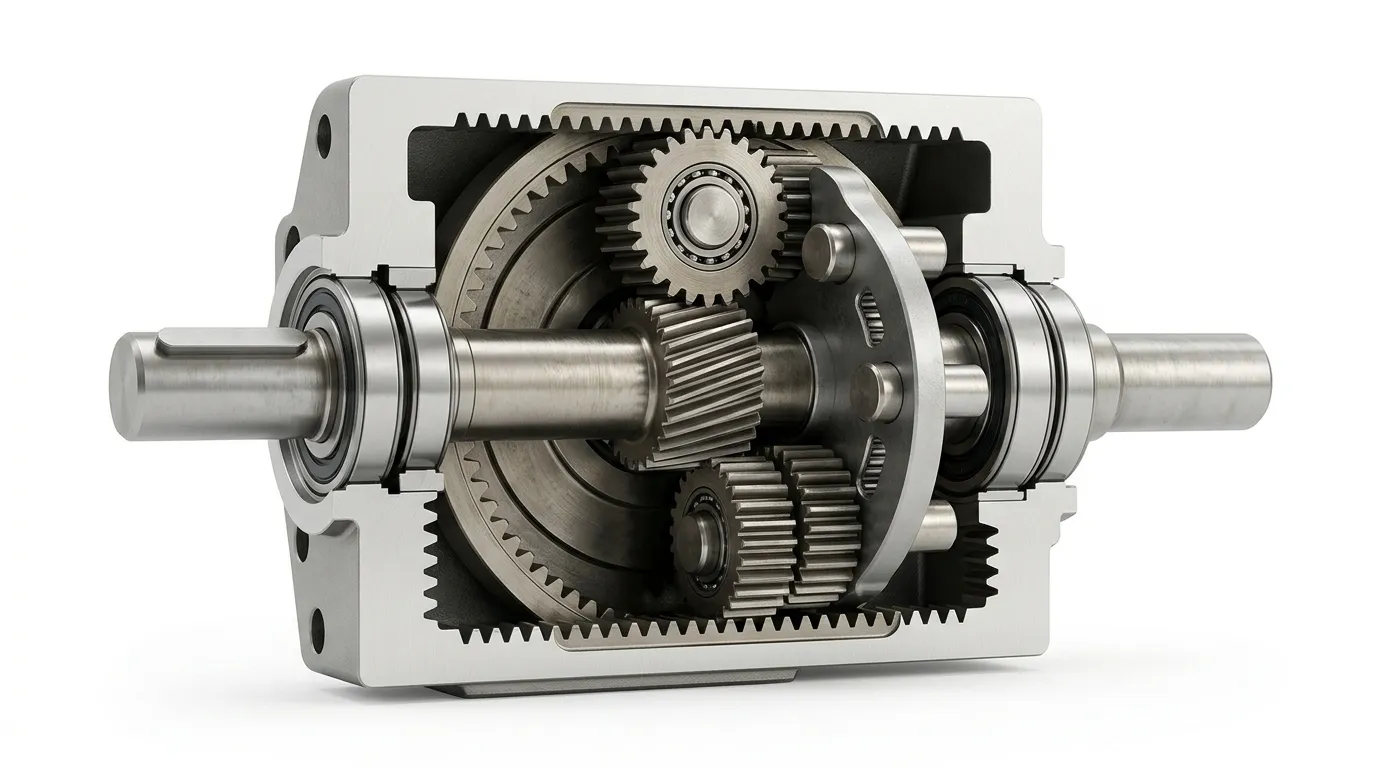
A planetary gearbox is a compact power transmission device that distributes torque across multiple meshing gear teeth simultaneously. It consists of a central sun gear, a set of planet gears mounted on a rotating carrier, and an outer ring gear with internal teeth. This arrangement splits the load across several contact points, giving planetary gearboxes high torque density in a relatively small envelope.
The gearbox works through a simple sequence:
- Input rotation drives the sun gear at the center.
- Planet gears (typically three or more) mesh with the sun gear and rotate around it.
- The planet carrier — to which the planet gears are attached — rotates and delivers output torque.
- The ring gear (stationary or rotating, depending on configuration) constrains the planet gears' path.
According to Harmonic Drive LLC, single-stage planetary gears can achieve reduction ratios of up to 10:1. Ratios above 10:1 use a two-stage design where the carrier of the first stage drives the sun gear of the second stage, multiplying the reduction.
Planetary gearboxes are manufactured across a wide range of quality and precision classes. Standard industrial units measure backlash in arc minutes, while precision-grade units with ground gears and preloaded bearings can approach sub-arc-minute levels.
What Is a Harmonic Drive? (How It Works)
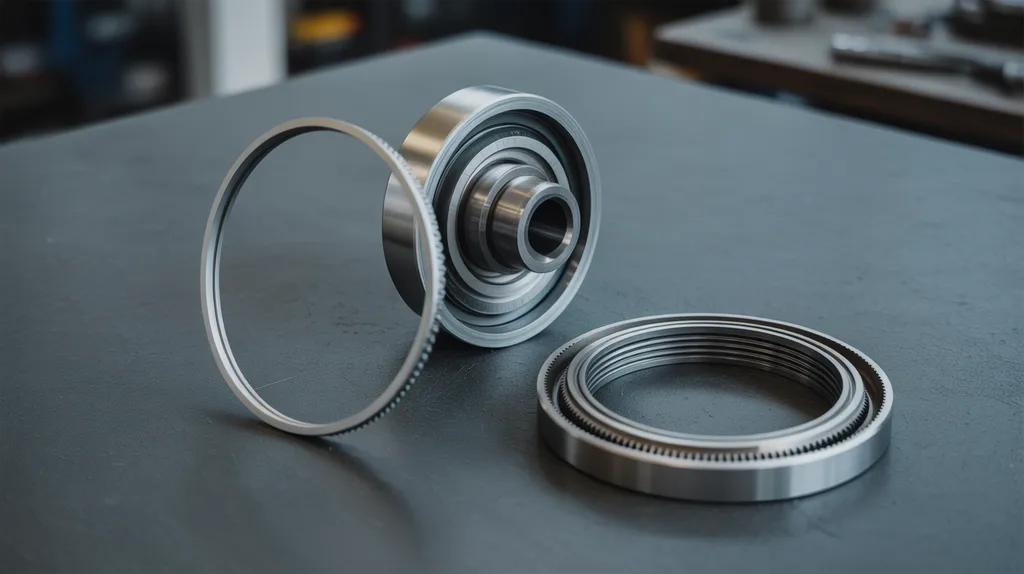
A harmonic drive — also called a strain wave gear — is a precision gear mechanism that produces high reduction ratios in a single stage using elastic deformation rather than rigid gear engagement. It consists of three components: a wave generator, a flexspline, and a circular spline.
The term "harmonic drive" is a brand name that became the generic term for this mechanism; "strain wave gear" is the engineering description of how it works. Both terms refer to the same technology.
The operating principle works in four steps:
- The wave generator — an elliptical cam with a flexible bearing — rotates inside the flexspline.
- The flexspline is a thin-walled, flexible steel cup with external teeth; it deforms into an elliptical shape as the wave generator rotates.
- The circular spline is a rigid ring with internal teeth, having two more teeth than the flexspline.
- Each full rotation of the wave generator causes the flexspline to move counter-clockwise by two teeth, producing the reduction ratio.
Harmonic Drive LLC explains that this differential tooth engagement is what makes the mechanism work: the circular spline has two more teeth than the flexspline, and the elastic deformation of the flexspline allows it to mesh with the circular spline at two points on opposite sides of the ellipse.
Harmonic drives are known for zero backlash because the flexspline teeth are always engaged with the circular spline — there is no clearance between teeth as in conventional gears. Harmonic Drive LLC's S-tooth profile allows up to 30% of teeth to engage simultaneously, increasing torque capacity, torsional stiffness, and operational life compared with conventional involute tooth profiles.
Planetary Gearbox vs Harmonic Drive: Side-by-Side Comparison
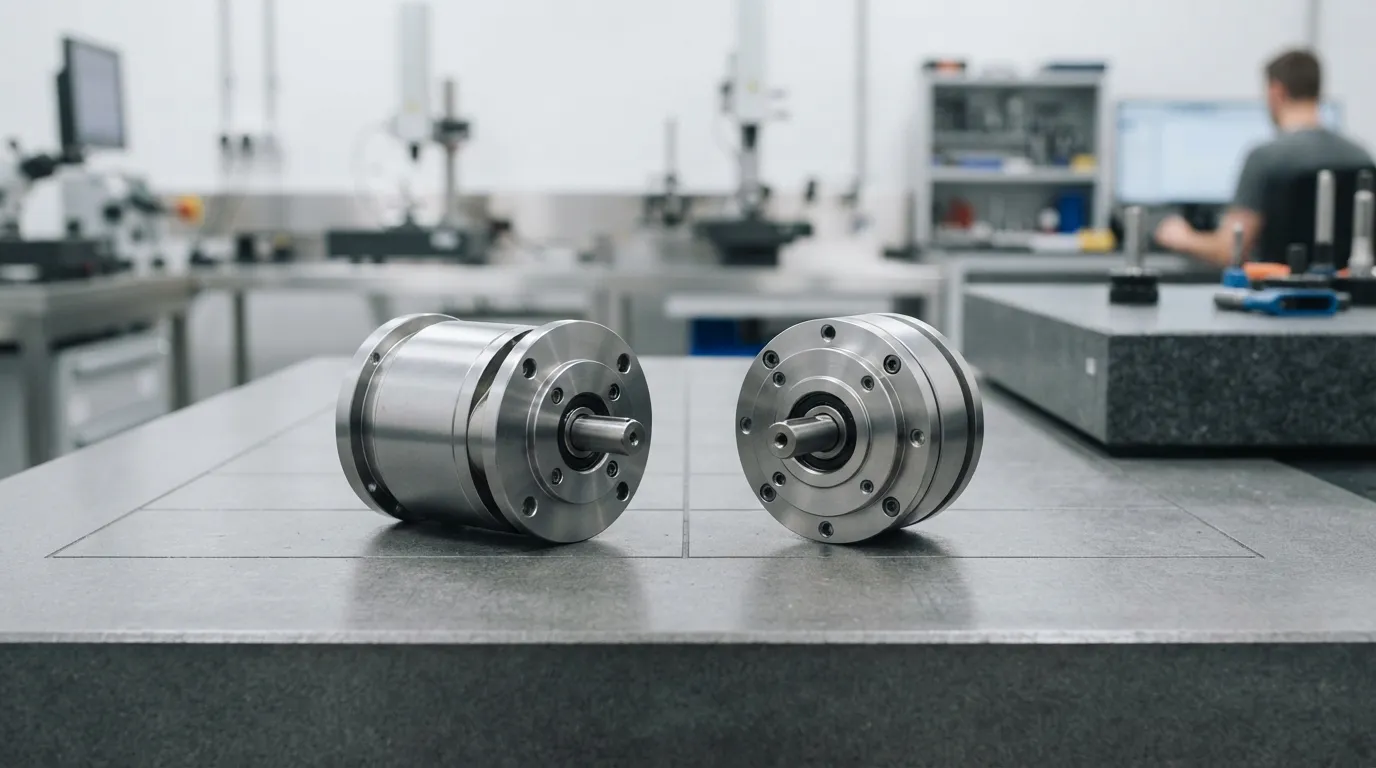
The table below compares the parameters that matter most for precision motion applications. Values reflect typical catalog ratings across major manufacturers.
| Parameter | Planetary Gearbox | Harmonic Drive | Why It Matters |
|---|---|---|---|
| Backlash | 3–10 arc minutes (standard); 1 arc minute or less (precision) | Effectively zero | Positioning accuracy and repeatability |
| Reduction ratio per stage | Up to 10:1 | 30:1 to 300:1 | Simplicity of achieving high ratios |
| Maximum reduction ratio | 100:1 (multi-stage) | 300:1 (single-stage) | Range of speed reduction options |
| Torsional stiffness | Generally high with rigid gear engagement | Good, but depends on design and sizing | Resistance to deflection under load |
| Torque density | High — load distributed across multiple gear teeth | Good — but flexspline limits peak torque | Compactness for given torque |
| Efficiency | 85–97% depending on ratio and quality | 60–85% depending on ratio and speed | Energy consumption and heat generation |
| Size and weight | Moderate — grows with ratio and stages | Compact and lightweight, especially at high ratios | Envelope and inertia constraints |
| Shock-load resistance | Excellent — rigid metal-to-metal contact | Limited — flexspline can be damaged by shock loads | Survival of impact loads |
| Durability / lifecycle | Long — depends on gear quality and lubrication | Long — per catalog ratings when properly applied | Maintenance and replacement intervals |
| Relative cost | Moderate — mature manufacturing base | Higher — precision manufacturing and materials | Budget allocation |
| Positioning accuracy | Good — precision grades approach harmonic levels | Excellent — zero backlash, high repeatability | End-of-arm and axis accuracy |
| Temperature sensitivity | Moderate — predictable performance | More sensitive to ambient temperature variation | Performance consistency across environments |
Source data: Harmonic Drive LLC, Harmonic Drive SE, CubeMars, PICEA Motion, and PMC research literature. Consult manufacturer catalogs for application-specific values.
Backlash: How Much Precision Do You Actually Need?
Backlash is the lost motion between input and output when the direction of rotation reverses. It is measured in arc minutes (1/60 of a degree) or arc seconds (1/3,600 of a degree). For a robot joint or camera gimbal, one arc minute of backlash at the output means the load can move off position by that amount before the gear train "catches."
Harmonic drives are effectively zero-backlash because the flexspline is always in mesh with the circular spline. There is no clearance between teeth to create lost motion. According to Harmonic Drive SE, their harmonic planetary gears achieve backlash of less than 1 arc minute and repeatability within ±20 arc seconds — exceptional figures for a precision reducer.
Planetary gearboxes, by contrast, have measurable backlash because they rely on rigid gear teeth meshing with clearance. Standard industrial planetary gearboxes typically spec 3–10 arc minutes of backlash. Precision-grade planetary gearboxes with ground gears and preloaded components can reach 1 arc minute or less — approaching, but rarely matching, harmonic levels.
Key question to ask: What positional accuracy does your application actually require? A packaging machine indexing axis may do fine with 5 arc minutes; a semiconductor wafer-handling robot joint does not. Overspecifying creates unnecessary cost; underspecifying creates functional failures.
Gear Ratio: One Stage vs Multiple Stages
Gear ratio determines how much speed reduction (and torque multiplication) one gearbox provides. The fundamental difference between planetary and harmonic drives lies in how many stages are needed.
Planetary gearboxes achieve up to 10:1 in a single stage, according to Harmonic Drive LLC. Higher ratios require stacking stages, which adds length, weight, and cost. A 100:1 planetary gearbox typically needs two or three stages, each adding its own backlash and efficiency losses.
Harmonic drives deliver 30:1 to 300:1 in a single stage (per PICEA Motion). This means a harmonic drive can achieve a ratio that would require two or three stacked planetary stages — in a smaller, lighter package with zero added backlash from extra stages.
Selection logic: If your ratio requirement is below 10:1, a planetary gearbox is the natural fit. If you need 30:1 or higher and cannot afford the length and weight of multiple planetary stages, a harmonic drive becomes attractive.
Torsional Stiffness and Torque Capacity
Torsional stiffness is the resistance of a gearbox to wind-up (twist) under load. It directly affects the dynamic response of a servo system: low stiffness leads to resonance, vibration, and reduced positioning stability at speed.
Planetary gearboxes with rigid gear engagement generally provide high torsional stiffness, making them well suited for high-speed servo control, CNC machine applications, and heavy-load positioning, according to CubeMars. The load path through hard metal gears with multiple contact points creates a stiff, predictable mechanical system.
Harmonic drives achieve good torsional stiffness through the elastic preload of the flexspline, but the stiffness value depends strongly on design, sizing, and the tooth profile used. The S-tooth profile from Harmonic Drive LLC improves stiffness by engaging more teeth simultaneously — up to 30% versus typical involute profiles.
Torque capacity follows a similar pattern. Planetary gearboxes handle high peak and shock loads well because the load is distributed across multiple gear teeth in simultaneous contact. Harmonic drives, by contrast, have the flexspline as a limiting component: it is a thin, elastic steel cup that must flex repeatedly. Shock loads that would be absorbed by a planetary gearbox can over-stress a flexspline and shorten its life.
Trade-off to know: A harmonic drive's torque rating is a thermal and fatigue limit, not just a mechanical one. The flexspline flexes millions of times per day in operation, and even though stresses stay below the material's endurance limit (per Harmonic Drive LLC), shock loads or overload conditions can push it beyond safe limits.
Efficiency and Temperature Sensitivity
Efficiency is the percentage of input power that reaches the output, with the remainder lost as heat. For battery-powered robots or high-duty-cycle machinery, even small efficiency differences matter.
Planetary gearboxes typically run at 85–97% efficiency, declining with higher ratios and more stages. Harmonic drives generally run at 60–85%, with efficiency dropping as ratios increase (per CubeMars). This is because the flexspline's constant elastic deformation and sliding contact generate more internal friction than rolling gear meshes.
Temperature sensitivity is another differentiator. A 2024 study published in PMC (Oberneder et al.) found that planetary gear drives show a flatter influence of ambient temperature than strain wave drives, and lower torque dependency. In practical terms, a planetary gearbox's performance is more predictable across environmental temperature changes than a harmonic drive's.
Application note: For high-speed operation — inputs above 3,000 rpm — planetary gearboxes are the proven choice. Harmonic drives are typically applied at input speeds of 1,000–4,500 rpm depending on size, and their efficiency at high speed drops.
Cost: Which Is More Expensive and Why?
Harmonic drives are generally more expensive than planetary gearboxes for equivalent torque capacity, according to CubeMars. The cost premium has three main drivers:
- Precision manufacturing: Harmonic drive components require tight tolerances and specialized machining to achieve zero backlash and smooth operation.
- Material requirements: The flexspline needs high-fatigue-strength steel, processed and heat-treated to survive billions of elastic deformation cycles.
- Assembly complexity: Aligning the wave generator, flexspline, and circular spline requires skill and precision that adds labor cost.
Planetary gearboxes benefit from mature, high-volume manufacturing, standardized components, and simpler assembly. Their cost advantage grows at lower ratios and in larger sizes, where the harmonic drive's complexity and material costs scale up.
The hidden cost of "zero backlash": That specification is worth paying for when you need it, but if your application can tolerate 3–5 arc minutes, a precision planetary gearbox will likely deliver the performance you need at a meaningfully lower price — and with better efficiency and shock-load resistance.
When to Choose an Industrial Planetary Gearbox
Choose an industrial planetary gearbox when you need high torque, high efficiency, cost-effectiveness, and durability at high speeds — for example in machine tools, conveyors, packaging machinery, and material handling. Planetary gear ratios range from 1:1 to virtually any value, with multiple stages used for higher reductions (per Source Robotics).
Applications where planetary gearboxes are the natural choice:
- Machine tools and CNC axes: High stiffness, precision positioning, and high speed capability.
- Conveyors and material handling: High torque at low speed, excellent shock-load resistance, long service life.
- Packaging machinery: Cyclic operation, indexing, and cost-effective precision.
- Mixing and processing equipment: Continuous duty, high torque, and durability.
- Servo motor-driven axes: Standardized mounting flanges and predictable stiffness for tuning.
For these applications, the combination of ratio range, cost, efficiency, and standard mounting options makes planetary gearboxes the default. Front-end planetary gearbox applications span conveying, material handling, packaging, and other high-torque industrial equipment where reliability matters more than absolute positioning precision.
Planetary Gearbox Applications at a Glance
| Application Category | Why Planetary Wins |
|---|---|
| Machine tools / CNC | High stiffness and speed capability |
| Conveyors / material handling | High torque, shock-load resistance, long life |
| Packaging machinery | Cost-effective precision, cyclic duty |
| Mixing equipment | Continuous operation, high torque density |
| Servo motor axes | Standard flanges, predictable stiffness |
When to Choose a Harmonic Drive
Choose a harmonic drive when you need zero backlash, very high single-stage ratios, and lightweight, compact construction — typically in robotic arms, medical devices, and precision positioning systems. Harmonic drives are the industry standard for most industrial robotic arm joints (per Source Robotics), where weight at the end effector and absolute positioning certainty are critical.
Applications where harmonic drives excel:
- Industrial robotic arms: Joint actuators where compactness, zero backlash, and smooth motion at low speed are required.
- Medical and surgical robotics: Ultra-precision positioning with zero backlash for delicate procedures.
- Aerospace mechanisms: Lightweight, compact drives for satellites and positioning systems.
- Semiconductor equipment: Precise wafer handling and alignment stages.
Harmonic drives are compact and lightweight with zero backlash, per Cone Drive, making them effective in robotics and aerospace applications. Their single-stage high ratio eliminates the need for stacked stages, saving envelope and weight.
Application note: For a robot arm's shoulder or elbow joint requiring 100:1 reduction in a package that fits inside the joint housing, a harmonic drive is often the only practical choice. A 100:1 planetary gearbox would require multiple stages and occupy significantly more space.
How to Choose: A 5-Step Selection Framework for Precision Motion
Work through load profile, positional accuracy target, ratio, envelope constraints, and budget — in that order — and the right technology choice becomes self-evident. Applying this framework before contacting suppliers prevents overspecification and underspecification.
Step 1: Define your load profile. What torque do you need at the output, at what speed, and for what duty cycle? Include peak and shock loads. If shock loads exceed 200% of rated torque, planetary is the safer choice. If the load is smooth and continuous, either technology can work.
Step 2: Set your positional accuracy target. What is the maximum allowable error at the output? If you need zero backlash (no measurable lost motion), harmonic is the only choice. If 3–5 arc minutes is acceptable, precision planetary will save cost and energy. One arc minute at the output of a 100:1 drive equals 1/60 of a degree — understand your tolerance before choosing.
Step 3: Determine your reduction ratio. Below 10:1, planetary is standard. Between 10:1 and 30:1, both technologies can work; compare cost and envelope. Above 30:1, harmonic's single-stage advantage becomes significant — unless you need shock-load resistance, in which case multi-stage planetary may still be the better call.
Step 4: Measure your envelope and weight constraints. A harmonic drive at 100:1 will be dramatically smaller and lighter than a multi-stage planetary at the same ratio. If space and weight drive the design, harmonic wins. If you have room for a larger gearbox, planetary delivers equivalent torque at lower cost.
Step 5: Compare total lifecycle cost. Include purchase price, efficiency losses (energy cost over the machine's life), maintenance, and replacement intervals. Planetary gearboxes cost less upfront, run more efficiently, and are simpler to service. Harmonic drives have fewer applications where replacement is needed — per Harmonic Drive LLC, strain wave stresses are designed to stay below material endurance limits — but the higher purchase price and efficiency loss can outweigh that advantage outside robotics.
Bridge option — harmonic planetary: If you need very low backlash but not zero, consider harmonic planetary gears, which combine planetary gearing with elastic preload. According to Harmonic Drive SE, these achieve ratios from 3:1 to 45:1 with backlash below 1 arc minute and repeatability within ±20 arc seconds — a middle ground between standard planetary and pure harmonic designs.
Where Mingye Fits: Sourcing Industrial Planetary Gearboxes
If your application points toward a planetary gearbox, Mingye designs and builds industrial planetary reducers, helical gear motors, and related power transmission products at its own CNC-equipped factory in Shanghai. Mingye's product range spans more than 20 series — including heavy-duty planetary reducers, cycloidal pinwheel reducers, helical gear motors (R, S, K, F series), NMRV worm gear motors, and three-phase asynchronous motors.
Mingye operates on modular, standardized designs that allow OEM customization of mounting dimensions and transmission ratios. Standard delivery is 7–15 days, which supports prototyping and production schedules that cannot wait for long import lead times. The company serves OEMs and plant engineers across plastics and rubber, mixing, conveying and material handling, packaging, mining, cement, power, and port industries.
For readers exploring adjacent technologies: a cycloidal gearbox vs harmonic drive comparison covers another precision option, while planetary vs cycloidal gearbox addresses that boundary for heavy-load applications. Mingye manufactures both types and can help you weigh the trade-offs.
If your application involves motor selection alongside the reducer, Mingye also builds both motors and reducers — a practical advantage for OEMs who want a single supplier for the complete drive train. The gear motor vs servo motor decision is part of that equation, and Mingye can advise on both.
Frequently Asked Questions
What is the difference between a strain wave gear and a harmonic drive?
They are the same technology. "Harmonic Drive" is a brand name that became the generic term for this mechanism; "strain wave gear" is the engineering description of the operating principle using a wave generator, flexspline, and circular spline. Both terms refer to the same gear type.
Can a planetary gearbox be zero-backlash?
Premium planetary gearboxes can approach very low backlash — measured in arc minutes or sub-arc-minutes — by using precision-ground gears and preloaded bearings, but true zero backlash is characteristic of harmonic drives, which use elastic deformation rather than rigid gear engagement. Planetary gearboxes always have some measurable clearance.
Are harmonic drives more expensive than planetary gearboxes?
Yes, generally. The cost premium comes from precision manufacturing, the flexspline's special material requirements, and tight assembly tolerances. Planetary gearboxes benefit from mature, high-volume manufacturing and standardized components, making their cost structure more competitive — especially at lower ratios where both technologies can serve the application.
Share on Social:


Contact Us
In This Article
Right Angle Geared Motor: Matching Electrical Supply, Variable Speed and Braking
Oct 26, 2026
Planning a Bevel Reducer Installation: Turn Shaft Requirements Into a Practical Drive Layout
Oct 26, 2026
Choosing an Overhead Crane Gearbox by Its Hoisting or Travel Function
Oct 26, 2026
Replacing an Industrial Worm Gearbox: What to Keep and What to Reassess
Oct 25, 2026