


 Home /
Gear Motor vs Servo Motor: Which Is Right for Automation?
Right Angle Geared Motor: Matching Electrical Supply, Variable Speed and Braking
Oct 26, 2026
Planning a Bevel Reducer Installation: Turn Shaft Requirements Into a Practical Drive Layout
Oct 26, 2026
Choosing an Overhead Crane Gearbox by Its Hoisting or Travel Function
Oct 26, 2026
Replacing an Industrial Worm Gearbox: What to Keep and What to Reassess
Oct 25, 2026
For most fixed-speed and continuous-duty automation tasks — conveyors, mixers, hoists, material handling — a gear motor is the simpler and more cost-effective choice; for closed-loop positioning with high accuracy, such as pick-and-place, CNC, or robotics, a servo motor is required. The deciding factors are control complexity, positioning accuracy, and torque-at-speed behavior. This guide compares both technologies across those criteria so you can match the drive to the duty.
Key takeaways:
- Gear motors use open-loop control and deliver continuous torque at fixed or variable speeds; servo motors use closed-loop control with encoder feedback for position, speed, and torque accuracy.
- Servo motors excel at positioning — micrometer-level accuracy and millisecond-level response — but their peak torque is typically limited to roughly 1% duty cycle, making them unsuitable for continuous heavy loads.
- Gear motors maintain torque across the full duty cycle and are simpler to commission and maintain; servo systems require tuning, more complex spares, and higher initial investment.
- Decision rule: choose a gear motor for continuous fixed- or variable-speed duty; choose a servo motor when closed-loop positioning accuracy is the priority.
What Is a Gear Motor?
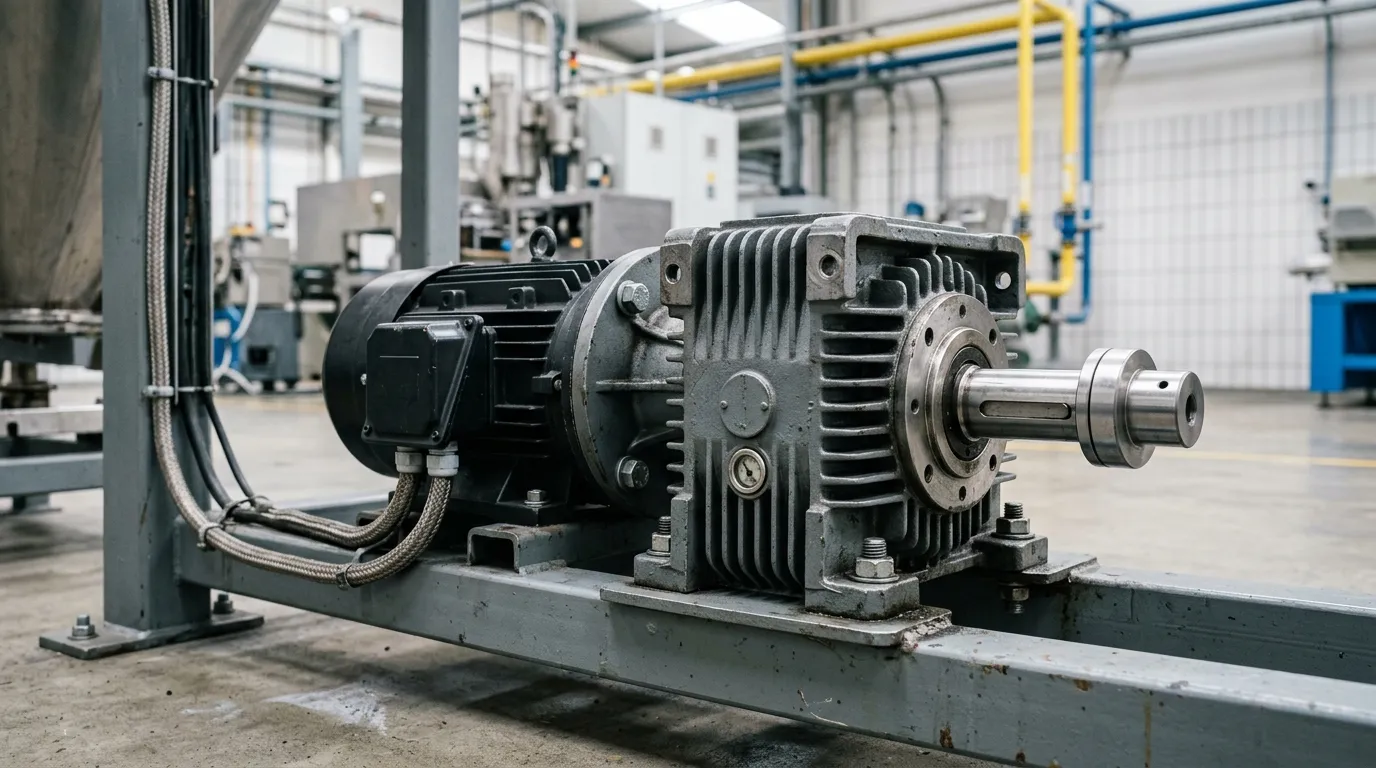
A gear motor is a power output device that integrates an electric motor with a gear reduction mechanism to deliver low-speed, high-torque output. According to Target Hydraulics, a gear motor "outputs low-speed, high-torque power" by combining the motor with a reduction gearset. The gearbox reduces output speed while multiplying torque, allowing a relatively small motor to drive heavy loads.
Gear motors typically use open-loop control: the motor receives a command to run at a certain speed, but there is no feedback mechanism to verify the actual output. This makes them simple, robust, and well suited to continuous-duty applications where precise positioning is not required.
A common example is the helical geared motor, widely used for continuous conveying, mixing, and material handling. If you are unsure how a gear motor differs from a plain electric motor without a reduction stage, our gear motor vs electric motor comparison explains the distinction.
What Is a Servo Motor?
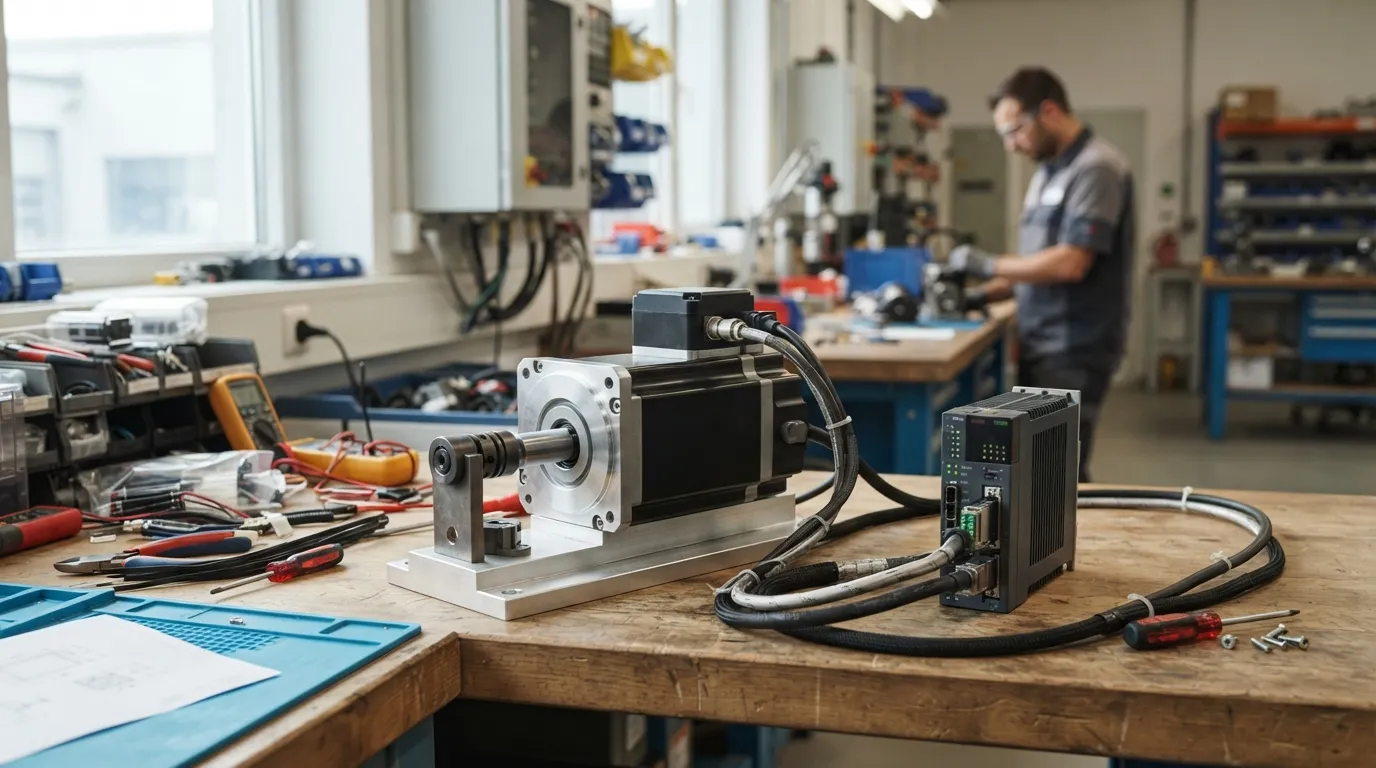
A servo motor is any electric motor — typically AC or brushless DC — integrated with an encoder, driver, and controller to provide closed-loop position, speed, and torque control with real-time feedback. As Clemson University's engineering resource explains, a servo motor is technically any motor with a closed-loop controller; the term describes the control system, not a specific motor construction.
Servo motors support three control modes: position, speed, and torque, according to Target Hydraulics. The encoder continuously reports the rotor's actual position back to the controller, which compares it against the commanded value and corrects any deviation automatically.
Servo motors typically feature 4 to 12 poles (ISL Products), which contributes to their wide speed range and fast response. This closed-loop architecture is what enables the high positioning accuracy that automation applications such as robotics and CNC machinery demand.
Gear Motor vs Servo Motor: Side-by-Side Comparison
The table below compares gear motors and servo motors across the criteria that matter most in automation: control method, positioning accuracy, torque behavior, speed range, cost, complexity, maintenance, and duty cycle.
| Criterion | Gear Motor | Servo Motor |
|---|---|---|
| Control method | Open-loop (no feedback) | Closed-loop (encoder feedback) |
| Positioning accuracy | Low; depends on load and voltage stability | High; micrometer-level |
| Torque behavior | Continuous torque across full duty cycle | High continuous torque; peak torque limited to ~1% duty cycle |
| Speed range | Fixed or limited variable via VFD | Wide speed range; consistent torque across band |
| Initial cost | Lower | Higher (motor + drive + controller + tuning) |
| Complexity | Simple; plug-and-play | Complex; requires PID tuning and commissioning |
| Maintenance | Simple; predictable gearbox wear | Encoder, drive, and tuning maintenance; more spares |
| Duty cycle | Continuous duty capable (S1) | Best for intermittent, dynamic duty |
The most important takeaway from this comparison is the difference in control architecture. Gear motors run open-loop: they do not verify their output against a command. Servo motors run closed-loop: they continuously check the encoder reading against the commanded position, speed, or torque, and correct any error in real time.
This difference drives every other comparison axis — accuracy, cost, complexity, and application fit.
Open-Loop vs Closed-Loop Control — What Changes in Practice?
Open-loop control means the motor receives a command but gets no feedback on whether it achieved it. The motor runs at a set speed, and whatever variation occurs due to load or voltage is simply accepted. According to Target Hydraulics, gear motor output speed is affected by voltage fluctuations and load changes, and there is no automatic compensation for movement deviation.
Closed-loop control, by contrast, uses an encoder to verify position and speed continuously, automatically correcting deviations. This is why servo systems can maintain accuracy even under varying loads.
What this means for your application:
- Open-loop (gear motor): Acceptable when speed variation of a few percent does not affect product quality or process safety.
- Closed-loop (servo motor): Required when the axis must hold position or maintain precise speed regardless of load disturbances.
Servo motors also require tuning to stabilize the feedback loop, according to Assun Motor. This is a commissioning step that adds time and requires technical expertise — something a gear motor never needs. Stepper motors also run open-loop; see our gear motor vs stepper motor comparison for a related side-by-side.
Torque at Speed: The Performance Difference That Decides
Gear motors deliver continuous torque for the full duty cycle, while servo motors provide high continuous torque but limit peak torque to approximately 1% duty cycle. This distinction is the most commonly misunderstood aspect of the gear motor vs servo motor decision.
A servo motor can output a high peak torque for a brief moment — useful for accelerating a load quickly or overcoming a temporary obstacle. But that peak torque cannot be sustained. Assun Motor states that servo motor peak torque is typically limited to a ~1% duty cycle, meaning the motor can only operate at peak torque for a small fraction of each duty cycle before it must return to continuous torque levels.
For an application that requires sustained heavy torque — a conveyor running 24/7, a mixer processing viscous material, a hoist lifting a constant load — a gear motor is the better choice because it delivers its rated torque continuously without overheating or derating.
Servo motors do offer one torque advantage: they maintain consistent torque across a wider speed band and can operate 2–4 times faster than stepper motors without losing torque, according to ISL Products. At the hobby scale, a same-size servo can deliver roughly twice the stall torque of a comparable geared DC motor (Pololu Forum), but this ratio does not translate directly to industrial continuous-duty comparisons.
The practical rule: if your load demands continuous torque at a fixed or slowly varying speed, a gear motor will usually be smaller, cheaper, and more reliable than a servo system sized for the same continuous torque — because the servo would need to be significantly oversized to keep peak torque operation within its duty-cycle limit.
Cost Comparison: What You Really Pay For
Gear motors cost less upfront, require no tuning, and have simpler spares; servo systems cost substantially more because the motor needs a drive, controller, encoder, and commissioning time — a total-cost-of-ownership difference that grows with system size.
The cost difference has three components:
1. Initial purchase cost. AC gear motors are good for simple jobs and are usually cheaper; servo motors offer dynamic control but at a higher price point (Wanshsin Drive). The gap widens because a servo motor cannot operate alone — it needs a matching drive and controller.
2. Commissioning and tuning. A servo system requires configuration and PID tuning to stabilize the feedback loop (Assun Motor). This is engineering time that a gear motor never consumes. For a plant with limited automation expertise, this cost can be significant.
3. Maintenance and lifecycle cost. Gear motors have predictable gearbox wear and simple replacement parts. Servo systems have more components — encoder, drive, cables, tuning parameters — that can fail or drift. Spare parts inventory and diagnostic time are higher.
For an OEM building a machine with multiple axes, the cost difference compounds. If the application does not genuinely require closed-loop positioning, choosing servo motors means paying for capability the machine will never use. If you are evaluating gear motors for a new product line, our gear reduction motor buying guide for oems covers specification and procurement considerations in more depth.
Which Applications Need Which Motor?
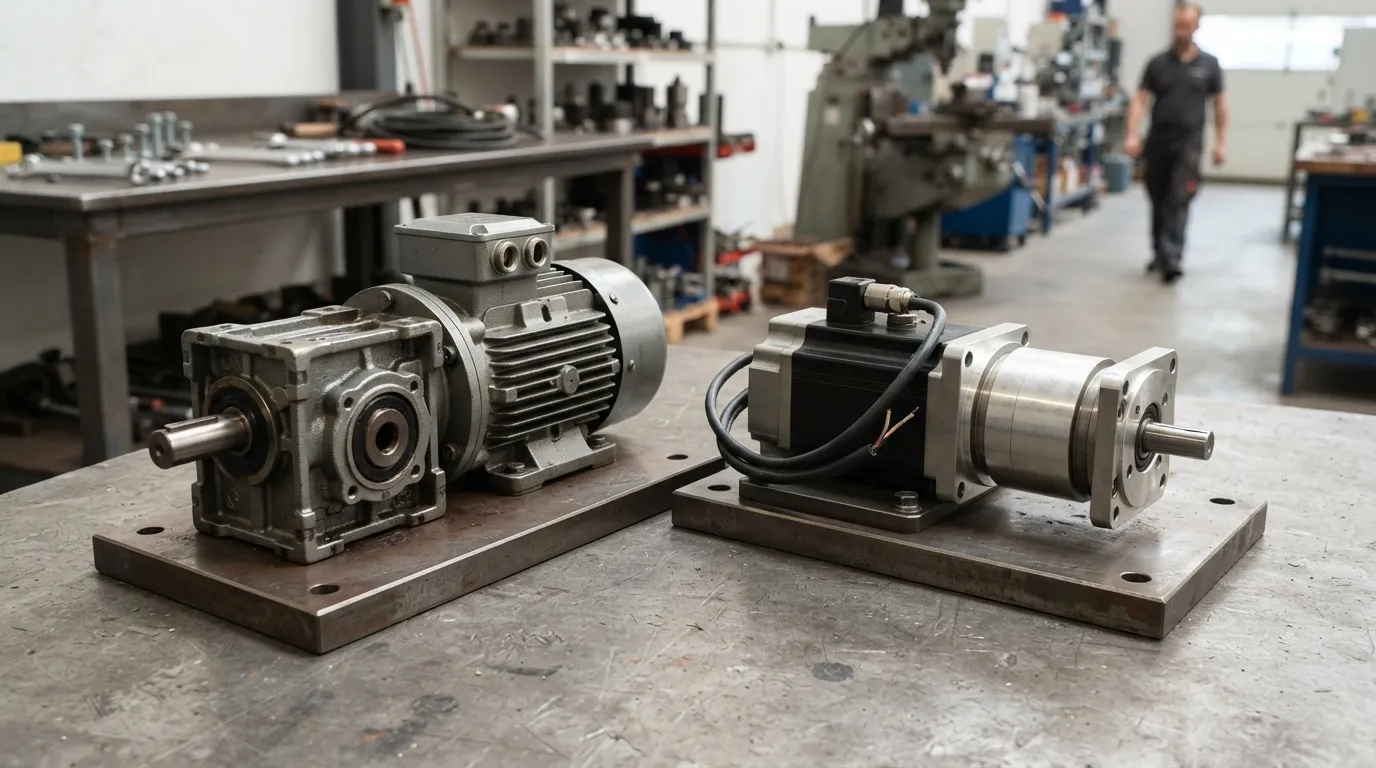
Continuous fixed- or variable-speed duty with low positioning demands points to gear motors; dynamic positioning, quick starts and stops, and high accuracy points to servo motors.
The table below matches common industrial applications to the technology that fits best.
| Application | Gear Motor | Servo Motor |
|---|---|---|
| Conveyors / material handling | ✔ Best fit | ✘ Over-engineering |
| Mixers / agitators | ✔ Best fit | ✘ Over-engineering, cost |
| Hoists / winches | ✔ Best fit (continuous duty) | △ Possible, but peak torque limits |
| Packaging (filling/sealing) | △ Possible | ✔ Best fit (dynamic positioning) |
| Pick-and-place robots | ✘ Low accuracy | ✔ Best fit |
| CNC machines | ✘ No positioning accuracy | ✔ Best fit |
| Welding rotators | ✔ Best fit (continuous rotation) | △ Possible, unnecessary cost |
Before you compare these two technologies in detail, it is worth reviewing the broader process of choosing an industrial electric motor, which covers motor families, duty cycles, and enclosure considerations that apply regardless of control type.
The Decision Rule: Servo for Positioning, Gear Motor for Continuous Duty
Use a servo motor when you need closed-loop positioning accuracy; use a gear motor for continuous fixed- or variable-speed duty. This rule covers roughly 90% of industrial automation decisions.
To apply it systematically, work through these five steps:
Step 1: Determine whether your axis needs position feedback. If the application requires holding a position, following a precise path, or synchronizing with another axis, a servo motor is required. If the load just needs to move at a certain speed without positional verification, a gear motor will work.
Step 2: Assess the duty cycle. Continuous operation — running for hours or 24/7 — favors gear motors. Intermittent, dynamic moves with frequent starts, stops, and reversals favor servo motors, which can exploit their brief peak torque capability.
Step 3: Calculate torque at speed. Determine the torque the load requires at the operating speed. Can a servo motor sustain that torque continuously? Remember that servo peak torque is limited to roughly 1% duty cycle. If the load demands continuous torque and the servo must be oversized to provide it, a gear motor is likely the better engineering choice.
Step 4: Compare total cost. Add up motor, drive, controller, tuning time, spares, and expected maintenance for both options. For a single positioning axis, the servo cost may be justified; for a 20-axis conveyor system, it is rarely so.
Step 5: Check environmental factors. Consider washdown requirements, ambient temperature, enclosure ratings, and available space. Gear motors, with their self-contained gearbox, are often easier to specify for harsh industrial environments than servo motors with external drives and encoders.
When Servo Motors Need a Gearbox — And Why It Matters
Many servo applications — robotics, CNC machines, positioning tables — pair the servo motor with a precision planetary gearbox to multiply torque, reduce reflected inertia, and match the motor to the load. This is not a sign that a gear motor could replace the servo; rather, it is standard practice for optimizing servo system performance.
A servo gearbox serves three purposes:
- Torque multiplication: A planetary reducer increases the torque available at the output shaft, allowing a smaller servo motor to drive a heavier load.
- Inertia matching: The reducer changes the reflected load inertia seen by the motor, which improves dynamic response and stability.
- Backlash control: Precision planetary reducers with low backlash (measured in arcminutes) preserve the servo system's positioning accuracy.
If your application uses a servo motor, the choice of reducer matters. Mingye manufactures planetary gear reducers designed for servo-driven machinery, with precision gearing suited to positioning applications. For a deeper look at the trade-offs between reducer types, see our comparison of planetary gearbox vs harmonic drive.
Gear Motor Advantages and Limitations
Gear motors win on simplicity, continuous torque, and cost — but they lack positioning accuracy and cannot correct for load-induced speed variation.
Advantages:
- Continuous torque across the full duty cycle (Target Hydraulics)
- Lower initial cost than servo systems (Wanshsin Drive)
- Simple open-loop control; no tuning or commissioning required
- Predictable maintenance with straightforward gearbox wear
Limitations:
- No closed-loop feedback; speed varies with load and voltage fluctuations (Target Hydraulics)
- Low positioning accuracy — unsuitable for applications requiring precise position control
- Limited dynamic response compared to servo systems
Servo Motor Advantages and Limitations
Servo motors deliver high accuracy and dynamic response — but they cost more, need tuning, and their peak torque is limited to roughly 1% duty cycle.
Advantages:
- Closed-loop accuracy at the micrometer level (Target Hydraulics)
- Millisecond-level response time (Target Hydraulics)
- Three control modes: position, speed, and torque (Target Hydraulics)
- High electrical efficiency, typically 80–90% (ISL Products)
Limitations:
- Requires tuning to stabilize the feedback loop (Assun Motor)
- Peak torque limited to ~1% duty cycle (Assun Motor)
- Higher cost — motor plus drive plus controller (Wanshsin Drive)
- More complex spares and maintenance requirements
Frequently Asked Questions
What are the key differences between a gear motor and a servo motor?
The four main differences are control method, positioning accuracy, torque-at-speed behavior, and cost. Gear motors use open-loop control with lower accuracy and lower cost; servo motors use closed-loop control with high accuracy and higher cost. Gear motors deliver continuous torque, while servo motors limit peak torque to roughly 1% duty cycle.
What are the disadvantages of using a servo motor?
Servo motors cost more, require PID tuning during commissioning, and have a peak torque limited to approximately 1% duty cycle. They also have more components — encoder, drive, controller — that can fail or drift, leading to more complex spares and maintenance compared to a gear motor.
What are the three types of servo motors?
Servo motors are typically classified by current type: AC servo motors, DC servo motors, and brushless DC (BLDC) servo motors. All three use closed-loop control with encoder feedback. The classification matters for selection because AC servos generally offer higher power and smoother operation at speed, while DC servos are simpler to drive.
Does a servo motor need coding?
Servo motors do not require traditional programming, but the drive or controller must be configured and tuned — often through software — to stabilize the feedback loop and match the load characteristics. This is a commissioning step, not software development. The tuning process adjusts PID parameters so the motor responds without oscillation or overshoot.
How do I select between a gear motor and a servo motor?
Use the five-step decision rule: determine whether your axis needs position feedback, assess the duty cycle, calculate torque at speed, compare total cost, and check environmental factors. If you need closed-loop positioning accuracy, choose a servo; for continuous fixed- or variable-speed duty, choose a gear motor.
If your application points to a gear motor — continuous conveying, mixing, hoisting, or material handling — Mingye manufactures R, S, K, and F series gear motors with in-house CNC machining and OEM customization of mounting dimensions and ratios. If your axis needs a servo motor paired with a precision planetary gearbox, Mingye's planetary reducers are built for servo duty. Contact our engineering team with your torque, speed, and duty-cycle data for a no-obligation recommendation.
Share on Social:


Contact Us
In This Article
Right Angle Geared Motor: Matching Electrical Supply, Variable Speed and Braking
Oct 26, 2026
Planning a Bevel Reducer Installation: Turn Shaft Requirements Into a Practical Drive Layout
Oct 26, 2026
Choosing an Overhead Crane Gearbox by Its Hoisting or Travel Function
Oct 26, 2026
Replacing an Industrial Worm Gearbox: What to Keep and What to Reassess
Oct 25, 2026