


 Home /
Planetary Gearbox vs Helical Gearbox: How to Choose
Right Angle Geared Motor: Matching Electrical Supply, Variable Speed and Braking
Oct 26, 2026
Planning a Bevel Reducer Installation: Turn Shaft Requirements Into a Practical Drive Layout
Oct 26, 2026
Choosing an Overhead Crane Gearbox by Its Hoisting or Travel Function
Oct 26, 2026
Replacing an Industrial Worm Gearbox: What to Keep and What to Reassess
Oct 25, 2026
A planetary gearbox is usually the better choice when torque density, compact footprint, low backlash or precision motion matter most; a helical gearbox is often the more practical choice for continuous-duty industrial drives that need flexible mounting, smooth transmission and straightforward service. The right decision depends on torque, space, shaft arrangement, duty cycle, precision, maintenance and total cost—not gearbox type alone.
- Planetary gearboxes distribute load across multiple planet gears, supporting high torque relative to package size.
- Helical gearboxes use angled teeth that engage progressively, supporting smooth transmission while creating axial thrust that the bearings and housing must accommodate.
- Planetary gearboxes often suit compact, high-torque or precision applications; helical gearboxes often suit continuous-duty industrial drives with flexible shaft and mounting arrangements.
- Efficiency depends on ratio, stage count, load, speed, lubrication and temperature, so percentages should be compared under equivalent conditions.
- Selection should begin with output torque, speed, ratio, duty cycle, shock load, mounting, shaft orientation, radial and axial loads, and allowable backlash.
Planetary gearbox vs helical gearbox: What is the difference?
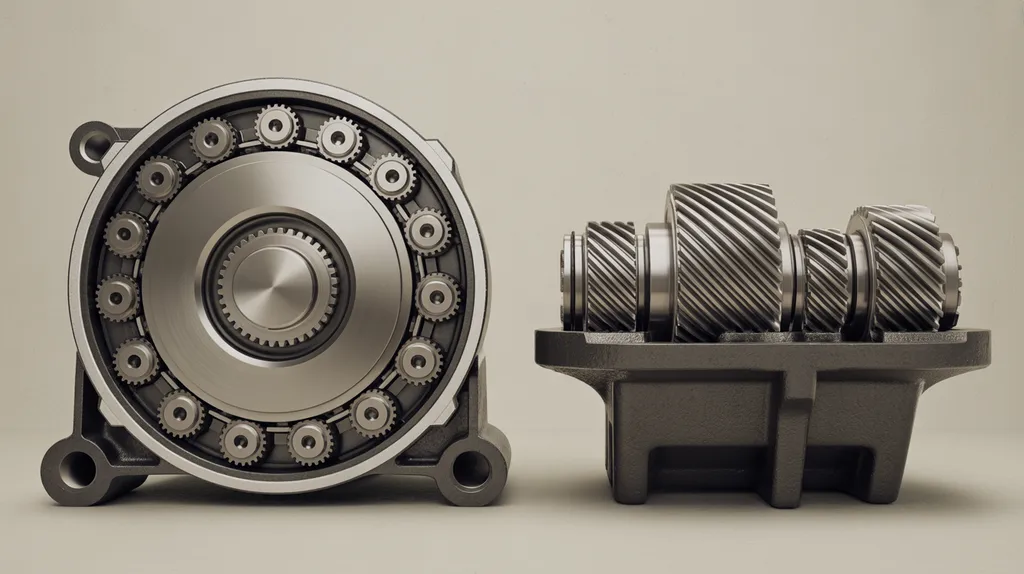
A planetary gearbox transmits motion through a sun gear, multiple planet gears, a ring gear and a carrier. A helical gearbox transmits motion through gear pairs with teeth set at an angle to the shaft axis. Planetary gearing emphasizes load sharing and compact torque transmission, while helical gearing emphasizes smooth meshing and flexible industrial layouts.
| Criterion | Planetary gearbox | Helical gearbox |
|---|---|---|
| Main arrangement | Sun gear, planet gears, ring gear and carrier | Angled-tooth gear pairs |
| Main design advantage | Load sharing and compact torque density | Smooth engagement and layout flexibility |
| Typical selection priority | Space, torque density and precision | Continuous duty, mounting and serviceability |
| Key design issue | Backlash, stage count and configuration | Axial thrust, bearings and shaft arrangement |
| Common application direction | Servo, robotics, compact machinery and high-torque drives | Conveyors, mixers, material handling and industrial machinery |
How does a planetary gearbox work?
A planetary gearbox is also called an epicyclic gear system. The sun gear is positioned at the center, planet gears rotate around it, the ring gear surrounds the planets and the carrier supports the planet gears.
The exact input, output and fixed member can vary by configuration. This allows a planetary gearbox to provide different reduction ratios and shaft arrangements while keeping several gears engaged. Because the transmitted load is distributed across multiple planet gears, planetary designs are commonly associated with high torque density.
That does not mean every planetary gearbox has the same torque capacity, efficiency or backlash. The result depends on the number of stages, gear geometry, materials, bearings, lubrication, speed and manufacturer rating.
How does a helical gearbox work?
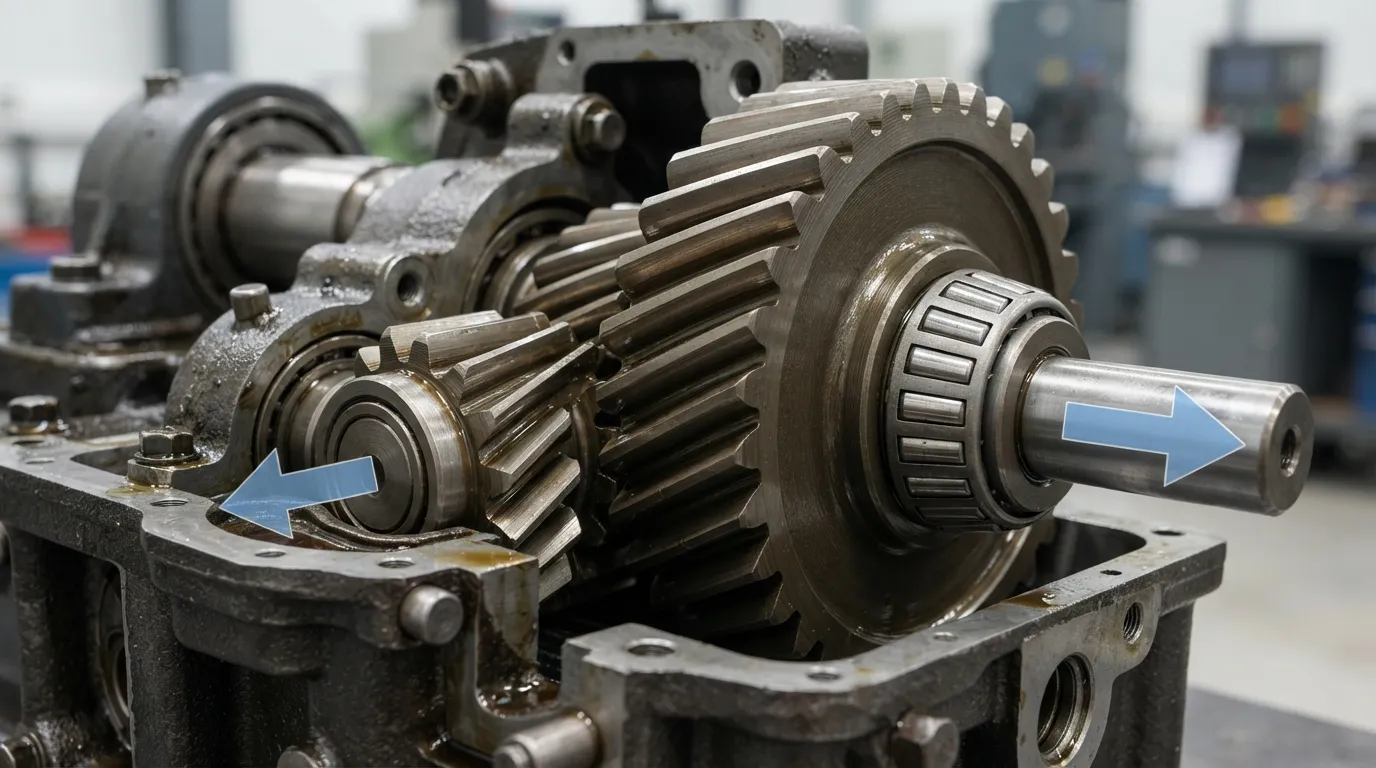
A helical gearbox uses cylindrical gears with teeth cut at an angle. The angled teeth engage progressively, rather than making the entire tooth width contact at once. This supports smooth power transmission and can help reduce vibration compared with less gradual tooth engagement.
The trade-off is axial thrust. Because helical teeth are angled relative to the shaft, the gear mesh produces a force along the shaft axis. The gearbox bearings, housing and mounting arrangement must be designed for that load.
Helical gearboxes can be configured in different layouts, including inline and parallel-shaft arrangements. The appropriate layout depends on the machine’s available space, shaft direction, output loading and mounting interface.
[DIAGRAM: Side-by-side cutaway showing the sun gear, planet gears, ring gear and carrier in a planetary gearbox, alongside angled helical teeth and axial thrust arrows in a helical gearbox.]
Which gearbox has higher torque density and the smaller footprint?
A planetary gearbox generally has the stronger case when the priority is high torque relative to gearbox volume, because multiple planet gears share the transmitted load. A helical gearbox may still provide the required total torque, but the housing can be larger for an equivalent duty depending on the ratio, rating and configuration.
Torque density means the torque a gearbox can transmit relative to its physical size or mass. Torque density is different from total torque capacity: a larger helical gearbox may transmit more torque than a smaller planetary gearbox, even if the planetary design provides more torque per unit of volume.
| Selection question | Planetary tendency | Helical tendency | Qualification |
|---|---|---|---|
| Highest torque per unit volume | Often favorable | May require a larger package for equivalent duty | Compare equivalent torque, ratio and duty |
| Smallest envelope | Often favorable in coaxial designs | Depends on inline, parallel-shaft or other layout | Check the actual installation envelope |
| Highest total torque | Not automatically planetary | Not automatically helical | Use the manufacturer’s rating at the operating point |
| Lowest weight | May be compact, but not universally lighter | Varies by housing and duty | Compare the complete drive assembly |
According to Industrial Gearbox Supply, planetary gearboxes are commonly associated with compact size and high torque density. Mill Gears similarly describes the load-sharing effect of multiple planet gears as a reason for the high torque capability of planetary designs.
The practical question is not simply “Which gearbox is stronger?” Ask instead:
- How much continuous output torque is required?
- What peak or starting torque must the gearbox withstand?
- How much installation space is available?
- Is the space restriction radial, axial or both?
- Does the gearbox need to support external radial or axial loads?
- Is a compact package worth a potentially higher purchase or integration cost?
How do shaft arrangement and mounting affect the choice?
Shaft arrangement can determine the practical choice before efficiency or gearbox price is considered. Planetary gearboxes are commonly selected for compact coaxial installations, while helical gearbox families can provide inline, parallel-shaft or other layouts depending on the design.
A gearbox must fit the machine’s available mounting surfaces, shaft direction, flange or foot arrangement and output-load requirements. A technically suitable gearbox that cannot fit the existing interface may require costly redesign of the machine.
| Mounting requirement | Likely starting point | Checks before selection |
|---|---|---|
| Compact coaxial input and output | Planetary | Envelope, flange, backlash and output loading |
| Parallel shafts | Parallel-shaft helical configuration | Shaft spacing, foot or flange mounting and radial load |
| Right-angle installation | Appropriate gearbox architecture and layout | Torque direction, lubrication, efficiency and mounting |
| Existing machine interface | Either, if dimensions and loads match | Mounting dimensions, shaft diameter, keying and ratio |
| Limited access for service | The layout with better inspection and replacement access | Lubrication, removal path and maintenance space |
Helical gearboxes generate axial force through the angled tooth contact, so the supplier must account for that force in the bearing and housing design. The required arrangement may also change if the output shaft carries a belt, chain, pulley, sprocket or mixer element.
For a parallel-shaft example, review Mingye’s F series parallel shaft helical gear motor 1.html, while confirming the actual dimensions and ratings from the applicable product documentation.
How do efficiency, heat and reduction ratio compare?
Neither gearbox type should be declared universally more efficient. Efficiency depends on the number of stages, reduction ratio, gear quality, lubrication, load, speed and operating temperature, so comparisons should use equivalent operating conditions.
| Factor | Why it matters | What to request from the supplier |
|---|---|---|
| Reduction ratio | Multiple stages can affect losses and heat | Ratio, stage count and output speed |
| Load point | Efficiency varies with loading | Continuous and peak torque |
| Input speed | Speed affects friction and thermal behavior | Motor speed and operating range |
| Lubrication | Lubricant condition affects friction and temperature | Lubricant type and service conditions |
| Operating temperature | Temperature affects thermal limits and lubricant behavior | Ambient and expected operating temperature |
| Duty cycle | Intermittent and continuous operation create different thermal demands | Operating hours, starts and stops |
According to Industrial Gearbox Supply, efficiency is influenced by stage count, gear quality, lubrication, load, speed and operating temperature. That makes a single percentage unsuitable for comparing all planetary and helical gearboxes.
Reduction ratio also affects the comparison. Linear Motion Tips gives a product-specific example in which a 5:1 planetary stage combined with a 3:1 stage produces a total 15:1 ratio. The same source describes approximately 3:1 to 10:1 as a typical single-stage planetary range. These figures are examples from that source, not universal limits for every planetary gearbox.
Compare the following before selecting a gearbox:
- Input speed and required output speed.
- Continuous and peak output torque.
- Required ratio and whether multiple stages are needed.
- Expected efficiency at the actual load point.
- Heat generation during the complete duty cycle.
- Lubrication requirements and ambient conditions.
Do not compare one manufacturer’s efficiency percentage with another manufacturer’s figure unless the ratio, speed, load, temperature, lubrication and test conditions are sufficiently comparable.
Which gearbox has lower backlash and higher precision?
A precision planetary gearbox is commonly chosen when low backlash, torsional stiffness and repeatable motion are important, especially in servo or positioning systems. A conventional helical gearbox may be appropriate when the application prioritizes power transmission and continuous operation rather than frequent precision reversal.
Backlash is the clearance or play between mating gear teeth. Manufacturers may express backlash in arcminutes. The required value depends on positioning accuracy, reversal frequency, load changes and the acceptable amount of output movement before torque is transmitted in the opposite direction.
According to Linear Motion Tips, some precision planetary gearbox designs achieve backlash as low as 1–2 arcminutes. This is a product-specific example, not a universal specification for all planetary gearboxes.
| Requirement | Planetary starting point | Helical starting point |
|---|---|---|
| Low backlash | Often preferred, subject to product specification | Verify whether the available backlash is acceptable |
| Frequent reversing | Check backlash and torsional stiffness carefully | Use only when verified precision meets the requirement |
| Continuous power transmission | Suitable when compactness or torque density matters | Common starting point for industrial duty |
| Servo positioning | Often preferred | Consider only with verified precision specifications |
| Simple speed reduction | May be unnecessary if precision is not needed | May offer a practical solution |
A low-backlash gearbox is not automatically the right choice. If a conveyor or mixer does not require precise reversing or positioning, paying for a precision specification may add cost without improving the process. Conversely, excessive backlash can affect repeatability in robotics, computer numerical control machinery and servo-driven equipment.
Which gearbox is better for continuous-duty industrial applications?
For conveyors, mixers, material handling and other continuous-duty systems, a helical gearbox is often a practical starting point when mounting flexibility, steady power transmission and serviceability matter. A planetary gearbox becomes more attractive when the same application also imposes tight space, high torque density, high shock load or precision requirements.
| Application condition | Better starting point | Why | Verify |
|---|---|---|---|
| Conveyor with ample installation space | Helical | Practical continuous-duty layout options | Torque, service factor and mounting |
| Mixer with high starting or shock load | Planetary or heavy-duty helical | Depends on torque density and peak load | Peak torque, duty cycle and thermal rating |
| Compact packaging machine | Planetary | Compactness and precision may dominate | Backlash, ratio and output loading |
| Servo or robotic axis | Precision planetary | Low backlash and stiffness may be priorities | Arcminutes, torsional stiffness and reflected inertia |
| Mining, cement or port equipment | Heavy-duty helical or planetary | Depends on shock, space and output torque | Environment, shock factor and serviceability |
| Plastics and rubber machinery | Either, depending on the machine interface | Ratio, mounting and process load determine choice | Continuous torque, temperature and customization |
Helical gearboxes are used in applications such as printing, earth-moving, steel, rolling mills, power and port equipment, according to Santram Engineers. Planetary gearboxes are commonly associated with compact, high-torque and precision applications.
The application name alone is not enough to select a gearbox. For example, a mixer may need a compact planetary reducer because of limited space, or a heavy-duty helical gearbox because the machine has ample room and prioritizes straightforward continuous operation. The torque profile, mounting and peak load determine the choice.
For a broader application review, see planetary gearbox uses.
Which gearbox is easier to maintain?
Maintenance depends more on the specific gearbox design, sealing, lubrication, duty and accessibility than on the architecture name alone. A maintenance-friendly selection provides suitable inspection access, correct lubrication, adequate bearing capacity and a practical removal path.
Planetary designs contain multiple interacting gears and bearings, so configuration-specific service instructions should be followed. Helical gearboxes require attention to lubrication and the axial thrust created by angled teeth. Neither design should be selected on the assumption that it will be maintenance-free.
Review these points before purchase:
- Lubricant type, quantity and change requirements.
- Inspection and replacement access.
- Operating temperature and contamination.
- Continuous or intermittent duty.
- Radial and axial output loads.
- Shock loads and frequent starts or stops.
- Seal arrangement and installation orientation.
- Availability of technical documentation and replacement parts.
- Consequences of gearbox downtime.
Lubrication also affects efficiency and operating temperature. The correct lubrication arrangement depends on the specific gearbox, speed, orientation, load and environment, so the supplier’s instructions should take priority over a generic gearbox rule.
Which gearbox costs less?
Initial cost cannot be determined from gearbox type alone. A planetary gearbox may justify a higher purchase price when its compactness, torque density or precision reduces machine size and integration work; a helical gearbox may be more economical when standard industrial duty and flexible mounting meet the requirement.
| Cost factor | Questions to ask |
|---|---|
| Purchase price | Is the comparison based on equivalent torque, ratio and rating? |
| Installation | Will the gearbox fit the existing mounting and shaft interface? |
| Motor and drive | Does the gearbox change the required motor size or reflected inertia? |
| Energy | What is the expected efficiency at the actual duty point? |
| Maintenance | What lubrication and inspection work is required? |
| Downtime | How difficult is replacement or access? |
| Customization | Are nonstandard mounting dimensions or ratios required? |
| Machine redesign | Will the selected layout require new shafts, guards or supports? |
A fair cost comparison should use gearboxes with equivalent:
- Continuous and peak torque ratings.
- Input and output speeds.
- Reduction ratio.
- Duty cycle and shock factor.
- Thermal requirements.
- Mounting and shaft interfaces.
- Backlash and precision requirements.
A lower purchase price can become less attractive if the gearbox requires extensive mounting changes, operates inefficiently at the actual load point or is difficult to service. A compact planetary design can also create value by reducing machine footprint, but that benefit must be evaluated against the complete drive and installation cost.
How do you choose between a planetary and helical gearbox?
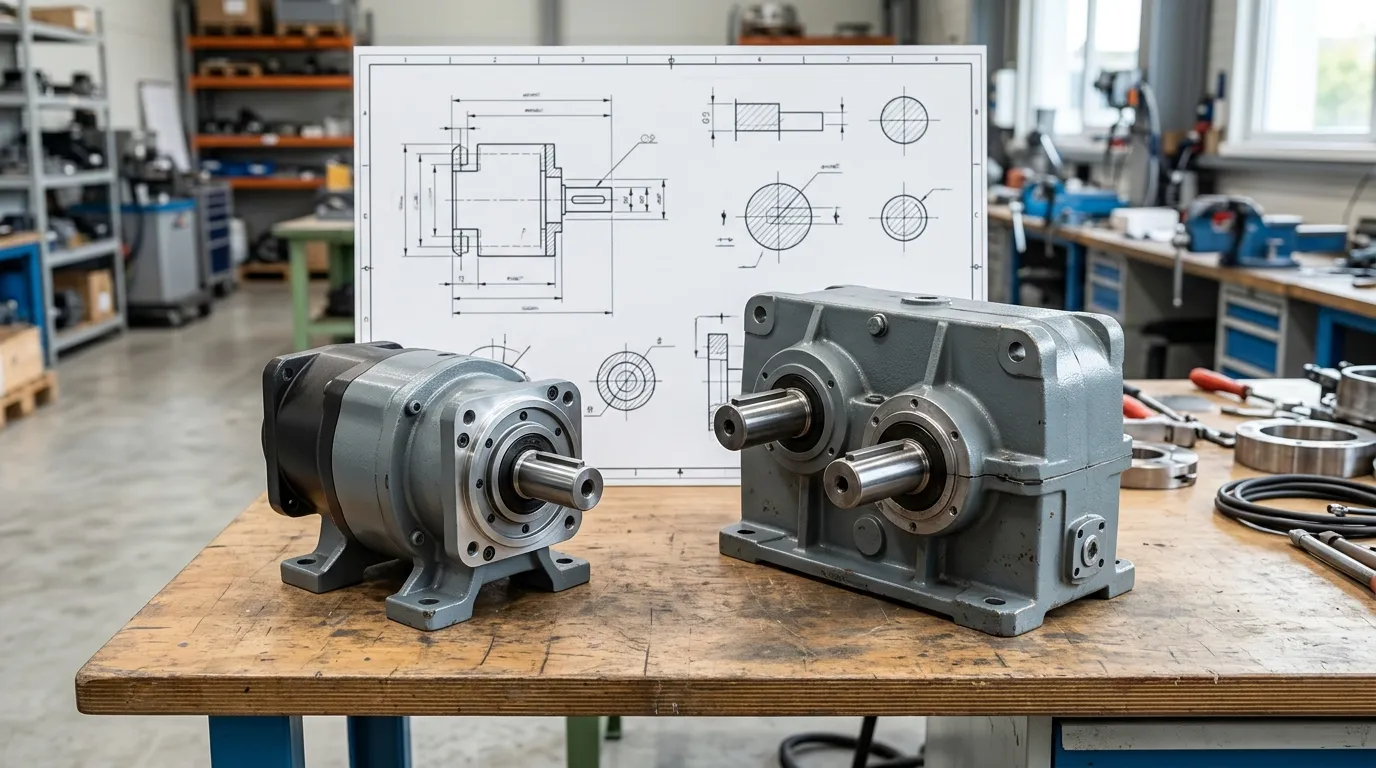
Start with the required output torque, speed and ratio, then check whether the machine prioritizes compactness, torque density, precision, shaft layout, continuous duty, maintenance access or cost. Choose a planetary gearbox when space, torque density or low backlash dominate; choose a helical gearbox when mounting flexibility, steady industrial duty and practical serviceability dominate, subject to verified ratings.
Planetary gearbox or helical gearbox: A practical selection process
- Define motor power, input speed and output speed.
Record the motor rating and the actual operating speed range, not only the nominal motor data.
- Confirm the reduction ratio.
Calculate the ratio from input speed and required output speed. Identify whether one or multiple stages are needed.
- Calculate continuous and peak output torque.
Include starting torque, acceleration, reversing and process-related peaks.
- Identify the duty cycle and shock load.
Record operating hours, starts per hour, load changes, jams and impact conditions.
- Measure the available footprint.
Check radial and axial clearance, service access and whether a coaxial, inline or parallel-shaft arrangement is possible.
- Specify shaft orientation and mounting.
Confirm foot, flange, torque-arm or other mounting requirements, along with output shaft diameter and keying.
- Decide whether precision is critical.
If the drive reverses frequently or controls position, specify allowable backlash and required torsional stiffness.
- Check radial and axial output loads.
Include external loads from belts, chains, sprockets, pulleys, mixers or other driven equipment.
- Compare thermal and lubrication requirements.
Evaluate efficiency, heat generation, lubricant, ambient temperature and duty at the actual operating point.
- Compare total cost.
Include purchase, installation, energy, maintenance, replacement access and potential machine redesign.
- Request a supplier review.
Provide the complete operating data rather than requesting a gearbox from motor power and ratio alone.
| If the priority is... | Start by evaluating... |
|---|---|
| Minimum footprint | Planetary gearbox |
| High torque in limited space | Planetary gearbox |
| Low backlash or precision motion | Precision planetary gearbox |
| Parallel-shaft installation | Parallel-shaft helical option |
| Continuous industrial duty with flexible mounting | Helical gearbox |
| Standard speed reduction with ample space | Helical gearbox |
| High shock or unusual process load | Heavy-duty ratings and service factors for both types |
| Lowest total cost for a standard duty point | Equivalent helical and planetary configurations |
The decision rule is a starting point, not a substitute for sizing. A planetary gearbox can be the wrong choice if the application has ample space, modest torque and no precision requirement. A helical gearbox can be the wrong choice if the machine has severe space restrictions, high torque relative to volume or demanding positioning requirements.
What specifications should you send a gearbox supplier?
A supplier needs more than motor power and nominal ratio. Provide operating torque and speed, duty pattern, external loads, environment, shaft arrangement, mounting dimensions and precision requirements so the gearbox can be evaluated at the actual duty point.
Use this specification checklist when requesting a selection or quotation:
- Motor power in kilowatts.
- Input speed in revolutions per minute.
- Required output speed.
- Reduction ratio.
- Continuous output torque in newton-metres.
- Peak or starting output torque in newton-metres.
- Duty cycle and operating hours.
- Starts, stops and reversing frequency.
- Shock loads, jams and acceleration requirements.
- Radial and axial output loads.
- Shaft orientation and mounting type.
- Available envelope and interface dimensions.
- Shaft diameter, keying or flange requirements.
- Ambient temperature, dust, moisture and washdown conditions.
- Required backlash, noise or positioning accuracy.
- Lubrication and maintenance constraints.
- Required motor, brake or encoder interfaces.
- Any required mounting-dimension or transmission-ratio customization.
Readers who have already identified a planetary architecture as a likely fit can continue with Mingye’s guide on how to choose planetary gearbox.
Common selection mistakes to avoid
The most common mistakes are comparing nominal ratios instead of equivalent duty points, confusing torque capacity with torque density, ignoring shaft and mounting constraints, overlooking axial loads and selecting low backlash or high efficiency without confirming the actual operating conditions.
Avoid these errors:
- Choosing a gearbox type before calculating output torque.
- Treating a compact package as proof of higher total capacity.
- Comparing efficiency percentages from different ratios or load conditions.
- Ignoring the axial thrust produced by helical teeth.
- Specifying low backlash when the application does not need precision.
- Failing to account for peak torque and shock loads.
- Selecting a gearbox that does not fit the machine interface.
- Assuming maintenance requirements from gearbox architecture alone.
- Comparing a precision planetary gearbox with a standard industrial helical gearbox without matching the specifications.
- Treating a typical delivery time as a guarantee for every custom configuration.
- Evaluating purchase price without considering installation, energy, maintenance and downtime.
A reliable comparison uses the same operating conditions for both gearbox types. The comparison should include equivalent torque, ratio, speed, duty cycle, temperature, mounting, external loads and precision requirements.
How Mingye can support gearbox selection
Mingye designs, makes and supplies industrial power transmission equipment, including heavy-duty planetary reducers and R, S, K and F series helical gear motors. The company builds motors and reducers in its own CNC-equipped factory using modular, standardized designs.
Mingye offers OEM customization of mounting dimensions and transmission ratios. That capability can be relevant when an OEM needs a gearbox to fit an existing machine interface or a particular transmission requirement. Mingye normally delivers in 7–15 days, although the actual timing depends on the configuration and order requirements.
For readers reviewing the wider helical drive family, Mingye’s helical geared motor range provides a relevant next step. Selection should still be based on the application data, product documentation and confirmed ratings for the specific gearbox.
Frequently asked questions
What are the disadvantages of a planetary gearbox?
A planetary gearbox can involve a more complex arrangement of sun, planet, ring and carrier components than a simple gear pair. Its suitability still depends on ratio, stage count, lubrication, load and backlash requirements. A planetary design may be unnecessary when the machine has ample space and needs only standard continuous-duty power transmission.
What are the disadvantages of helical gears?
Helical gears generate axial thrust because their teeth are angled to the shaft axis, so the bearings and housing must be designed for that load. A conventional helical gearbox may also be less attractive than a planetary design when the machine requires very high torque density, a very compact package or tightly controlled backlash.
What specifications are needed to select a planetary or helical gearbox?
Provide motor power, input and output speed, ratio, continuous and peak torque, duty cycle, starts and stops, shock loads, mounting dimensions, shaft orientation, radial and axial loads, environment, allowable backlash and maintenance requirements. These details allow the supplier to compare gearbox architectures at the actual operating point.
Is a planetary gearbox always more efficient than a helical gearbox?
No. Efficiency depends on the number of stages, ratio, gear quality, lubrication, load, speed and operating temperature. A planetary gearbox may be the better choice for compact, high-torque or precision motion, while a helical gearbox may perform appropriately in continuous industrial service. Compare efficiency data at equivalent operating conditions.
For another type of reducer comparison, readers evaluating worm-drive alternatives can review Mingye’s helical vs worm gearbox guide. The same principle applies: compare the actual torque, ratio, speed, mounting and duty requirements rather than selecting by gearbox name alone.
If you need help comparing a planetary reducer with a helical gearbox, send Mingye the required torque, speed, ratio, duty cycle, mounting dimensions and shaft arrangement. Mingye can use those operating details to discuss a suitable configuration and available OEM customization options.
Share on Social:


Contact Us
In This Article
Right Angle Geared Motor: Matching Electrical Supply, Variable Speed and Braking
Oct 26, 2026
Planning a Bevel Reducer Installation: Turn Shaft Requirements Into a Practical Drive Layout
Oct 26, 2026
Choosing an Overhead Crane Gearbox by Its Hoisting or Travel Function
Oct 26, 2026
Replacing an Industrial Worm Gearbox: What to Keep and What to Reassess
Oct 25, 2026