


 Home /
What Information Is Needed for a Custom Gearbox Quote?
Right Angle Geared Motor: Matching Electrical Supply, Variable Speed and Braking
Oct 26, 2026
Planning a Bevel Reducer Installation: Turn Shaft Requirements Into a Practical Drive Layout
Oct 26, 2026
Choosing an Overhead Crane Gearbox by Its Hoisting or Travel Function
Oct 26, 2026
Replacing an Industrial Worm Gearbox: What to Keep and What to Reassess
Oct 25, 2026
To get an accurate custom gearbox quote, you need to provide seven core specifications: output torque, input and output speed (or ratio), duty cycle, mounting and shaft details, motor data, operating environment, and estimated quantity. Supplying these details upfront helps the manufacturer size the gearbox correctly, recommend the right service factor, and deliver a complete, accurate price. Missing information leads to delays, re-quoting, or a quote that does not fit your application.
The 7 Core Specifications Every Gearbox RFQ Must Include
Every custom gearbox quotation begins with the same foundation. Whether you are replacing an existing unit or designing a new machine, the manufacturer needs these seven inputs to provide a meaningful price and delivery date:
| Information Needed | Why It Matters | Typical Units / Values |
|---|---|---|
| Output torque | Determines gear size, tooth strength, and housing dimensions | Nm or lb-ft |
| Input speed | Establishes the gearbox ratio calculation and input shaft loading | RPM |
| Output speed or gear ratio | Sets the reduction ratio; provide either value | RPM or X:1 |
| Duty cycle | Drives the service factor and therefore the gearbox size | Hours/day, starts/hour, shock load |
| Mounting and shaft details | Ensures the gearbox physically fits your equipment | Position, shaft diameters, keyways, flange type |
| Motor data | Matches the input shaft and adapter to your prime mover | kW/hp, RPM, IEC or NEMA frame size |
| Operating environment | Affects material, sealing, and coating choices | Temperature range, dust, humidity, indoor/outdoor |
| Estimated quantity | Unit pricing depends heavily on order volume | Pieces per year |
If you are unsure whether you need a custom gearbox or a standard unit, that decision comes before you request a quote — a standard gearbox may meet your needs at a lower cost and faster delivery.
Output Torque and Speed — The Performance Foundation
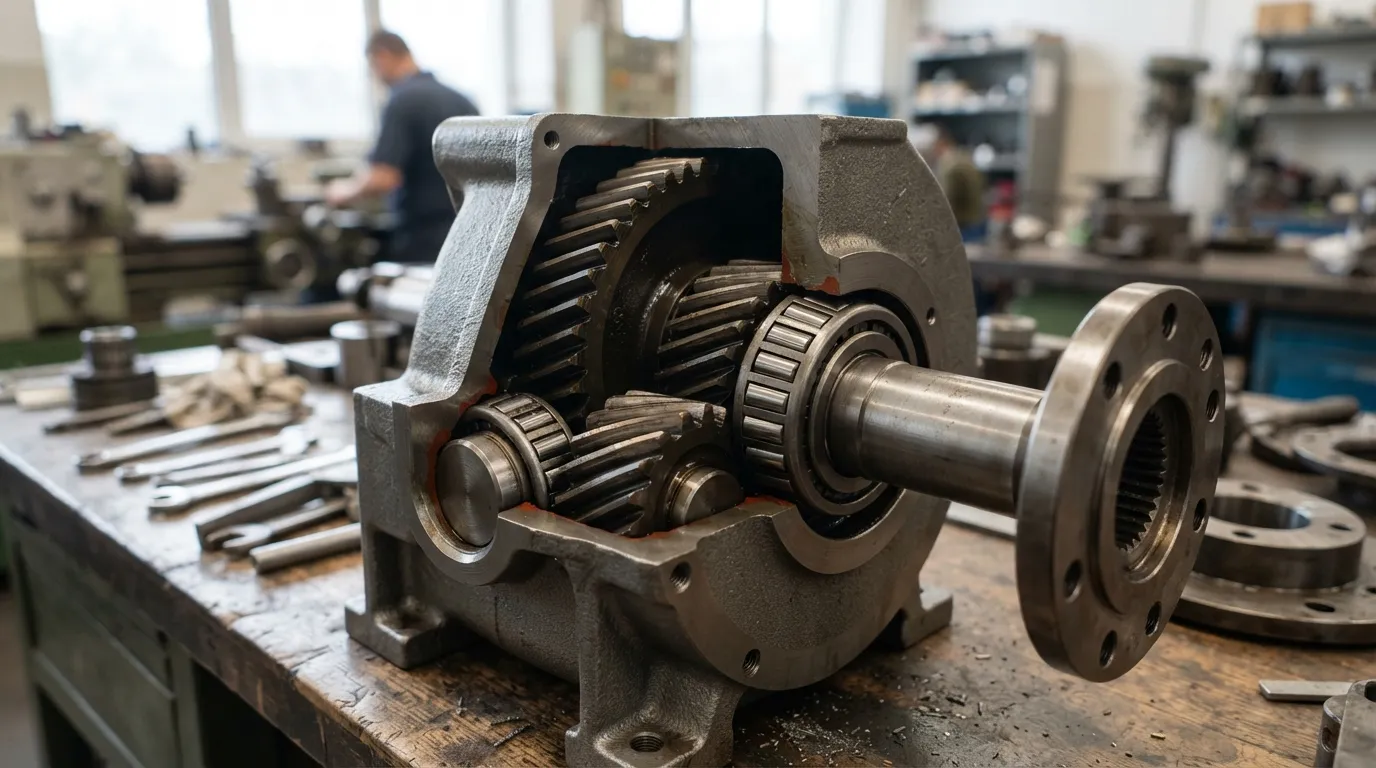
Output torque and speed are the first numbers a gearbox manufacturer needs. These values determine the gear size, tooth strength, housing dimensions, and ultimately the cost of the unit.
Output torque — measured in Newton-meters (Nm) or pound-feet (lb-ft) — is the rotational force the gearbox must deliver to the driven machine. Input speed is the rotation speed of the prime mover, typically an electric motor. These two values allow the manufacturer to calculate the required reduction ratio and verify that the gearbox can handle the transmitted power continuously.
According to PEM Ltd., application data for custom gearbox specification should include input power, input speed, required output speed or ratio, operating environment, space envelope, and mounting configuration. Providing these values together prevents the manufacturer from making assumptions about your application and quoting an incorrect unit.
Gear Ratio — Specify Ratio or Output Speed
Provide either the required reduction ratio (for example, 20:1) or the output speed in RPM. If the application needs a specific output speed, the manufacturer calculates the ratio from the input speed. Providing only the motor power without the speed leaves the manufacturer unable to determine the ratio, which often results in follow-up questions and a slower quotation.
For a deeper look at how torque, ratio, and mounting customization work together, see gearbox customization torque ratio mounting.
Duty Cycle and Service Factor — Why "Hours Per Day" Changes the Quote
The duty cycle is how often and how hard the gearbox works. It determines the service factor, which is a multiplier applied to the nominal torque to ensure the gearbox handles peak and transient loads without premature failure.
The number of operating hours per day, starts per hour, and severity of shock loads determine the service factor. A gearbox running 24 hours a day with heavy shock loads needs a higher service factor than one running two hours a day with smooth loads — and that changes the size, material grade, and cost of the quoted unit.
PEM Ltd. notes that the service factor is not a "one size fits all" number. It must reflect the specific application. The safety factor is a separate calculation: it relates to the material yield strength and heat treatment limits of the gear teeth, not the application conditions. Mixing up these two values produces either an undersized gearbox that fails early or an oversized, unnecessarily expensive unit.
| Duty Type | Hours/Day | Typical Applications | Service Factor Direction |
|---|---|---|---|
| Light | 2–4 hours | Positioning tables, manual adjustment, occasional use | Lower |
| Standard | 8–10 hours | Conveyors, mixers, packaging lines with moderate loads | Moderate |
| Heavy | 24 hours | Continuous process lines, crushers, high-shock equipment | Higher |
Under-specifying the duty cycle is one of the most common mistakes in RFQ submissions. If you state "8 hours per day" but your line actually runs continuous shifts with frequent starts, the quoted gearbox will be undersized. That leads to premature bearing failure, gear tooth wear, and warranty complications — none of which are covered when the duty cycle was misstated.
Mounting and Shaft Details — Physical Interfaces That Matter
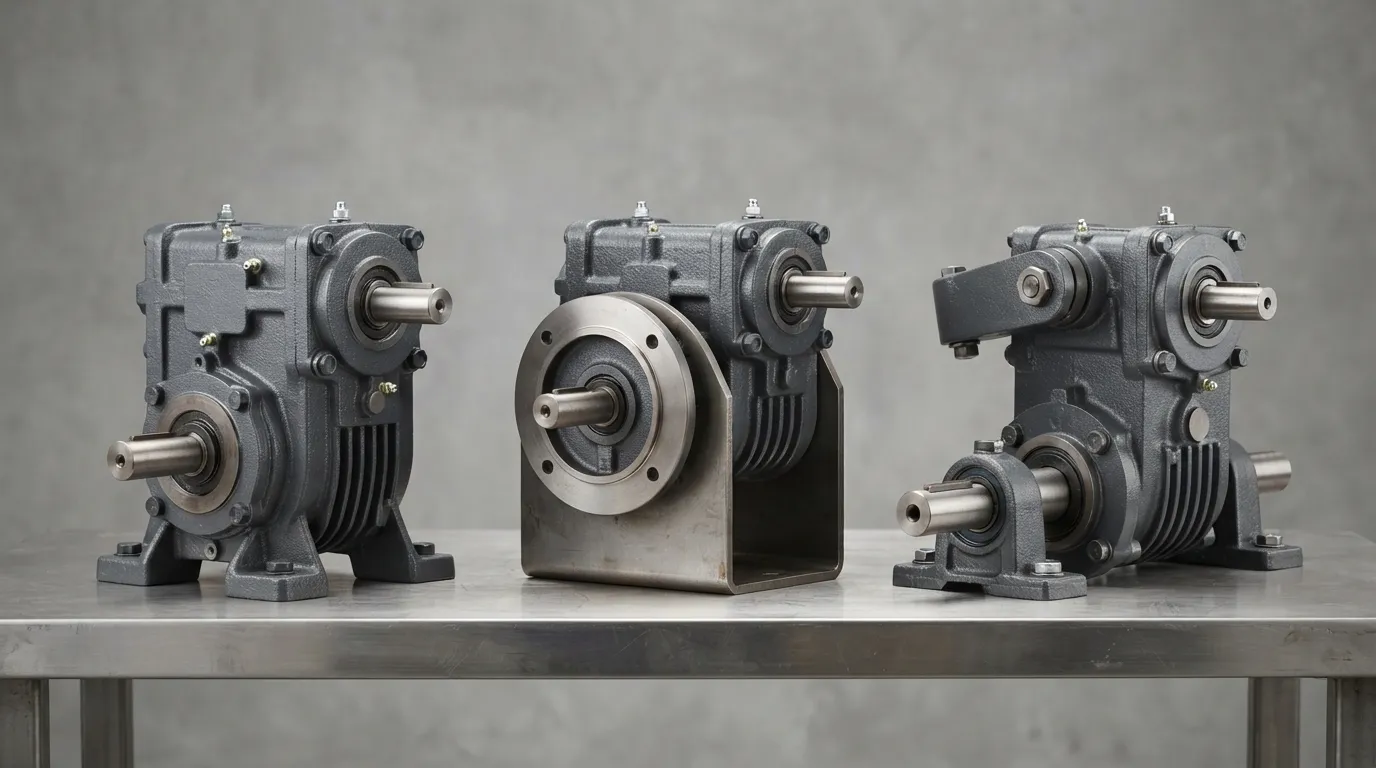
The gearbox must physically fit your equipment. The manufacturer needs the mounting position (foot-mounted, flange-mounted, or shaft-mounted), input and output shaft dimensions (diameter, keyway size, shaft length), hollow bore dimensions if applicable, and any space envelope constraints from your machine design.
These physical details are where miscommunication most often happens. A gearbox that delivers the correct torque but has the wrong output shaft diameter or keyway size cannot be installed without modification — which adds cost and delays the project.
Drawings are the most efficient and effective way to provide this information. According to Gear Motions, drawings give the manufacturer nearly every piece of information needed for an accurate quote. If you are replacing an existing gearbox, include the original dimensional drawing or the nameplate data so the manufacturer can identify the exact model and its interface dimensions.
Motor Data — What the Manufacturer Needs to Match the Gearbox
When the gearbox is coupled to an electric motor, the manufacturer needs the motor data to match the input shaft and adapter flange correctly. Include the motor power (kW or hp), motor speed (RPM), frame size (IEC or NEMA), voltage and frequency, and motor mounting configuration (B3 foot-mounted, B5 flange-mounted, B14 face-mounted).
This data is especially critical for gearmotor quotes — a gearmotor combines the motor and reducer into a single unit, so the motor flange and shaft must match the gearbox input perfectly.
Mingye builds both motors and reducers in the same factory, which means the motor and gearbox are designed as a matched pair rather than adapted from separate suppliers. This integration avoids the interface mismatches that occur when a motor from one manufacturer is coupled to a gearbox from another.
For a complete motor selection walkthrough, see the gear reduction motor buying guide for oems.
Operating Environment — Conditions That Change Materials and Seals
The operating environment affects the materials, coatings, seals, and lubrication specified in the quote. A gearbox running in a heated indoor facility has very different requirements than one exposed to outdoor weather, washdown, or corrosive chemicals.
Include the following environmental conditions in your RFQ:
- Ambient temperature range (minimum and maximum, in °C)
- Humidity levels and condensation risk
- Dust or particulate exposure
- Washdown or chemical exposure (food processing, chemical plants)
- Indoor or outdoor installation
- Altitude above sea level (affects cooling and lubrication)
Each condition changes the design. Dust exposure may require a higher IP (Ingress Protection) rating to keep contaminants out of the gearbox housing. Corrosive atmospheres may require special paint systems or stainless steel components. High ambient temperatures affect lubricant selection and may require additional cooling.
Drawings and 3D Models — The Fastest Way to Get an Accurate Quote
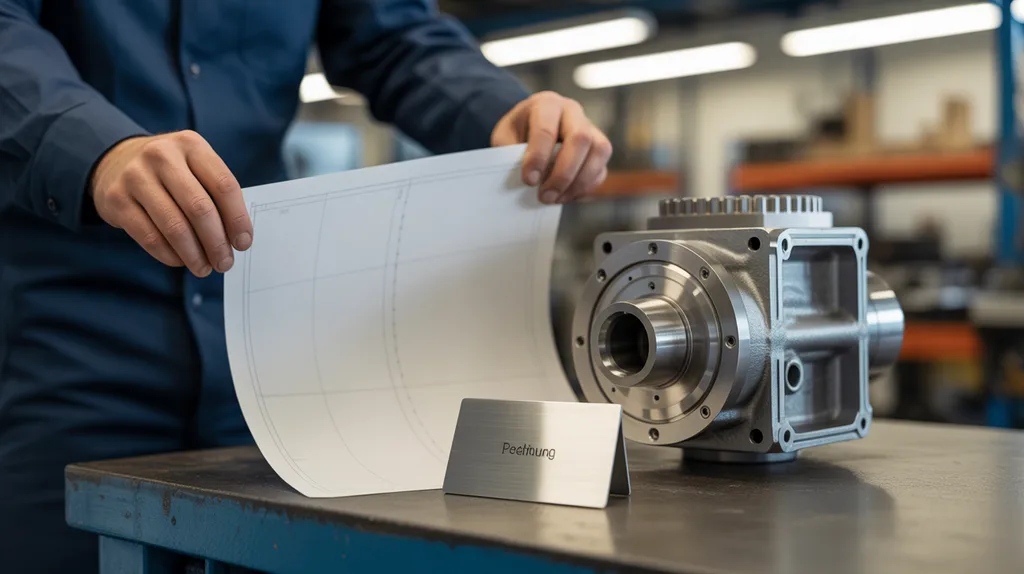
Dimensional drawings, 3D CAD models, or the original gearbox nameplate provide the most complete information for a quotation. According to Gear Motions, drawings are the most efficient and effective method of providing gear information for a quote because they give nearly every piece of information a manufacturer needs.
If you have them, include:
- Dimensional drawings with tolerances
- 3D CAD models (STEP, IGES, or native formats)
- Original nameplate data ( for replacements)
- Shaft details including keyway dimensions
- Mounting hole patterns and positions
When a manufacturer receives a complete drawing package, the quoting process is significantly faster because no follow-up calls are needed to clarify dimensions or configurations.
Quantity and Commercial Information — What Affects the Price
Estimated annual quantity, target delivery date, and any packaging or documentation requirements all affect the quoted price. According to Gear Motions, quantity is a huge factor in gear quoting — reduced pricing per piece applies to large volumes, while single-unit or low-volume orders carry higher prices due to setup and tooling costs.
Include the following commercial data in your RFQ:
| Information | Why It Matters |
|---|---|
| Estimated annual quantity | Unit price varies significantly between 1 piece and 100 pieces |
| Target delivery date | Affects manufacturing planning and possibly freight costs |
| Packaging requirements | Export crating or specialized packaging adds cost |
| Documentation needs | Certificates, inspection reports, or test documentation may be required |
Quantity and delivery are not the only price factors — see what else affects industrial gearbox price.
Common RFQ Mistakes That Delay or Inflate Your Quote
The most common mistakes in custom gearbox RFQs are omitting duty cycle, giving only motor power without speed, providing no dimensional constraints, and forgetting environmental conditions. Each omission forces the manufacturer to make assumptions — and assumptions can lead to an undersized unit or a quote that does not match the installation space.
| Common Mistake | What Happens | How to Avoid It |
|---|---|---|
| Omitting duty cycle | Manufacturer assumes standard duty; undersized gearbox if duty is heavy | State hours/day and shock load explicitly |
| Providing only motor power, no speed | Manufacturer cannot calculate the ratio | Include motor RPM with power |
| No drawings or dimensions | Manufacturer cannot verify physical fit | Send dimensional drawing or CAD file |
| Vague environment description | Wrong material or seal selection for the actual conditions | Give temperature range and exposure details |
| No quantity estimate | Quote may be priced for the wrong volume tier | State expected annual units |
Copy-Ready RFQ Checklist — What to Send to a Manufacturer
Custom Gearbox RFQ
- Application: (Describe the driven machine, e.g., "belt conveyor for mining, 45° incline")
- Output torque: ______ Nm (or lb-ft)
- Input speed: ______ RPM
- Output speed or gear ratio: ____ RPM or ____:1
- Duty cycle: ____ hours/day, __ starts/hour, ____ shock load (none/moderate/heavy)
- Mounting position: (Foot / Flange / Shaft-mounted — specify orientation if known)
- Shaft details: Output shaft diameter ____ mm/in, keyway __, shaft length ____ mm/in
- Motor data: ____ kW/hp, __ RPM, IEC/NEMA frame __, voltage ____, mounting (B3/B5/B14)
- Operating environment: Temperature ____ to ____ °C, indoor/outdoor, dust/washdown/corrosive (specify)
- Quantity: ______ pieces per year
- Target delivery: ______ (date)
- Drawings attached: Yes / No (if yes, list file names)
Once your RFQ is ready, use this guide to choose custom gearbox manufacturer that fits your project requirements.
What Happens After You Send Your RFQ
After receiving your information, the manufacturer reviews the specifications, asks clarifying questions if anything is missing, calculates the gearbox sizing and service factor, and issues a formal quotation with pricing and delivery.
The process typically follows these steps:
- Receive and review: The manufacturer confirms the RFQ is complete or requests missing details.
- Engineering review: The gearbox size, material selection, and service factor are calculated from your application data.
- Quotation issued: A formal quote with pricing, delivery, and terms is sent for your review.
- Technical clarification: Any questions about mounting, shaft details, or special requirements are resolved.
- Order confirmation: Upon your acceptance, the order is scheduled for production.
The timeline for this process varies widely. According to Industrial Gearbox Supply, lead time categories range from stocked units that ship immediately to fully custom designs that take several months. Mingye's modular, standardized design approach allows customization of mounting dimensions and transmission ratios with a normal delivery of 7–15 days — a significant difference for OEMs and plant engineers working to tight schedules. To understand the full design and manufacturing process, see custom gearbox design.
FAQ
What is the difference between a service factor and a safety factor?
The service factor accounts for application conditions — load type, hours of operation, and shock — and is applied to the nominal torque to size the gearbox appropriately. The safety factor relates to material yield strength and heat treatment limits, measuring how close the gearbox operates to its mechanical limits. Both matter, but they address different risks.
How do I calculate the service factor for my application?
Service factor is determined by the application's duty cycle: operating hours per day, starts per hour, and the severity of shock loads. Manufacturers publish service factor tables or supply them with the quote request. Your role is to accurately describe the operating conditions — let the manufacturer match a standard factor to your duty description rather than calculating it yourself.
What if I don't know the output torque of my existing gearbox?
Use the nameplate data — most gearboxes list model, ratio, and rated torque. If the nameplate is missing, provide the driven equipment details and the motor power and speed; the manufacturer can calculate the torque from those values. In cases where no data exists, a manufacturer can recommend a reverse-engineering approach from the physical unit.
Share on Social:


Contact Us
In This Article
Right Angle Geared Motor: Matching Electrical Supply, Variable Speed and Braking
Oct 26, 2026
Planning a Bevel Reducer Installation: Turn Shaft Requirements Into a Practical Drive Layout
Oct 26, 2026
Choosing an Overhead Crane Gearbox by Its Hoisting or Travel Function
Oct 26, 2026
Replacing an Industrial Worm Gearbox: What to Keep and What to Reassess
Oct 25, 2026