


 Home /
Gearbox vs Gear Reducer: Are They the Same?
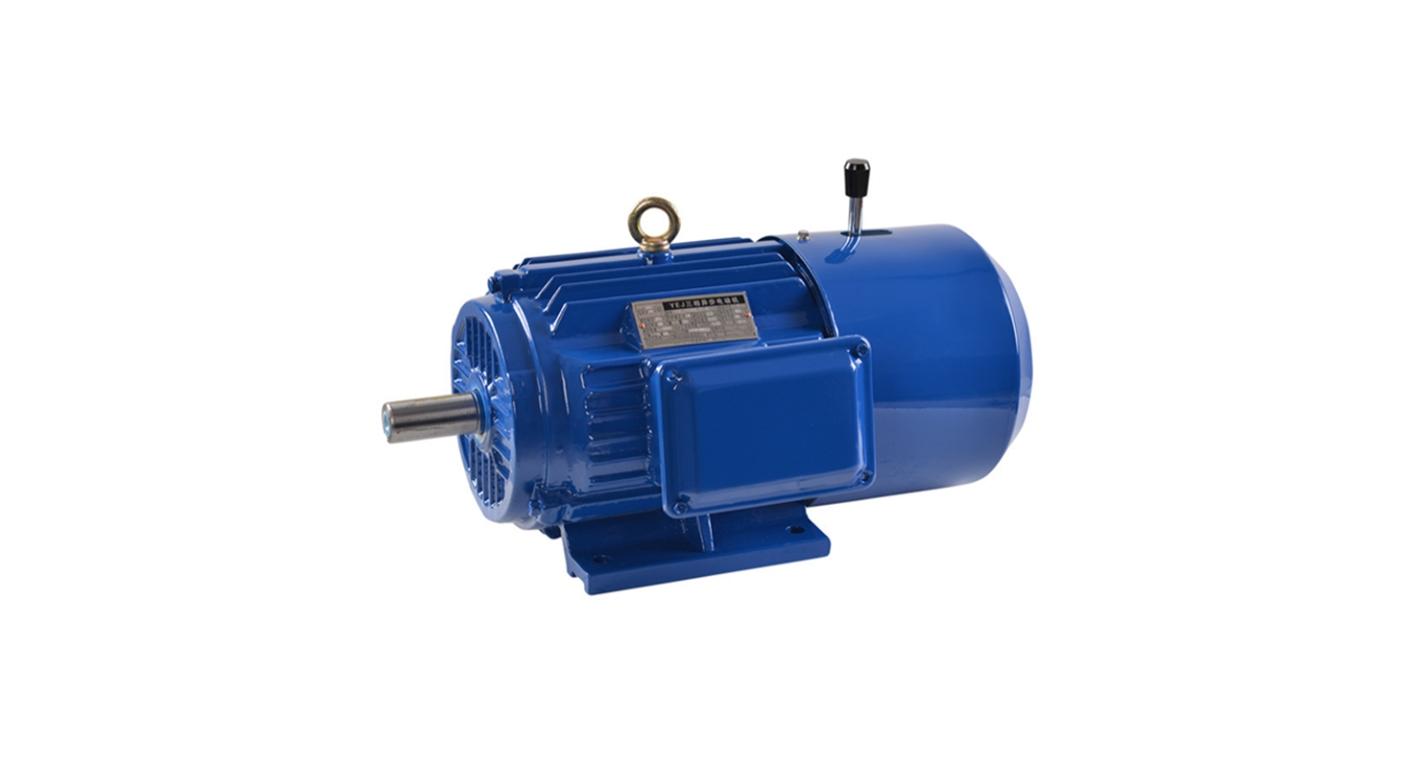
Right Angle Geared Motor: Matching Electrical Supply, Variable Speed and Braking
Oct 26, 2026
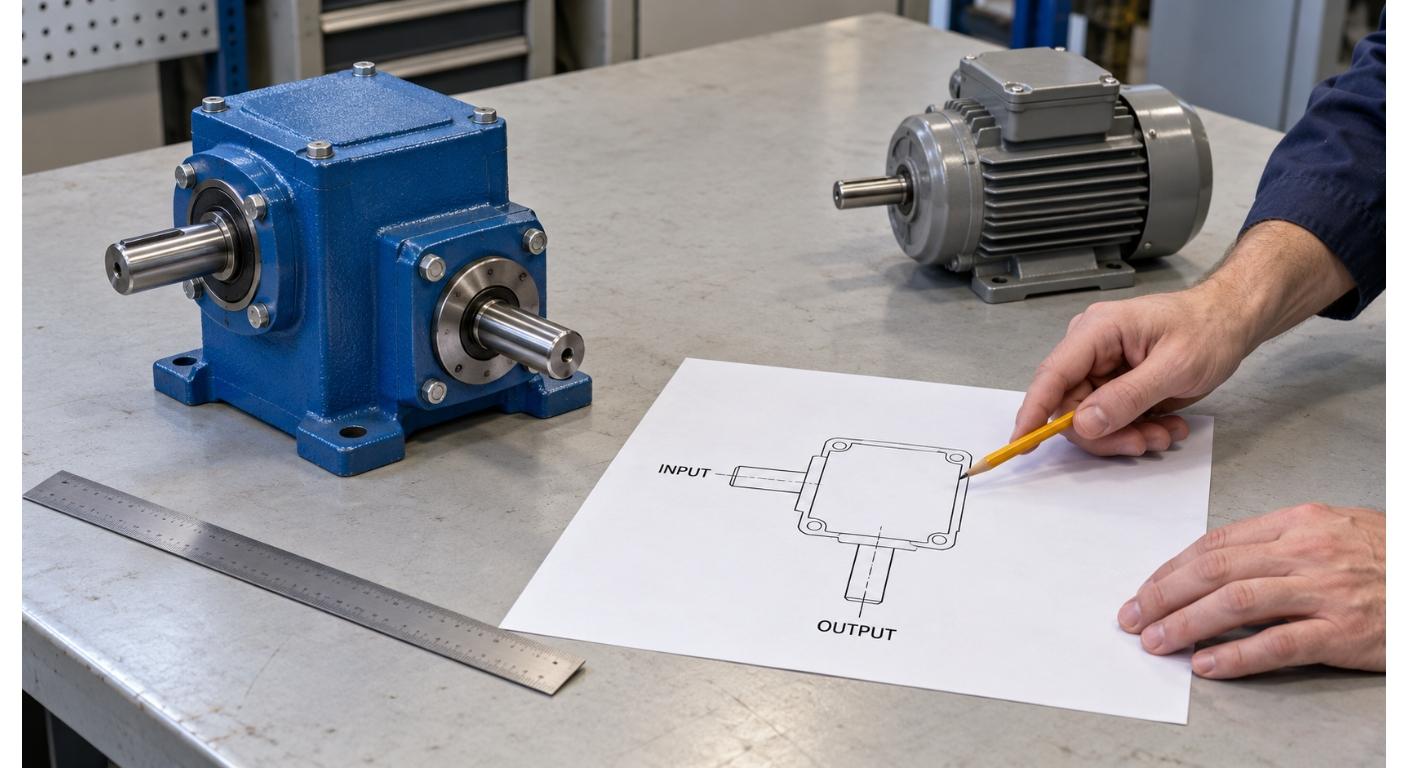
Planning a Bevel Reducer Installation: Turn Shaft Requirements Into a Practical Drive Layout
Oct 26, 2026
Choosing an Overhead Crane Gearbox by Its Hoisting or Travel Function
Oct 26, 2026
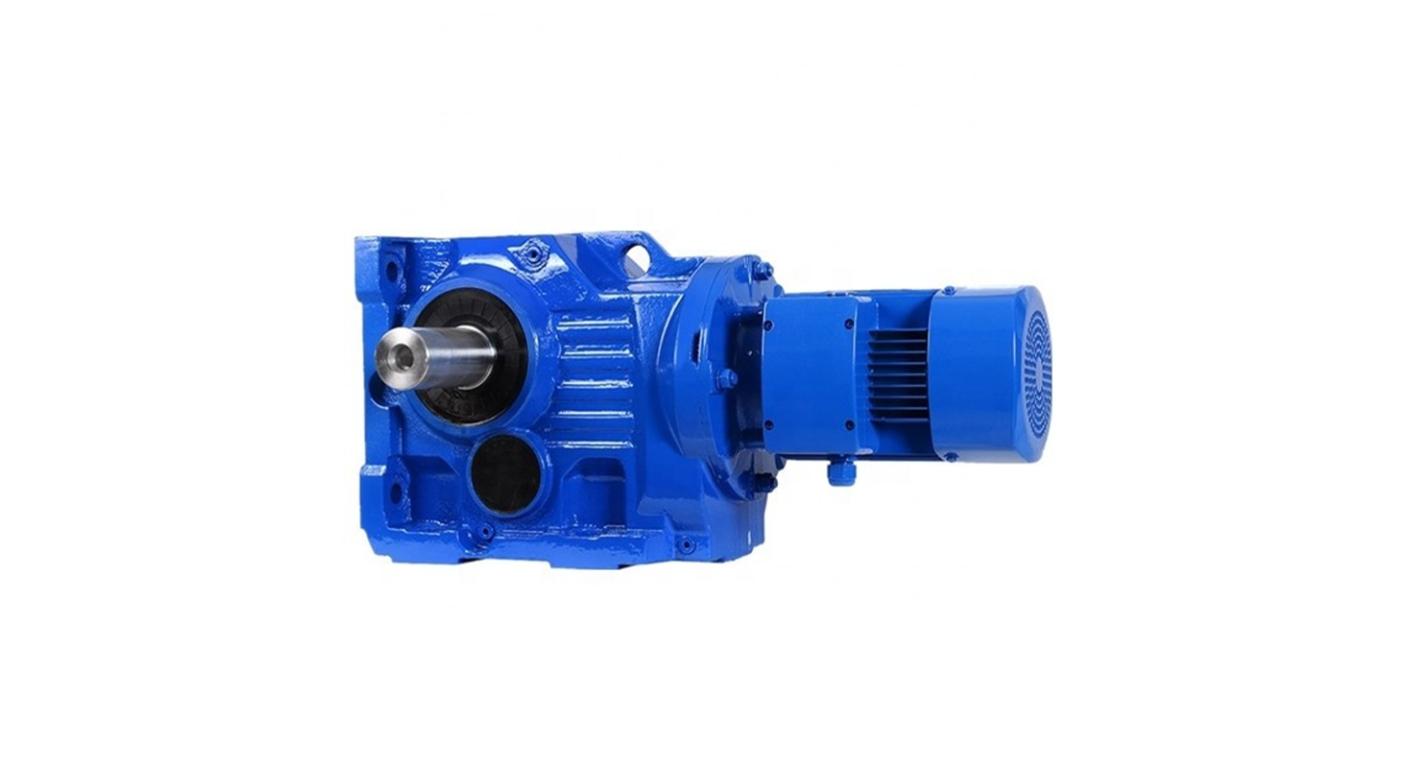
Replacing an Industrial Worm Gearbox: What to Keep and What to Reassess
Oct 25, 2026
A gear reducer is a gearbox whose job is to lower speed and raise torque, so in most industrial catalogs the two terms describe the same device. Gearbox is the broader name: it also covers speed increasers, direction-changing units and variable-speed drives. “Speed reducer” is simply another word for gear reducer.
Key takeaways
- All gear reducers are gearboxes, but not all gearboxes are gear reducers — a gearbox can also increase speed, change torque or redirect power.
- “Speed reducer” is a synonym for “gear reducer,” not a separate class of device.
- Ratio sets output speed: a 10:1 reducer turns a 1,750 RPM input into 175 RPM.
- A gear motor is a motor plus a gearbox, usually a reducer — it is a package, not a different name for the same part.
- In a few contexts, “reducer” is broader than “gearbox”: some reducers use sprockets or pulleys instead of gears.
The One-Line Rule: All Gear Reducers Are Gearboxes, but Not All Gearboxes Are Gear Reducers
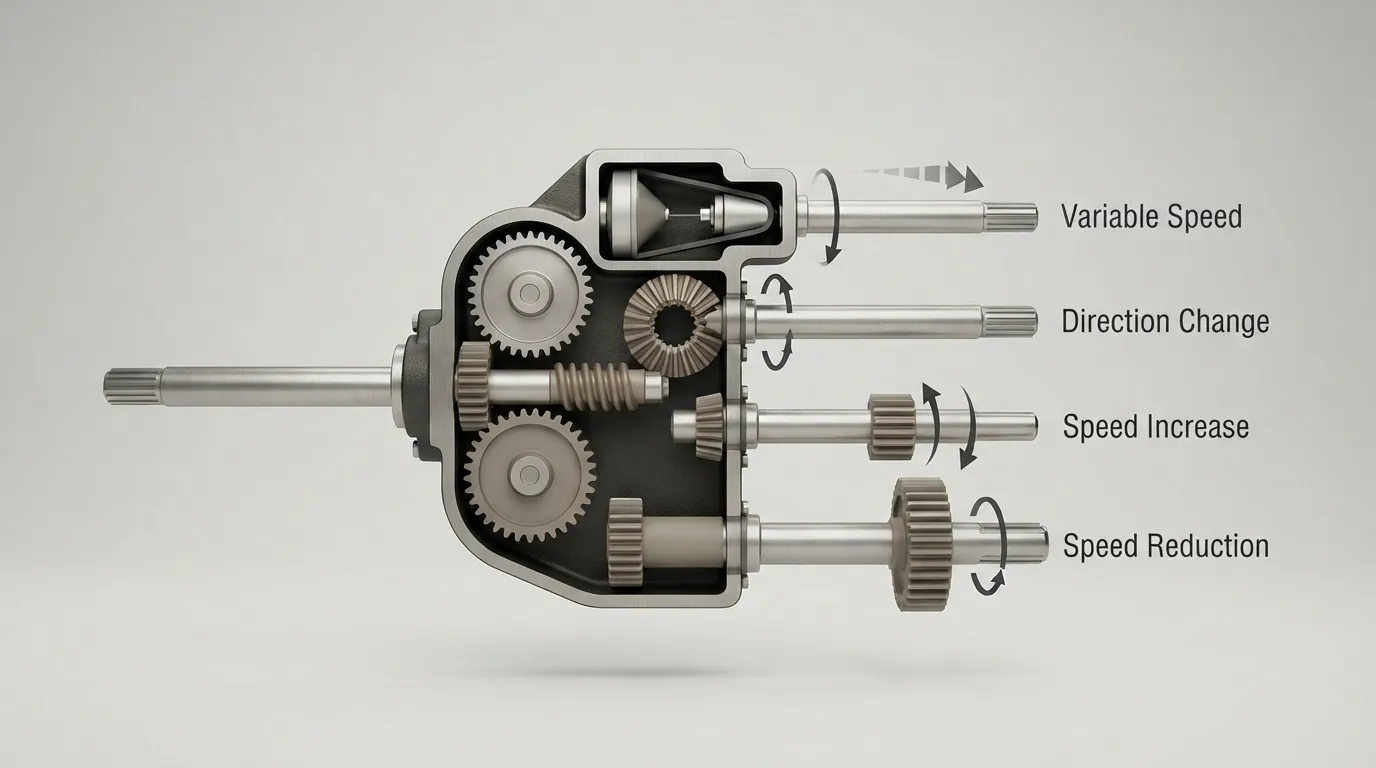
A gear reducer is a subset of gearbox. Every gear reducer is a gearbox, but a gearbox can also increase speed, change direction or vary speed, so the two words only swap cleanly when the task is speed reduction with torque increase.
According to STOBER (July 10, 2025), gearboxes can increase or decrease speed, change torque and redirect power, while gear reducers only reduce output speed and increase torque. That single sentence is the whole comparison: the reducer is defined by one job, the gearbox by a family of jobs.
[DIAGRAM: One input shaft splitting into four branches — speed down, speed up, direction change, variable speed — with the speed-down branch highlighted as the gear reducer subset inside the wider gearbox category.]
When the Two Terms Are Interchangeable in Industrial Purchasing
Whenever the duty is speed reduction with torque multiplication, the labels can be used interchangeably. A helical, worm, planetary or bevel unit sold to slow a conveyor, mixer or packaging line may be listed as a gearbox, a gear reducer or a speed reducer, and the buyer is requesting the same device in each case.
Konic (January 17, 2023) notes there is generally no distinction between a gearbox and a reducer, and describes gearboxes as dividing into reduction gearboxes, speed-increasing gearboxes and variable-speed gearboxes — a speed reducer being one type of reduction gearbox.
When They Are Not Interchangeable
The terms diverge when speed goes up, when direction changes, or when the motor is part of the purchase. A speed increaser is a gearbox whose output turns faster than its input, so it is a gearbox but not a reducer. A variable-speed gearbox adjusts output speed rather than holding one fixed reduction, and a gear motor combines a motor with a gearbox in one assembly.
None of those three should be ordered by asking for a “gear reducer,” because the label would describe only part of what the unit does.
What Is a Gear Reducer (and Is “Speed Reducer” the Same Thing?)
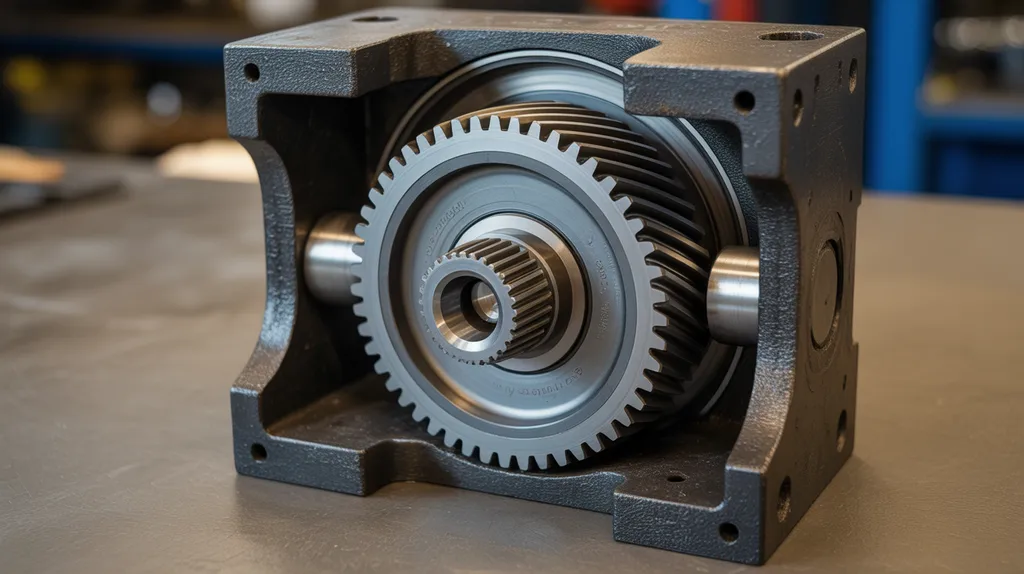
A gear reducer is a geared unit that takes a higher input speed and delivers a lower output speed with higher torque. “Speed reducer” names that function, while “gear reducer” names the mechanism that performs it, so the two labels describe the same device.
According to STOBER (2025), gear reducers only reduce output speed and increase torque. Vortex describes a gear drive as a set of gears in a housing and treats a speed reducer as one kind of gear drive — the other example it gives is an automotive transmission. That is why a supplier may use “speed reducer,” “gear reducer” and “reduction gearbox” for the same line item without meaning anything different.
What Is a Gearbox, and Does It Always Reduce Speed?
No. A gearbox is the housing and gear train that changes speed, torque or direction, so it does not always reduce speed. Reduction is the most common industrial use, but it is one option among several.
According to Konic (2023), gearboxes fall into three categories: reduction gearboxes, speed-increasing gearboxes and variable-speed gearboxes. STOBER (2025) confirms the broader set of functions — speed increase and decrease, torque change, and power redirection — which is why “gearbox” works as the umbrella term and “gear reducer” does not.
A practical consequence: if a datasheet states an output speed higher than the input speed, the unit is still a gearbox, but calling it a gear reducer would misdescribe it.
Gearbox vs Gear Reducer vs Speed Reducer vs Gear Motor
The three “reducer” labels point at the same speed-lowering duty, while “gearbox” is the wider category and “gear motor” is a motor-plus-gearbox package. The table below separates the four terms on function, not on marketing language.
| Term | What it does | Speed change | Typical use | Same device as the others? |
|---|---|---|---|---|
| Gearbox | Changes speed, torque or direction through a gear train in a housing | Down, up or variable | Broad industrial drives | Broader category — includes all of the below |
| Gear reducer | Lowers output speed and raises torque | Down only | Conveyors, mixers, packaging lines | Yes — a gearbox used for reduction |
| Speed reducer | Same duty as a gear reducer | Down only | Same applications as a gear reducer | Synonym, not a separate device |
| Gear motor | Pairs a motor with a gearbox, usually a reducer | Down per unit | Compact, integrated drives | A package, not a bare gearbox |
Gearbox vs Gear Motor: A Different Question
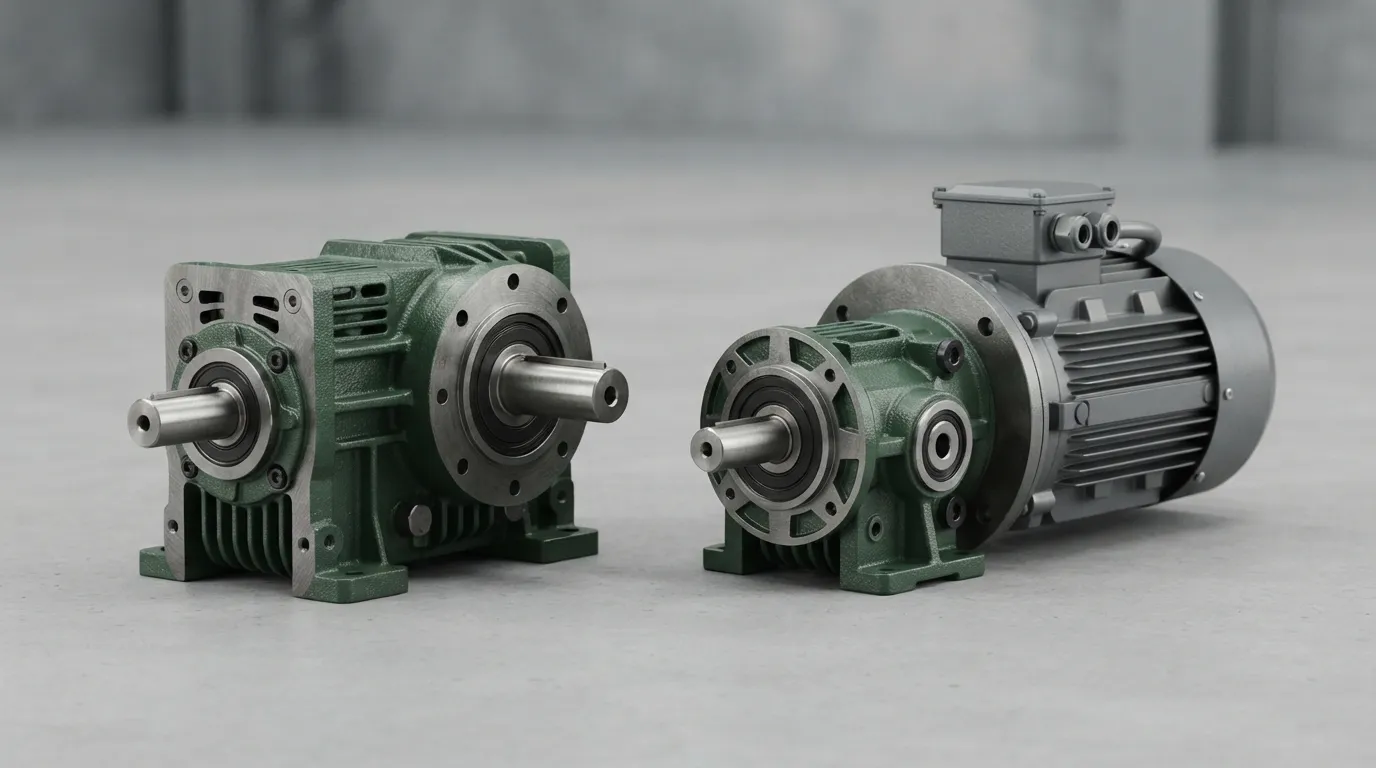
A gear motor is not a competing name for a gearbox. It is a motor and gearbox supplied as one assembly, which is why the same reduction unit can appear as a stand-alone reducer in one catalog and as a geared motor in another.
Vortex describes a gearmotor as a motor paired with a gearbox, usually a gear reducer, and notes it can be manufactured as a single piece. That packaging choice is the real decision behind a gear motor vs gearbox comparison: shaft alignment, footprint and how the drive is mounted. For an example of the integrated form, see how a helical geared motor combines both parts in one housing.
How Ratio Turns a “Reducer” into Numbers
Ratio equals input speed divided by output speed, so a 10:1 reducer turns a 1,750 RPM input into 175 RPM at the output shaft. According to IndustrialGearboxSupply, a 10:1 ratio means the input shaft turns ten times for every single rotation of the output.
| Input speed | Ratio | Output speed | Source |
|---|---|---|---|
| 1,750 RPM | 10:1 | 175 RPM | STOBER |
| 1,750 RPM | 20:1 | 87.5 RPM | Vortex |
| 1,800 RPM | 5:1 | 360 RPM | IndustrialGearboxSupply |
| 1,800 RPM | 10:1 | 180 RPM | IndustrialGearboxSupply |
| 1,800 RPM | 20:1 | 90 RPM | IndustrialGearboxSupply |
| 1,800 RPM | 30:1 | 60 RPM | IndustrialGearboxSupply |
| 1,800 RPM | 60:1 | 30 RPM | IndustrialGearboxSupply |
| 2,000 RPM | 10:1 | ~200 RPM | PlanetDrivePro |
Torque moves the other way. PlanetDrivePro notes that a 10:1 gear reducer taking a 2,000 RPM input delivers about 200 RPM, and that theoretical output torque is about ten times the input torque minus efficiency losses — which is the reason a reducer is specified at all. Those losses are the condition worth remembering: the speed figure follows the ratio exactly, but the torque figure does not.
Where the Name Changes by Reducer Type
Helical, worm, planetary and helical-bevel units are all gear reducers, yet catalogs tend to call a planetary unit a “planetary gearbox” and a worm unit a “worm reducer,” even though both lower speed and raise torque. The type name, not the function, usually decides which word appears on the label.
The type also decides the trade-offs. According to PlanetDrivePro, single-stage planetary reducers commonly cover 3:1 to 10:1, and multi-stage units reach higher ratios with more length and slightly lower efficiency. Winsmith reports that worm reducers can reach 100:1 with a single worm-and-gear pair, and that ratios of 40:1 and above are typically resistant to back-driving — useful on inclined loads, less useful when the load must be free to reverse. The same source notes helical-bevel reducers often offer higher torque capacity and efficiency than worm reducers, are more likely to back-drive, and typically cost more.
Naming differences of this kind are worth reading as catalog conventions rather than engineering distinctions. If you are weighing stage counts, the single stage vs multi stage gearbox comparison covers where the ratio and length trade-off lands; if the labels themselves are the confusion, see planetary gear reducer vs planetary gearbox.
How to Read a Supplier Catalog When the Terms Vary
Ignore the label and read four specification lines — duty, input speed, ratio, and output speed or torque. If the stated duty is reduction, then gearbox, gear reducer, speed reducer and reduction gear unit are all requests for the same device.
- Find the stated duty: reduction, speed increase or variable speed.
- Confirm the function word — “reducer,” “reduction gearbox” and “speed reducer” all mean the output turns slower.
- Check input speed and ratio, then calculate output speed from ratio = input ÷ output.
- Confirm mounting, shaft arrangement and whether a motor is included.
- If a motor is included, treat the unit as a gear motor and compare it under that heading instead.
Final check before ordering: is speed lowered, is torque raised, is the motor supplied separately? If all three are yes, the wording on the datasheet does not change what arrives.
[PHOTO: A supplier catalog page or nameplate showing the terms “gear reducer,” “speed reducer” and “gearbox” used for units of the same reduction duty.]
FAQ
Is a gearbox the same as a gear reducer?
A gear reducer is one kind of gearbox. According to STOBER (2025), all gear reducers are gearboxes, but not all gearboxes are gear reducers, because a gearbox can also increase speed, change torque or redirect power, while a reducer lowers output speed and raises torque.
Can a gearbox increase speed instead of reducing it?
Yes. According to Konic (2023), gearboxes divide into reduction gearboxes, speed-increasing gearboxes and variable-speed gearboxes, so a unit whose output turns faster than its input is still correctly called a gearbox. Calling that same unit a gear reducer would be wrong, because its output speed is higher, not lower.
What is a gear motor — a gearbox or a reducer?
A gear motor is a motor and gearbox supplied as one assembly, and the gearbox inside is usually a gear reducer. Vortex describes a gearmotor as a motor paired with a gearbox, one that can be built as a single piece, so it is a package rather than a competing term.
Next Step: Selecting the Unit Once the Terminology Is Clear
If the terminology is settled and the remaining question is sizing, the next step is choosing an industrial gearbox — matching duty, ratio, mounting and motor arrangement to the application rather than to the label.
Mingye designs, makes and supplies industrial power transmission equipment, covering more than 20 series including R, S, K and F series helical gear motors, HB series heavy-duty industrial gearboxes, heavy-duty planetary reducers, NMRV worm gear motors, cycloidal pinwheel reducers, cylindrical gear reducers, three-phase asynchronous motors and small gear motors. Both motors and reducers are built in Mingye's own CNC-equipped factory on modular, standardized designs, with OEM customization of mounting dimensions and transmission ratios available and normal delivery in 7–15 days.
Share on Social:


Contact Us
In This Article
Right Angle Geared Motor: Matching Electrical Supply, Variable Speed and Braking
Oct 26, 2026
Planning a Bevel Reducer Installation: Turn Shaft Requirements Into a Practical Drive Layout
Oct 26, 2026
Choosing an Overhead Crane Gearbox by Its Hoisting or Travel Function
Oct 26, 2026
Replacing an Industrial Worm Gearbox: What to Keep and What to Reassess
Oct 25, 2026