


 Home /
Can a Gearbox Be Customized for Torque, Ratio and Mounting?
Vertical-Axis Drives After Power Loss: Which Holding and Brake Data Must OEMs Verify?
Oct 14, 2026
Indexing Packaging Machines: Calculating Acceleration Torque From a Motion Profile
Oct 14, 2026

Changing an NMRV Worm Gearbox Ratio: Can You Keep the Existing Motor?
Oct 14, 2026
How to Check Overhung Load When a Chain Sprocket Is Moved Along a Gearbox Output Shaft
Oct 14, 2026
Yes. Industrial gearboxes can be customized for gear ratio, mounting dimensions, shaft and flange configurations, and torque capacity. Ratio and mounting are the most commonly customized parameters, while torque capacity is adjusted through gearbox frame size, gearing type, and the number of reduction stages. Manufacturers like Mingye offer OEM customization of mounting dimensions and transmission ratios on modular, standardized designs.
The Short Answer — Yes, Gearboxes Are Customizable
Gearbox customization is a standard practice across the industrial power transmission industry. Manufacturers routinely tailor gearboxes to match specific application requirements that standard catalog units cannot satisfy. According to Venture Mfg Co., customization applies at various levels, including mounting options, gear ratios, housing materials, and shaft orientation.
However, there is an important constraint. Most industrial gearboxes use fixed gear ratios that cannot be modified after manufacturing without a complete rebuild, as Cotta explains in its gear ratio guide. Customization happens at the design stage — the gear set is engineered for the required ratio before the unit is assembled. This is why working with a manufacturer that builds gearboxes on flexible, modular designs matters. Mingye, for example, builds both motors and reducers in its own CNC-equipped factory using modular, standardized designs that allow OEM customization of mounting dimensions and transmission ratios.
What Can Be Customized in a Gearbox?
Gearbox customization typically covers three core parameters — torque, ratio, and mounting — plus a range of secondary options that affect how the gearbox integrates with your driven equipment.
Ratio customization:
- Gear sets with specific tooth counts
- Multi-stage combinations to achieve non-standard reductions
- Fine ratio adjustment for precise speed matching
Torque customization:
- Frame size selection for higher load capacity
- Gear type changes (helical, worm, planetary, cycloidal)
- Additional reduction stages for increased torque multiplication
- Material selection for gears and housings
Mounting customization:
- Foot-mounted or flange-mounted configurations
- Shaft-mounted with torque arm
- Hollow bore with shrink disc or keyed connection
- Face-mounted for direct motor connection
- Custom bolt patterns and orientations
Other customizable parameters:
- Shaft diameter, length, and keyway specifications
- Input flange dimensions for motor mounting
- Housing material (cast iron, aluminum, steel)
- Lubrication method and seal types
- Output shaft extensions or special features
How Is Torque Capacity Customized?
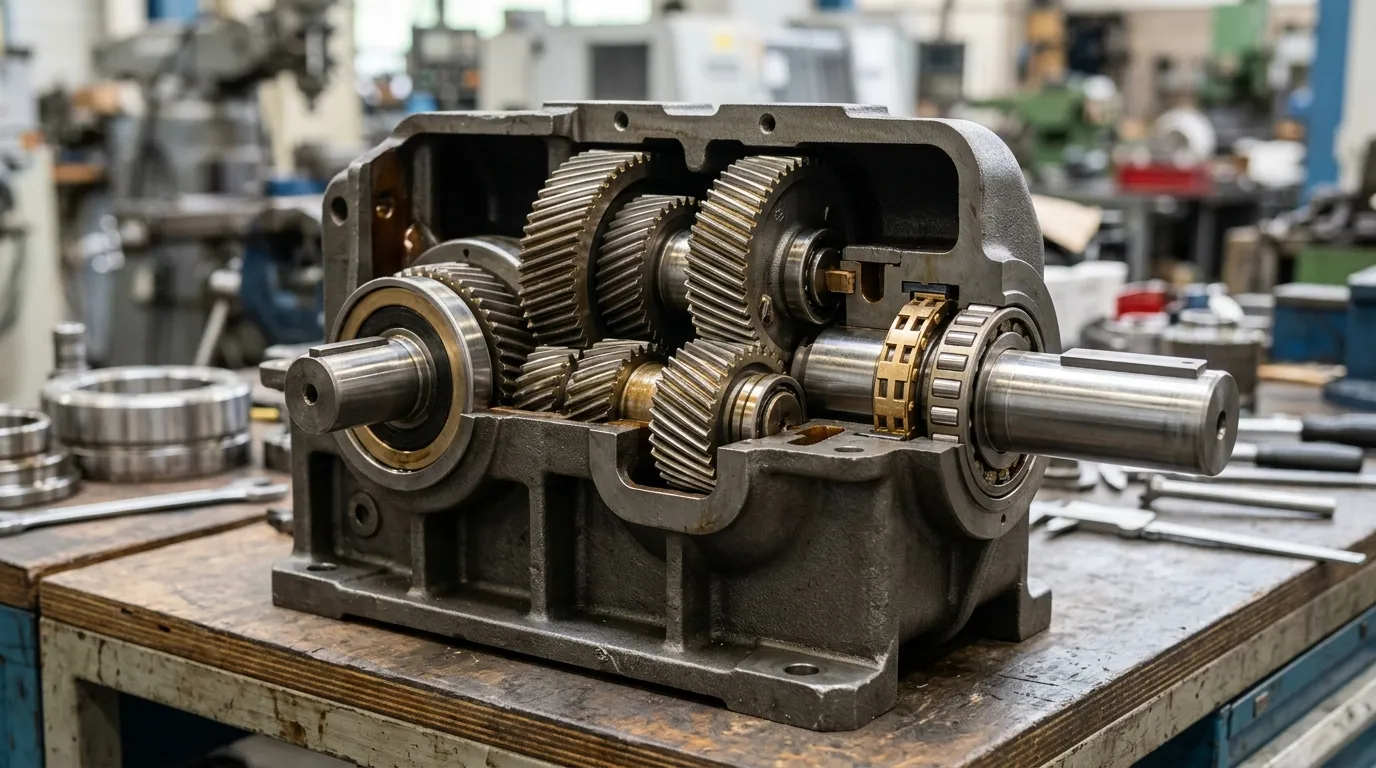
Torque capacity is not adjusted on a single gearbox — it is determined by the design and component selection. The output torque a gearbox can deliver is calculated as input torque multiplied by the gear ratio and the efficiency of the gearing, according to CMGear's guide on gear ratios. A 20:1 ratio at 98% efficiency transforms 50 lb-ft of input torque into approximately 980 lb-ft of output torque.
Manufacturers change torque capacity through four primary levers:
- Frame size: Larger gearboxes use larger gears, bearings, and shafts that can transmit higher torque loads without premature wear or failure. A small gearbox and a much larger gearbox can both be manufactured with a 25:1 ratio, as Industrial Gearbox Supply notes — but the larger unit will have a significantly higher torque rating.
- Gear type: Different gearing geometries handle different load levels. Helical gearing operates at 96–99% efficiency per stage, while worm gearing operates at 50–90% depending on ratio and lead angle, according to Malloy Electric's gearbox application guide. Planetary gearing achieves 96–99% efficiency per stage, and cycloidal reducers deliver 85–95%.
- Number of stages: Adding reduction stages multiplies torque. Two 5:1 stages combine to create a 25:1 overall ratio (5 × 5 = 25), as CMGear explains, enabling much higher torque multiplication than a single stage.
- Materials: Case-hardened steel gears handle higher loads than bronze or cast iron alternatives. Material selection directly affects torque capacity and service life.
A three-stage helical reducer at 98% efficiency per stage delivers approximately 94% overall efficiency — the product of the individual stage efficiencies, not the sum. This is why gearbox efficiency figures matter when comparing torque output claims across manufacturers.
How Are Gearbox Ratios Customized?
Gear ratio is the relationship between input speed and output speed, calculated as the number of driven gear teeth divided by the number of driver gear teeth. A gear with 60 teeth driving a gear with 20 teeth produces a 3:1 ratio, according to CMGear. The customization process follows a clear sequence:
- Define your requirements. Determine the required output speed (RPM) and the available input speed from your motor.
- Calculate the reduction ratio. Divide input RPM by the required output RPM. For example, a 1,450 RPM motor driving a conveyor at 58 RPM needs a 25:1 reduction.
- Select the gearbox type. Helical, worm, planetary, and cycloidal gearboxes each have different ratio ranges, efficiency profiles, and load capacities.
- Determine the number of stages. If a single-stage gearbox cannot achieve the required ratio efficiently, multiple stages are combined. Two 5:1 stages produce a 25:1 overall ratio.
- Engineer the gear set. The manufacturer designs the tooth counts for each gear pair to achieve the exact ratio, as well as the torque capacity needed for the application. Stober notes that customization extends to gearbox ratios for precise load and speed tuning.
The shaft or flange configurations that connect the gearbox to your motor and driven equipment are also fully customizable at this stage.
What Mounting Options Can Be Customized?
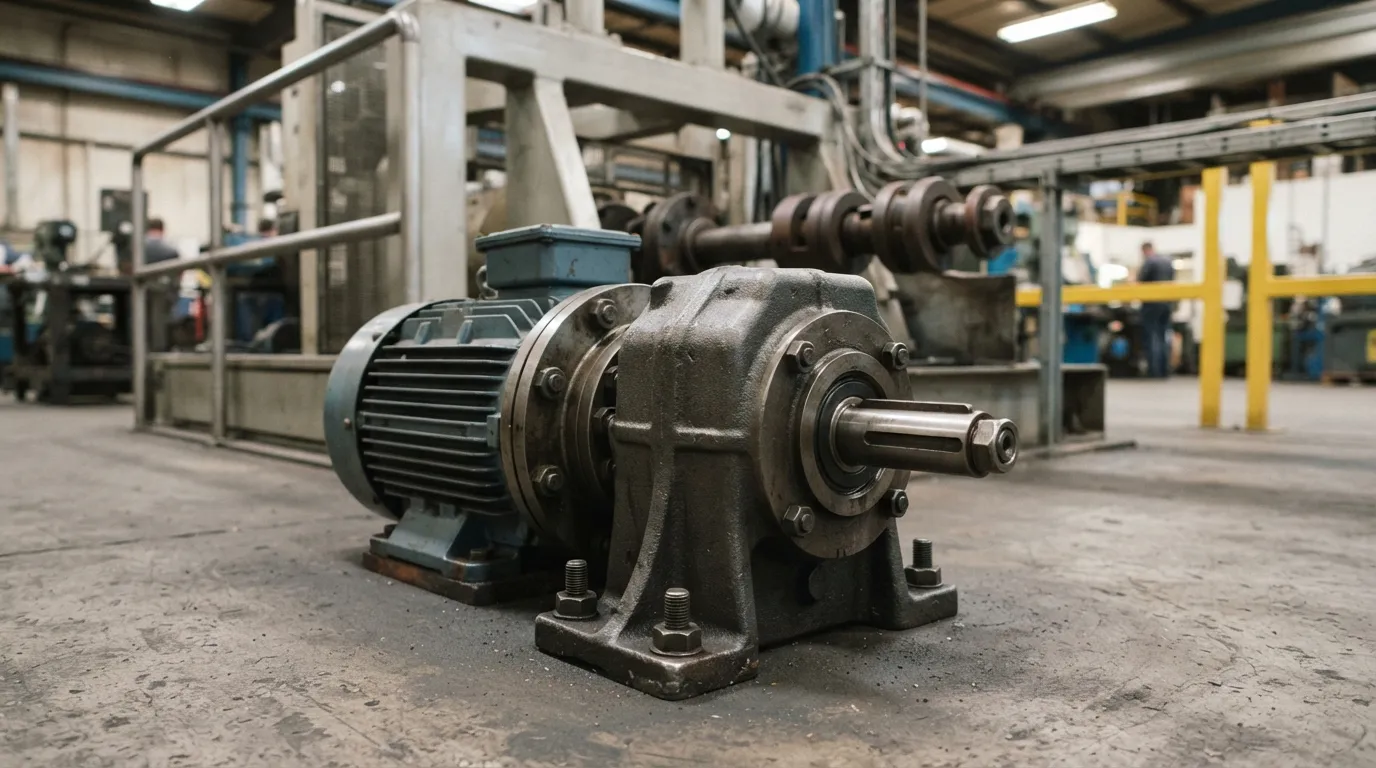
Mounting is the most visible and frequently customized parameter of an industrial gearbox. The physical interface between the gearbox, the motor, and the driven machine must align precisely for reliable operation.
Commonly customized mounting options include:
- Foot-mounted: The gearbox sits on a flat base with bolt holes. Foot patterns, hole sizes, and the distance between mounting holes can be customized to match existing equipment.
- Flange-mounted: A flange on the output side bolts directly to the driven machine. Flange diameters, bolt circle patterns, pilot diameters, and face dimensions can all be tailored.
- Shaft-mounted: The gearbox slides directly onto the driven shaft. Shaft diameter, keyway size, and locking mechanism (shrink disc, key, or friction grip) are customized to the shaft.
- Hollow bore: The output is a hollow shaft that fits over the driven shaft. Bore diameter, keyway, and torque arm mounting points are all configurable.
- Face-mounted: The input face is machined to match a specific motor flange pattern, including bolt circle and pilot diameter.
Venture Mfg Co. confirms that mounting options are a primary customization level in gearbox manufacturing. The key consideration is that your chosen mounting configuration affects installation cost and alignment requirements — a custom flange might add initial expense but reduce installation labor significantly.
Custom vs. Standard Gearbox — How to Decide
The decision between a standard and custom gearbox depends on how closely your application matches catalog specifications.
| Parameter | Standard Gearbox | Custom Gearbox |
|---|---|---|
| Ratio | Fixed catalog options | Any ratio within design limits |
| Torque rating | Fixed per frame size | Matched to application requirements |
| Mounting | Standard foot or flange patterns | Custom bolt patterns, shafts, flanges |
| Lead time | In stock or short lead time | 7–15 days typical for manufacturers like Mingye |
| Cost | Lower unit cost | Higher initial investment |
| Best for | Common, standard applications | Unique or demanding applications |
A standard gearbox works when your mounting dimensions, required ratio, and torque load all fall within the manufacturer's standard catalog ranges. According to Superior Gearbox Company, custom gearboxes require a higher initial investment but deliver lifecycle cost savings through reduced downtime and maintenance — the gearbox is built to fit your equipment precisely, eliminating adapters and alignment compromises.
Ratio alone does not determine whether you need a custom unit. Industrial Gearbox Supply emphasizes that the same ratio can be built in different sizes with different torque capacities — you must verify that the standard unit's torque rating meets your application's requirements, not just its ratio.
What Information Do I Need to Provide for a Custom Gearbox?
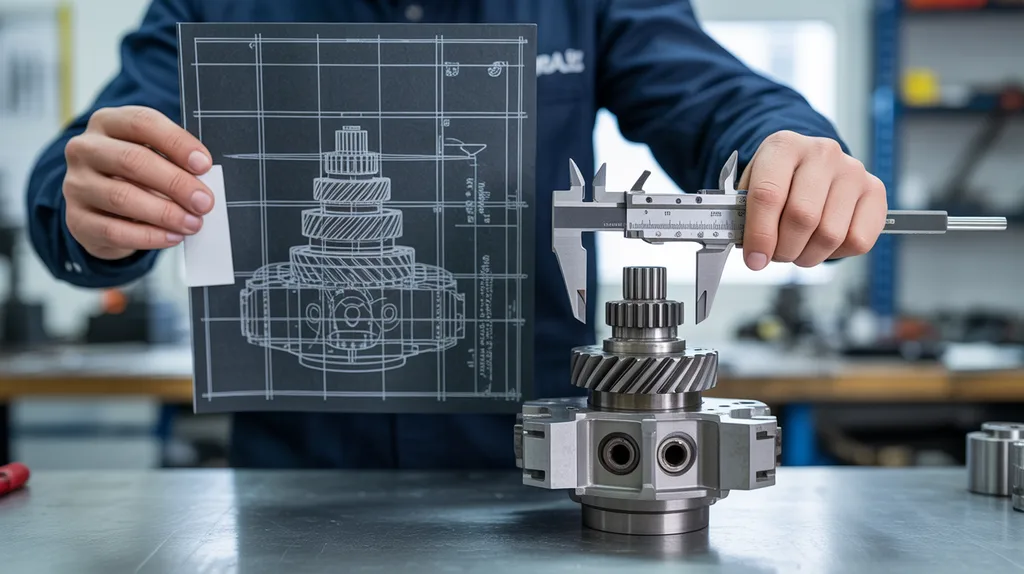
To get an accurate custom gearbox specification, you need to gather key operating parameters before contacting a manufacturer. According to Sumitomo Drive, manufacturers often use a reverse engineering approach — analyzing existing units, capturing critical dimensions, and evaluating gear geometry when a replacement is needed.
Prepare the following information:
- Input speed (RPM) and motor power (kW or HP)
- Required output speed (RPM) or the reduction ratio needed
- Required torque (N·m or lb-ft) and the service factor for your application
- Mounting type — foot, flange, shaft-mounted, or hollow bore
- Shaft dimensions — diameter, length, and keyway specifications
- Operating environment — temperature range, dust exposure, washdown requirements, chemical resistance
- Duty cycle and application type — conveyor, mixer, packaging line, or other driven equipment
Having these details ready speeds up the specification process significantly. The manufacturing process itself typically follows a clear sequence: initial consultation, CAD design, prototyping when needed, material selection, manufacturing, and quality control. Manufacturers like Mingye build both motors and reducers in their own CNC-equipped factory, which allows them to integrate the complete drive system rather than just the gearbox.
The Bottom Line
Gearboxes are genuinely customizable. Ratio and mounting are the most commonly tailored parameters, while torque capacity is adjusted through frame size, gearing type, and the number of reduction stages. The key is working with a manufacturer that builds both motors and reducers, so the entire drive system is optimized together rather than assembled from mismatched components. Mingye offers this integrated approach on modular, standardized designs, with OEM customization of mounting dimensions and transmission ratios. When your application demands specific torque, ratio, or mounting requirements, a custom gearbox is a practical, achievable solution.
Share on Social:


Contact Us
In This Article
Vertical-Axis Drives After Power Loss: Which Holding and Brake Data Must OEMs Verify?
Oct 14, 2026
Indexing Packaging Machines: Calculating Acceleration Torque From a Motion Profile
Oct 14, 2026
Changing an NMRV Worm Gearbox Ratio: Can You Keep the Existing Motor?
Oct 14, 2026
How to Check Overhung Load When a Chain Sprocket Is Moved Along a Gearbox Output Shaft
Oct 14, 2026