


 Home /
How to Calculate Gear Motor Torque and Speed?
Right Angle Geared Motor: Matching Electrical Supply, Variable Speed and Braking
Oct 26, 2026
Planning a Bevel Reducer Installation: Turn Shaft Requirements Into a Practical Drive Layout
Oct 26, 2026
Choosing an Overhead Crane Gearbox by Its Hoisting or Travel Function
Oct 26, 2026
Replacing an Industrial Worm Gearbox: What to Keep and What to Reassess
Oct 25, 2026
Gear motor torque and speed are calculated from the motor rating, gear ratio and gearbox efficiency: output speed = motor speed ÷ ratio, while output torque ≈ motor torque × ratio × efficiency. For machine-load sizing, also calculate load torque as force × pulley or shaft radius, then check continuous torque, peak torque, duty cycle and unit consistency before selecting a gear motor.
What is the basic gear motor torque and speed formula?
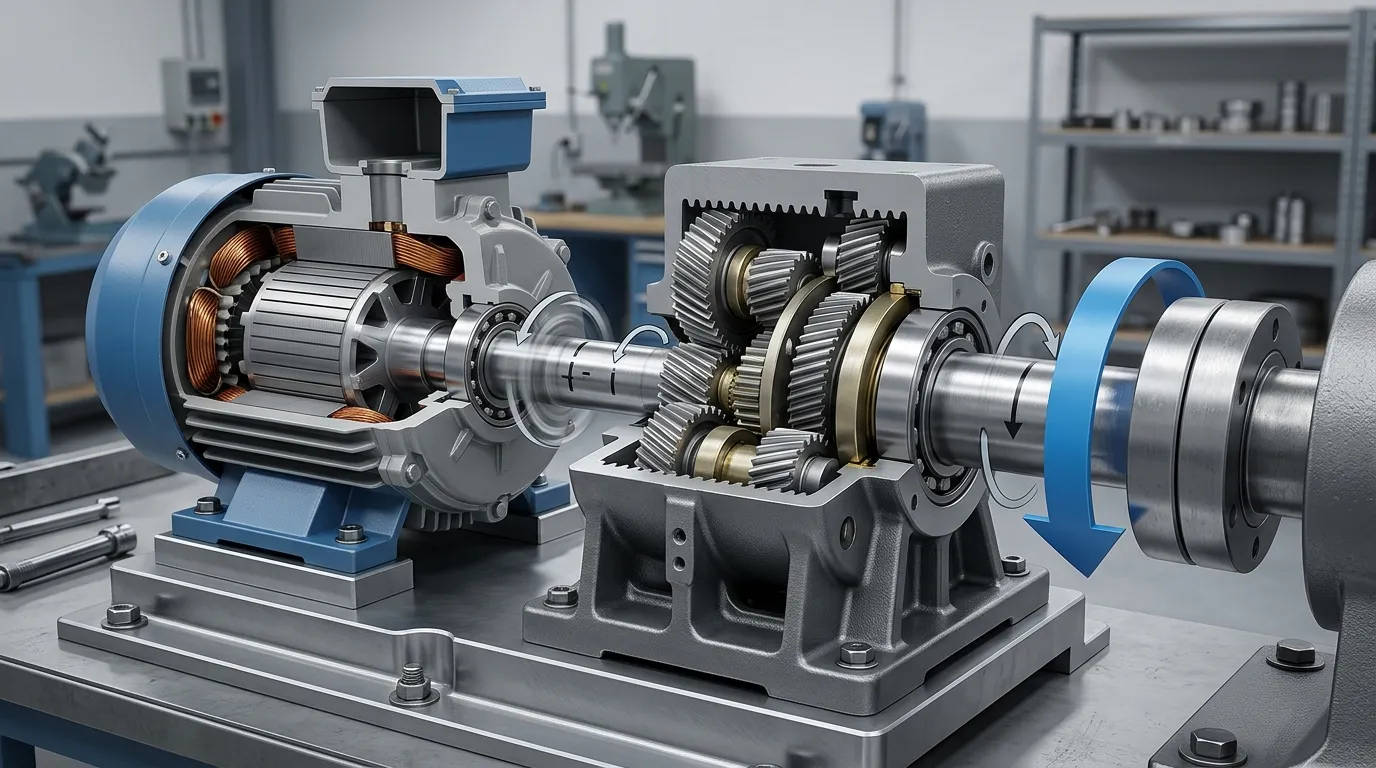
For a reduction gear motor, divide motor speed by the reduction ratio to calculate output speed. Estimate output torque by multiplying motor torque by the reduction ratio and gearbox efficiency:
\[ n{out}=\frac{n{motor}}{i} \]
\[ T{out}\approx T{motor}\times i\times\eta \]
Where:
| Variable | Meaning | Common unit |
|---|---|---|
| \(n_{motor}\) | Motor input speed | Revolutions per minute (RPM) |
| \(n_{out}\) | Gearbox output speed | RPM |
| \(i\) | Reduction ratio | For example, 20:1 |
| \(T_{motor}\) | Motor torque | Newton-meters (N·m), pound-feet or another torque unit |
| \(T_{out}\) | Estimated output torque | Same torque unit as motor torque |
| \(\eta\) | Gearbox efficiency | Decimal or percentage |
A reduction ratio trades speed for torque. The ideal calculation multiplies torque by the ratio, but real gearboxes lose some power through friction, gear interaction and lubrication. Use efficiency as a decimal in the equation: 75% becomes 0.75.
The ratio convention in these formulas is:
\[ i=\frac{\text{motor input speed}}{\text{gearbox output speed}} \]
Therefore, a 30:1 reduction means the motor turns approximately 30 times for each output-shaft revolution, before considering operating variation or speed-control equipment.
[DIAGRAM: Motor speed and torque entering a gearbox, with the reduction ratio and efficiency leading to lower output RPM and higher usable output torque.]
How do you calculate gear motor output speed?
Divide the motor’s input speed in RPM by the reduction ratio. For example, a 3,000 RPM motor with a 30:1 reduction ratio has a theoretical output speed of 100 RPM.
Output-speed calculation steps
- Record the motor speed.
Use the motor’s rated or operating speed in RPM.
- Confirm the ratio direction.
A reduction ratio such as 30:1 means the motor input speed is divided by 30.
- Divide motor speed by ratio.
\[ n_{out}=\frac{3,000}{30}=100\ \text{RPM} \]
- Check the result against the gearbox data.
A calculated speed is a starting point. Confirm the rated output speed under the intended motor frequency, load and operating conditions.
A higher reduction ratio produces lower output speed. If the target output speed is known but the ratio is not, use:
\[ i=\frac{n{motor}}{n{target}} \]
For example, a 1,500 RPM motor and a desired 75 RPM output require an approximate 20:1 ratio:
\[ i=\frac{1,500}{75}=20 \]
The nearest available standard ratio may produce a slightly different output speed, so verify the selected gearbox specification.
For more detail on choosing a practical ratio after calculating the target, see this guide to gearbox ratio selection.
How do you calculate gear motor output torque?
Multiply motor torque by the reduction ratio, then multiply by gearbox efficiency. A 1.3 N·m motor with a 29:1 ratio and 75% efficiency produces approximately 28.3 N·m of calculated output torque.
\[ T{out}\approx T{motor}\times i\times\eta \]
\[ T_{out}\approx1.3\times29\times0.75=28.275\ \text{N·m} \]
Rounded to the source example, the result is approximately 28.3 N·m.
Output-torque calculation steps
- Identify the motor’s rated torque.
- Confirm the gearbox reduction ratio.
- Convert efficiency from a percentage into a decimal.
- Multiply motor torque by the ratio.
- Apply efficiency.
- Compare the calculated result with the gearbox’s continuous and peak output ratings.
The calculated value is an estimate of usable output torque, not an automatic guarantee of the gearbox’s mechanical capacity. The selected gearbox may have separate limits for continuous torque, peak torque, radial load, axial load, thermal operation and service conditions.
| Torque term | Meaning | How to use it |
|---|---|---|
| Rated or continuous torque | Torque available for ongoing operation under stated conditions | Compare with continuous machine demand |
| Peak torque | Short-duration torque capability | Compare with starting, acceleration or impact demand |
| Stall torque | Torque at zero speed under specified motor conditions | Do not use as a normal continuous rating |
| Calculated output torque | Formula-based estimate after ratio and efficiency | Use for preliminary sizing |
| Allowable gearbox torque | Manufacturer’s mechanical limit | Do not exceed it |
A gearbox does not create power. Increasing torque through reduction is accompanied by a reduction in speed, and gearbox losses reduce the output power available.
Worked example: calculate output speed and torque step by step
If a motor runs at 1,500 RPM and produces 2.0 N·m of torque, a 20:1 gearbox with 80% efficiency produces a calculated output speed of 75 RPM and output torque of 32 N·m.
Given values
- Motor speed: 1,500 RPM
- Motor torque: 2.0 N·m
- Reduction ratio: 20:1
- Gearbox efficiency: 80% = 0.80
Step 1: Calculate output speed
\[ n{out}=\frac{n{motor}}{i} \]
\[ n_{out}=\frac{1,500}{20}=75\ \text{RPM} \]
Step 2: Calculate ideal torque before losses
\[ T{ideal}=T{motor}\times i \]
\[ T_{ideal}=2.0\times20=40\ \text{N·m} \]
Step 3: Apply gearbox efficiency
\[ T{out}\approx T{ideal}\times\eta \]
\[ T_{out}\approx40\times0.80=32\ \text{N·m} \]
The calculated result is therefore:
- Output speed: 75 RPM
- Estimated output torque: 32 N·m
The 32 N·m result should be treated as a preliminary calculation. Before selecting the gear motor, verify that the gearbox can continuously transmit the required torque and can withstand the application’s starting, acceleration and peak loads.
How do you calculate load torque from force and radius?
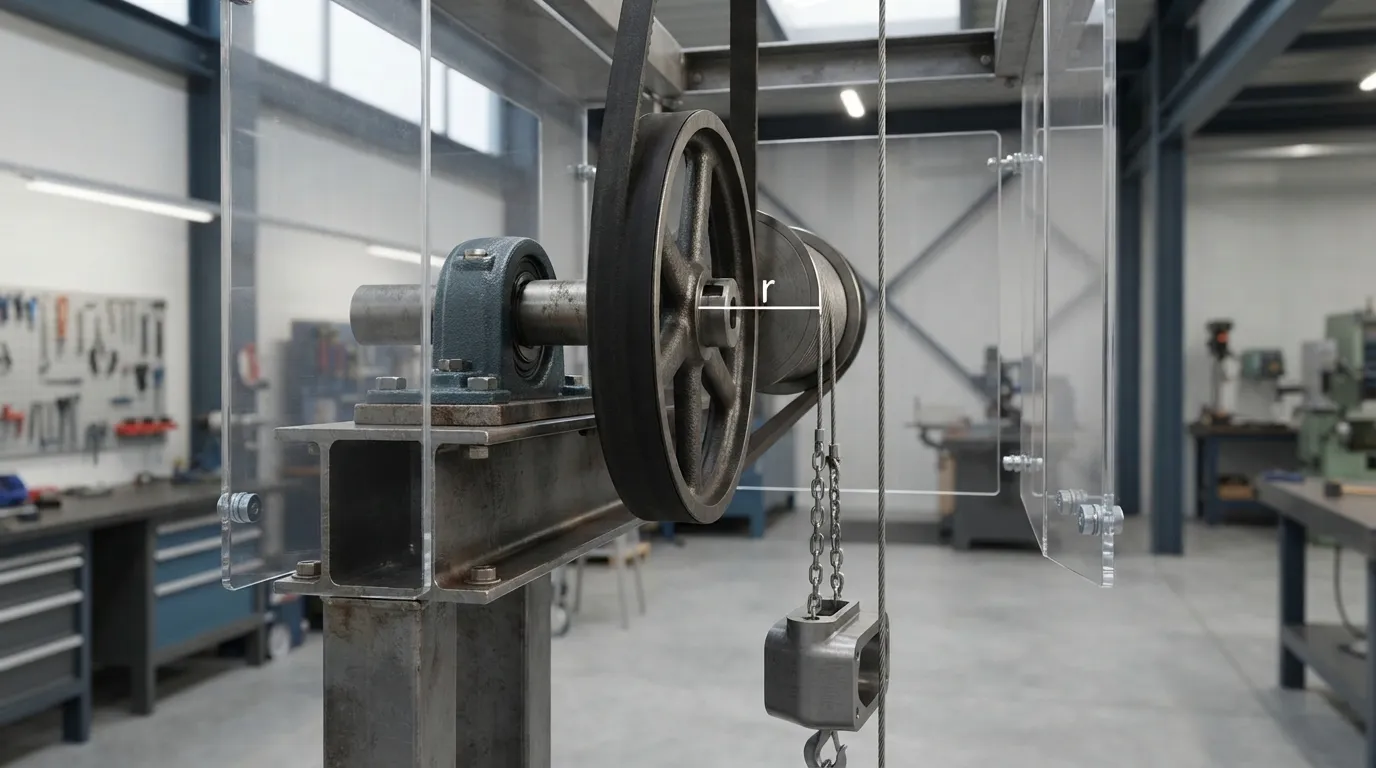
Calculate load torque by multiplying tangential force by the shaft or pulley radius:
\[ T_{load}=F\times r \]
Here, \(F\) is force in newtons and \(r\) is radius in meters. If the load is specified as a mass being lifted, first calculate force:
\[ F=m\times g \]
where gravitational acceleration is \(g=9.81\ m/s^2\).
According to Precision Microdrives, a 0.7 kg load lifted through a pulley with a 4 cm diameter has a 0.02 m radius and produces approximately 0.137 N·m of load torque.
Load-torque calculation steps
- Identify the load mass or tangential force.
- Convert mass into force using \(F=m\times9.81\) when appropriate.
- Measure the pulley or shaft radius.
- Convert the radius into meters when using newtons and N·m.
- Multiply force by radius.
- Add the effects of acceleration, friction, incline, shock or process resistance.
- Compare the resulting load torque with continuous and peak gear motor ratings.
Diameter is not radius
A common error is entering pulley diameter directly into the torque formula. The formula requires radius:
\[ r=\frac{d}{2} \]
A 4 cm diameter pulley therefore has a 2 cm radius, or 0.02 m. Using the full diameter would double the calculated torque.
How do torque, speed and power relate?
Torque and rotational speed together determine mechanical power. A gearbox changes the balance between speed and torque, but it does not create additional power; efficiency losses mean output power is lower than ideal input power.
The SI relationship is:
\[ P=T\times\omega \]
Where:
- \(P\) is mechanical power in watts.
- \(T\) is torque in N·m.
- \(\omega\) is angular speed in radians per second.
When a datasheet provides horsepower and RPM instead of torque, use a horsepower-based torque formula with the correct unit convention. Do not mix a horsepower formula for pound-feet with N·m values without converting the torque unit first.
Industrial Gearbox Supply presents a pound-foot relationship based on horsepower, efficiency and output RPM:
\[ T=\frac{5252\times HP\times\eta}{n_{out}} \]
The constant applies to the specified horsepower, RPM and pound-foot unit system. A different torque unit requires a different conversion.
Haydon Kerk Pittman gives an example using torque in ounce-inches and speed in RPM. Its calculation uses the factor \(7.4\times10^{-4}\) to obtain watts; 40 RPM and 1,400 oz-in produce 41.44 W in that example.
| Available motor data | Calculation route | Main caution |
|---|---|---|
| Motor torque and RPM | Use the ratio and efficiency formulas | Confirm whether torque is continuous, peak or stall |
| Power and RPM | Derive torque using a unit-specific power formula | Keep horsepower, RPM and torque units consistent |
| Load force and radius | Calculate load torque first | Include acceleration and resistance |
| Target output speed | Calculate the approximate reduction ratio | Check the nearest available ratio and actual output rating |
For a deeper explanation of converting mechanical torque and speed into motor power, see motor power from torque speed.
Which unit conversions cause gear motor calculation errors?
Most gear motor calculation errors come from mixing torque units, using pulley diameter instead of radius, treating efficiency as 75 instead of 0.75, or applying a power constant to the wrong unit system. Convert all inputs into one consistent system before calculating.
| Common error | Why it changes the result | Prevention |
|---|---|---|
| Using diameter as radius | Doubles the calculated pulley torque | Divide diameter by two |
| Entering 75 instead of 0.75 for 75% efficiency | Multiplies the efficiency term incorrectly | Convert percentage to a decimal |
| Mixing N·m with lb-ft | Produces an invalid numerical result | Convert all torque values first |
| Using millimeters or centimeters as meters | Changes the lever-arm scale | Convert distance units before calculating |
| Reversing the gear ratio | Gives the wrong output speed and torque | Define ratio as input speed ÷ output speed |
| Using an imperial power constant with metric torque | Produces the wrong power or torque | Match every formula to its stated units |
| Treating stall torque as continuous torque | Can lead to motor or gearbox overload | Use continuous and peak ratings separately |
A practical unit workflow is:
- Choose either a metric or imperial calculation system.
- Convert torque, force, distance and power into compatible units.
- Perform the calculation.
- Label the output unit.
- Convert the final result only after the calculation is complete.
Do not silently combine N·m, pound-feet, pound-inches, ounce-inches, millimeters and meters in the same equation.
How should duty cycle, safety factor and torque type affect the result?
A calculated torque value is only a starting point for gear motor selection. Confirm continuous torque for normal operation, peak torque for acceleration or shock, duty cycle and starting frequency, then apply a suitable safety factor without exceeding the gearbox’s allowable rating.
For intermittent operation, Haydon Kerk Pittman presents root-mean-square (RMS) torque as a method for assessing continuous motor torque. The gearbox must still accommodate the instantaneous peak torque, even when the average or RMS demand is lower.
Check these conditions before final selection:
- Required output RPM
- Continuous load torque
- Starting and acceleration torque
- Peak or shock load
- Duty cycle and starts per hour
- Motor rated speed and torque
- Gearbox efficiency
- Application safety factor
- Gearbox allowable output torque
- Radial and axial shaft loads
- Thermal and environmental conditions
- Mounting and shaft configuration
The safety factor should reflect the uncertainty and severity of the application. It should not be used to justify exceeding the gearbox’s mechanical or thermal rating.
Applications with substantial starting, shock or continuous-load demand require a separate high torque gear motor selection review rather than relying only on the ideal ratio formula.
What information is needed before selecting a gear motor?
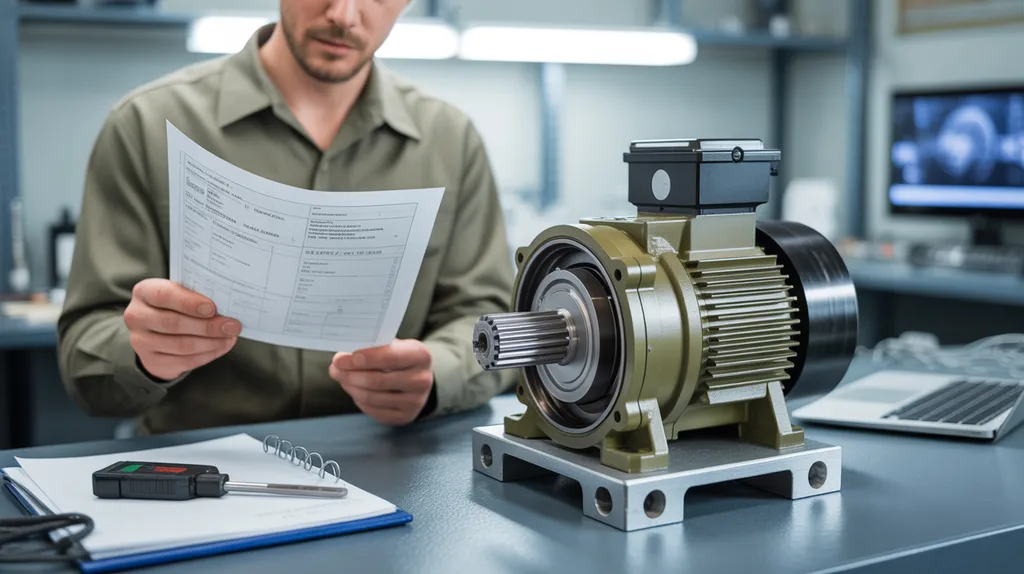
Before selecting a gear motor, collect the required output speed, continuous and peak torque, load geometry, duty cycle, motor power or torque, operating environment and mounting requirements. These inputs determine whether the calculated result is suitable for a real application.
Gear motor selection sequence
- Define the required output speed.
State the target RPM at the driven shaft.
- Calculate the load torque.
Use force × radius and include process resistance, acceleration and friction where relevant.
- Separate torque conditions.
Identify continuous, starting, acceleration, peak and shock torque.
- Estimate the reduction ratio.
Divide motor speed by target output speed.
- Apply efficiency.
Estimate usable output torque using the gearbox efficiency rather than the ideal ratio alone.
- Check the ratings.
Confirm continuous output torque, peak torque, thermal limits and allowable shaft loads.
- Confirm mechanical fit.
Check mounting dimensions, shaft arrangement and any application-specific requirements.
- Review the complete specification.
For an OEM-oriented specification process, use the gear reduction motor buying guide.
If the application data is incomplete, the what size gear motor guide can help organize the required load, speed and duty-cycle inputs.
Mingye designs and supplies industrial power-transmission equipment, including helical gear motors, heavy-duty industrial gearboxes, planetary reducers, worm gear motors, cycloidal reducers and motors. Its own CNC-equipped factory supports modular designs and OEM customization of mounting dimensions and transmission ratios. Those capabilities can be relevant after the required torque, speed, duty cycle and mounting data have been established.
Frequently asked questions
How do I calculate the RPM of a gear motor?
Divide the motor’s input RPM by the gearbox reduction ratio. For example, a 1,500 RPM motor with a 20:1 ratio has a calculated output speed of 75 RPM. Confirm the actual rated output speed in the gearbox documentation because motor frequency, speed control, load and operating conditions can affect the final result.
Does a gearbox increase motor power?
No. A gearbox trades speed for torque and reduces output power through mechanical losses. A reduction ratio can increase output torque while lowering output speed, but it does not create energy. Include gearbox efficiency when estimating output torque, and use torque, RPM and power together as a consistency check.
Should I use motor rated torque or stall torque?
Use rated or continuous torque for normal operating demand, and check peak torque for acceleration, shock or intermittent loads. Stall torque describes a zero-speed motor condition and should not be treated as a continuous operating rating. The gearbox’s allowable torque must also accommodate the application’s highest expected load.
How do I calculate torque for a pulley-driven load?
Multiply tangential force by pulley radius: \(T=F\times r\). For a lifting load, calculate force from mass × 9.81 m/s², then multiply by radius in meters. If the pulley dimension is diameter, divide it by two before using it in the torque calculation. Add acceleration and resistance where applicable.
How do I calculate the required gear ratio?
Divide motor speed by the desired output speed. For example, a 1,500 RPM motor intended to run at 75 RPM requires an approximate 20:1 reduction ratio. Select the nearest suitable available ratio, then verify the resulting output speed, torque, efficiency, duty cycle and gearbox ratings.
Share on Social:


Contact Us
In This Article
Right Angle Geared Motor: Matching Electrical Supply, Variable Speed and Braking
Oct 26, 2026
Planning a Bevel Reducer Installation: Turn Shaft Requirements Into a Practical Drive Layout
Oct 26, 2026
Choosing an Overhead Crane Gearbox by Its Hoisting or Travel Function
Oct 26, 2026
Replacing an Industrial Worm Gearbox: What to Keep and What to Reassess
Oct 25, 2026