


 Home /
Top 10 Gear Motor Manufacturers in the World 2026
Vertical-Axis Drives After Power Loss: Which Holding and Brake Data Must OEMs Verify?
Oct 14, 2026
Indexing Packaging Machines: Calculating Acceleration Torque From a Motion Profile
Oct 14, 2026

Changing an NMRV Worm Gearbox Ratio: Can You Keep the Existing Motor?
Oct 14, 2026
How to Check Overhung Load When a Chain Sprocket Is Moved Along a Gearbox Output Shaft
Oct 14, 2026
The top gear motor manufacturers for 2026 are best compared by product range, industrial application fit, published torque and power data, customization, engineering support and delivery evidence—not by brand recognition alone. This guide presents ten established manufacturers as an application-oriented shortlist and explains which supplier characteristics matter when sourcing gear motors for OEM and industrial equipment.
How We Evaluated the Top Gear Motor Manufacturers
The manufacturers are evaluated against the same commercial and technical criteria: product breadth, gearmotor type coverage, industrial relevance, published technical information, customization, engineering support, delivery evidence and suitability for common applications.
A global ranking cannot be completely objective because manufacturers serve different segments. Some specialize in miniature direct-current gearmotors or precision reducers, while others focus on industrial gear units, integrated drives or heavy-duty transmission equipment. The list below should therefore be read as a structured shortlist rather than a universal market-share ranking.
| Evaluation criterion | What to check | Why it matters |
|---|---|---|
| Product range | Helical, bevel, worm, planetary, cycloidal, parallel-shaft or other designs | Determines whether the supplier can match the machine requirement |
| Industrial relevance | Conveying, mixing, packaging, mining, plastics, cement, power or other applications | Shows whether the supplier serves comparable operating conditions |
| Technical evidence | Torque, power, speed, ratio, thermal and load information | Helps engineers verify suitability |
| Customization | Mounting dimensions, shaft arrangements, ratios and other modifications | Important for OEM integration and replacement projects |
| Engineering support | Selection assistance, drawings, documentation and application support | Reduces specification and installation risk |
| Lead-time evidence | Published or quotation-based delivery information | Helps procurement planning |
| Service support | Spare parts, warranty, regional support and maintenance information | Affects lifecycle risk |
Where a company does not publish a comparable figure or condition, the information should be treated as not publicly stated rather than assumed.
What Is a Gear Motor, and How Is It Different From a Gearbox?
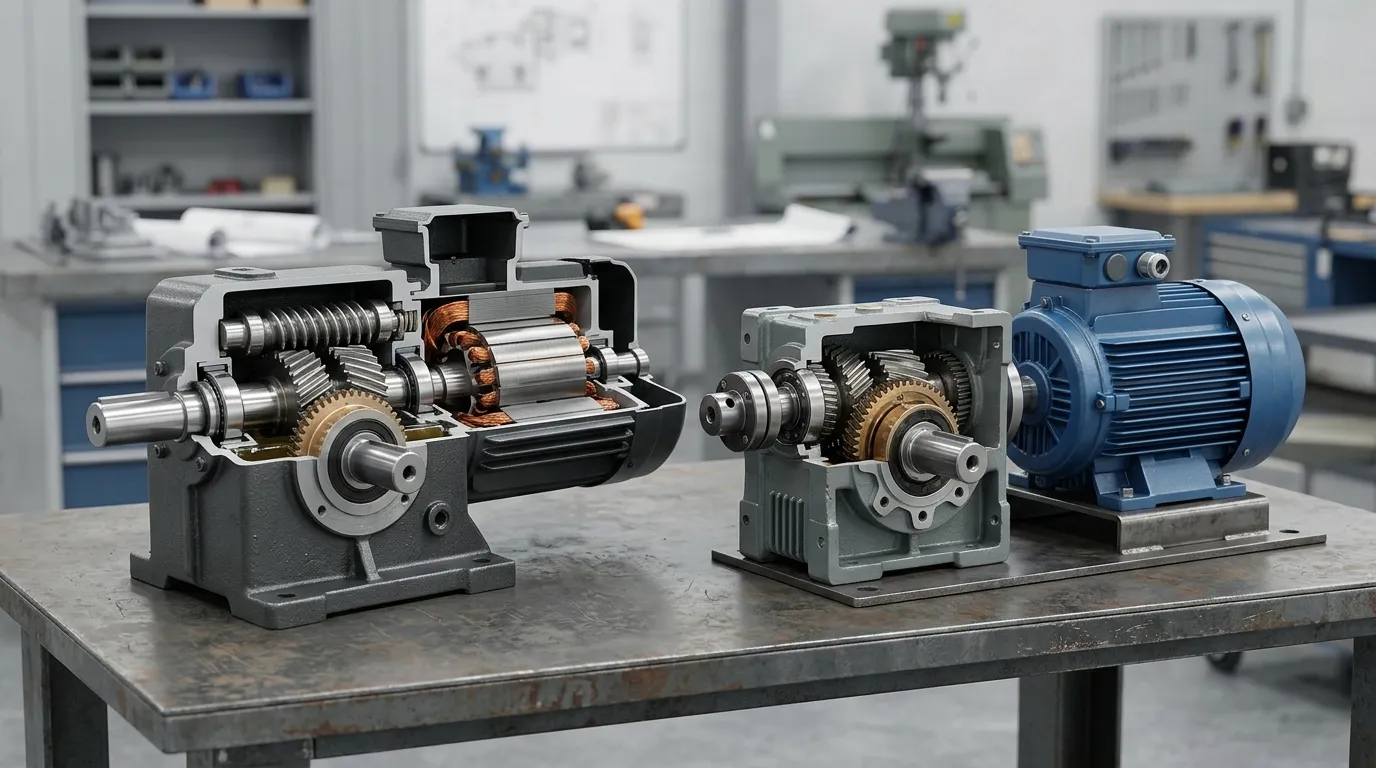
A gear motor combines an electric motor and a gearbox in one drive unit. The gearing reduces output speed and increases available output torque compared with the motor operating without reduction.
According to Kissling, an integrated gear motor can reduce the need for separate couplings and alignment between a motor and gearbox. A standalone industrial gearbox, by contrast, normally requires a separate motor and connection arrangement.
| Product type | Includes motor? | Typical use | Main information to compare |
|---|---|---|---|
| Integrated gear motor | Yes | Compact machine drives and OEM equipment | Motor power, output torque, speed, ratio and mounting |
| Standalone industrial gearbox | No | Heavy-duty or configurable drive systems | Gear ratio, torque, thermal capacity and motor compatibility |
| Precision reducer | Usually no | Robotics, automation and positioning | Backlash, accuracy, ratio and permissible loads |
| Miniature or direct-current gearmotor | Usually yes | Compact equipment and light-duty mechanisms | Voltage, speed, torque, dimensions and duty cycle |
A gearbox ranking is not automatically a gearmotor ranking. Readers comparing separate reduction units can also review top industrial gearbox manufacturers before deciding whether an integrated drive or separate gearbox is more appropriate.
The Top 10 Gear Motor Manufacturers in the World
The following companies appear in established manufacturer comparison lists covering industrial gearmotors, reducers, precision drives or related transmission equipment. Final procurement decisions should be based on each company’s current official product documentation and a quotation for the required configuration.
The ranking emphasizes product relevance and the amount of comparable information available to buyers. Torque, power, lead time, customization and engineering support are not stated as facts unless the manufacturer publishes them for the specific product range.
| Rank | Manufacturer | Main comparison focus | Suitable evaluation question |
|---|---|---|---|
| 1 | SEW-EURODRIVE | Industrial gearmotors and drive systems | Does the required drive configuration and support model fit the project? |
| 2 | FLENDER | Industrial gear units and drive technology | Is the product intended for the required torque, duty and installation? |
| 3 | NORD Drivesystems | Industrial drives and gearmotors | Can the supplier provide the required motor, reducer and accessories as a system? |
| 4 | Sumitomo Drive Technologies | Industrial reducers and drive systems | Does the selected reducer type match the load and operating cycle? |
| 5 | Bonfiglioli | Gearmotors, reducers and motion products | Are the relevant product family and application data documented? |
| 6 | Lenze | Integrated drive and automation solutions | Is the supplier appropriate for the motor, gearbox and control architecture? |
| 7 | Harmonic Drive | Precision reduction technology | Does the application require precision reduction rather than a conventional industrial gearmotor? |
| 8 | Nabtesco | Precision and industrial reduction products | Are the load, accuracy and duty requirements within the selected product’s documentation? |
| 9 | Faulhaber | Miniature motors and gearmotor systems | Is the application compact or precision-oriented rather than heavy industrial? |
| 10 | Nidec | Motors and related drive products | Can the required motor, gearmotor configuration and support be documented for the application? |
1. SEW-EURODRIVE
SEW-EURODRIVE is included as an industrial drive-system manufacturer in the retrieved comparison results. Buyers should assess its current official catalogue for the exact gearmotor families, motor powers, output torque ranges, mounting options, control integration and service coverage required by the project.
The important procurement question is not simply whether the company supplies gearmotors. It is whether the selected configuration meets the machine’s output speed, torque, duty cycle, environmental conditions and installation constraints.
2. FLENDER
FLENDER is included among established industrial gearbox and drive-technology manufacturers. Its suitability should be checked against the required gear unit type, torque, power, thermal conditions, shaft arrangement and connection to the selected motor.
Buyers should request current technical documentation for the specific configuration. A broad industrial product portfolio does not by itself confirm that every model is appropriate for conveying, mixing, mining, cement or other demanding applications.
3. NORD Drivesystems
NORD Drivesystems describes itself as a drive-technology manufacturer offering speed reducers, gear motors and alternating-current vector drives. The company is therefore relevant to buyers comparing integrated industrial drive packages.
The selection process should confirm the exact gearmotor series, output torque, power, speed range, ratio, mounting arrangement and control requirements. Service, spare-parts and delivery information should be checked for the destination market rather than assumed from the company’s international presence.
4. Sumitomo Drive Technologies
Sumitomo Drive Technologies is included in the retrieved global manufacturer comparison. Buyers should distinguish between its different reducer and drive categories and identify whether the project requires a conventional gearmotor, a heavy-duty gearbox, a precision reducer or another drive configuration.
The quotation should state the operating conditions behind any torque, power, efficiency or service-factor value. If the manufacturer does not publish a comparable figure for the requested model, the buyer should obtain it directly before approving the design.
5. Bonfiglioli
Bonfiglioli is included among established industrial gearbox and gearmotor suppliers. A product-category page retrieved during the comparison displayed helical, parallel-shaft, bevel, cycloidal, worm and three-phase gearmotor categories, illustrating the range of gearmotor designs buyers may need to compare.
The correct choice depends on the application. A worm gearmotor, for example, should not be treated as interchangeable with a helical, bevel or cycloidal unit without checking efficiency, load, duty cycle, speed ratio and thermal requirements.
6. Lenze
Lenze is included in the retrieved manufacturer comparisons as a supplier associated with drive and automation solutions. Buyers considering Lenze should define whether they need a motor, gearmotor, reducer, drive control or complete motion system.
The quotation should separate the mechanical and electrical parts of the proposed solution. Engineers should confirm output torque, motor power, speed, ratio, control compatibility, mounting dimensions and any required accessories.
7. Harmonic Drive
Harmonic Drive is included in global manufacturer comparisons because of its precision-reduction focus. Precision reducers should be evaluated differently from standard industrial gearmotors.
Relevant questions include required positioning accuracy, backlash, permissible radial and axial loads, ratio, duty cycle, speed and integration with the motor and control system. A precision reducer may be unsuitable where the application primarily requires high-throughput industrial conveying or heavy-duty material handling.
8. Nabtesco
Nabtesco is included among manufacturers associated with precision and industrial reduction products. Buyers should first establish whether the required application is a precision motion system or a conventional industrial power-transmission machine.
The supplier comparison should document the required torque, speed, ratio, load direction, duty cycle and installation dimensions. Product categories should not be compared solely by brand name because precision reducers and general industrial gearmotors solve different mechanical problems.
9. Faulhaber
Faulhaber appears in the retrieved top-ten gearmotor comparisons as a manufacturer associated with miniature and precision motor systems. It may be more relevant to compact equipment, instrumentation, automation or other applications where size and controlled motion are central requirements.
Buyers working on mining, cement, ports, large conveyors or heavy mixing equipment should verify that the selected product is intended for the required load and duty. Miniature motor expertise does not automatically establish suitability for heavy industrial transmission.
10. Nidec
Nidec is included in the retrieved manufacturer comparisons as a motor and drive-product supplier. Its relevance should be evaluated by identifying the exact motor or gearmotor product family and confirming that the product is available for the required application and configuration.
The buyer should request current documentation covering motor power, output torque, speed, transmission ratio, mounting, environmental conditions, support and delivery. Where those details are not publicly stated, they should remain open procurement questions.
Which Gearmotor Types Should Buyers Compare?
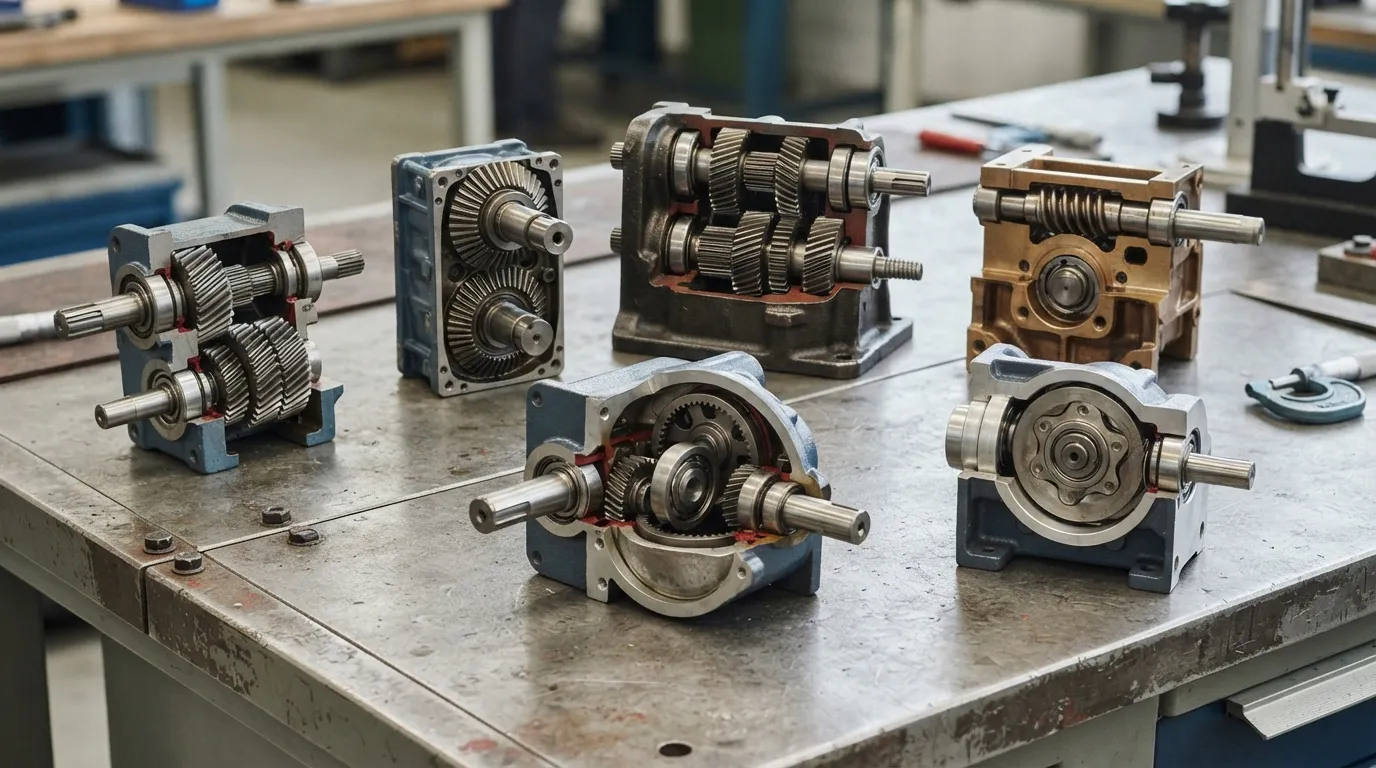
Common gearmotor and reducer types include helical, bevel, parallel-shaft, worm, planetary, cycloidal and spur designs. Each type has different trade-offs in efficiency, compactness, load capability, speed reduction, precision, cost and installation.
| Gearmotor type | Typical strengths | Main checks | Common application fit |
|---|---|---|---|
| Helical | Efficient and suitable for many industrial drives | Torque, noise, ratio, mounting and thermal conditions | Conveyors, mixers, packaging and general machinery |
| Bevel-helical | Changes drive direction while supporting industrial loads | Shaft arrangement, load, ratio and installation space | Conveying and machinery with right-angle layouts |
| Parallel-shaft | Compact arrangement for parallel input and output shafts | Radial loads, shaft design and mounting | Conveyors and material-handling equipment |
| Worm | Compact right-angle reduction arrangement | Efficiency, heat, duty cycle and output load | Compact machinery and selected industrial drives |
| Planetary | High torque density and compact reduction | Load, accuracy, ratio, thermal limits and backlash | Heavy-duty or precision applications |
| Cycloidal | High reduction capability and robust reduction mechanism | Torque, shock loading, speed and maintenance | Industrial machinery and demanding cyclic loads |
| Spur or miniature | Compact and simple for smaller mechanisms | Voltage, speed, torque, dimensions and duty | Small equipment and compact automation |
A helical geared motor is one common option, but gear type should be selected from the load and machine requirements rather than from the product name alone.
How Do You Choose a Gear Motor Manufacturer?
Choose a gear motor manufacturer by matching the supplier’s documented product, technical range, customization process and support model to the machine’s actual operating requirements. Catalogue breadth is useful, but it does not replace configuration-specific verification.
1. Define the driven machine and duty cycle
State whether the gearmotor will drive a conveyor, mixer, packaging machine, plastics line, mining system, cement process, port installation or another application. Record operating hours, starts and stops, reversing, shock loading and expected duty cycle.
2. Specify output torque and power
Output torque is the turning force available at the gearbox shaft. Motor power describes the rate at which the motor performs work. Both values must be matched to the driven load and operating conditions.
3. Specify input speed, output speed and transmission ratio
Transmission ratio is the relationship between input speed and output speed. The quotation should state the required output revolutions per minute and the ratio used to achieve it.
4. Select the gear type
Compare helical, bevel, parallel-shaft, worm, planetary and cycloidal designs according to efficiency, space, load, shock, duty cycle and right-angle or inline requirements.
5. Confirm mounting and shaft arrangements
Provide mounting dimensions, flange or foot requirements, shaft orientation, hollow or solid shaft requirements and any interchangeability constraints. Small dimensional differences can prevent direct replacement.
6. Check environmental and thermal conditions
State dust, moisture, corrosion, ambient temperature, washdown, outdoor exposure and other conditions. The supplier should confirm that the proposed configuration is suitable for the operating environment.
7. Confirm customization and engineering support
Ask whether the manufacturer can modify mounting dimensions, transmission ratios, shaft arrangements or other OEM requirements. Request drawings and technical approval before production.
8. Compare delivery, service and documentation
Confirm the delivery basis, technical documents, warranty, spare parts and after-sales support in writing. Do not treat a general company statement as a guaranteed lead time for every configuration.
OEM buyers can use this gear reduction motor buying guide to organize the supplier evaluation. If the required motor size is still unclear, review the information needed to determine what size gear motor the application requires.
What Should a Gear Motor RFQ Include?
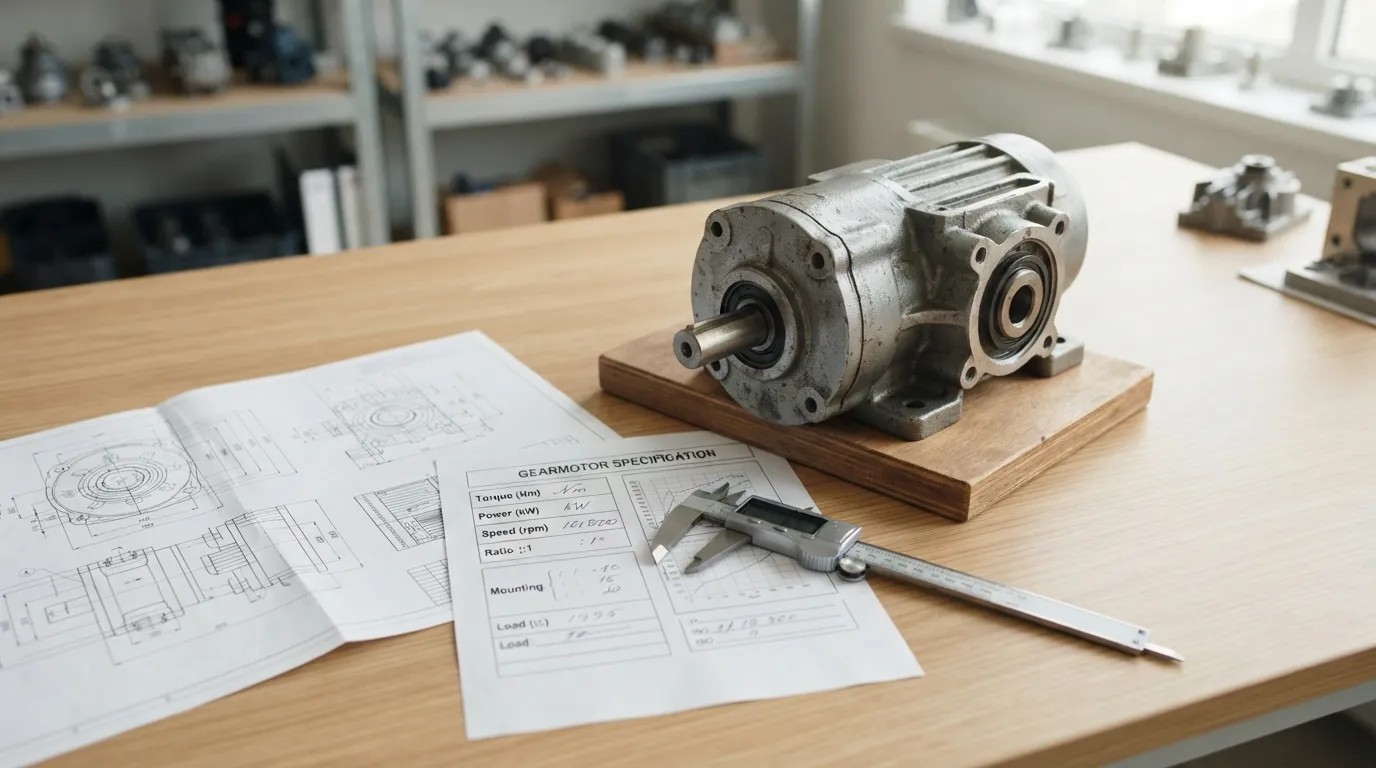
A gearmotor request for quotation should include the application, load, torque, power, speed, ratio, duty cycle, mounting, environment, controls and delivery requirements. Missing technical inputs make supplier quotations difficult to compare.
| RFQ input | Why the manufacturer needs it | What to compare |
|---|---|---|
| Driven machine | Establishes the application and load pattern | Relevant product family and application experience |
| Output torque | Defines required shaft force | Rated and peak torque under stated conditions |
| Motor power | Defines motor capacity | Rated power and operating margin |
| Input/output speed | Establishes the operating point | Speed range and ratio |
| Duty cycle | Shows how often and how hard the unit operates | Thermal and service requirements |
| Shaft and mounting | Determines mechanical integration | Drawings, dimensions and interchangeability |
| Environment | Defines operating conditions | Protection, thermal and material requirements |
| Voltage and controls | Determines electrical compatibility | Motor, inverter, brake and control options |
| Accessories | Identifies additional equipment | Brake, encoder, coupling or other components |
| Customization | Defines OEM modifications | Standard or engineered configuration |
| Delivery location | Affects quotation and logistics | Stated delivery basis and timing |
| Documentation | Supports approval and installation | Drawings, manuals, datasheets and warranty |
What Should Buyers Verify Before Selecting a Supplier?
Buyers should verify that every published claim applies to the requested configuration and operating conditions. A general product catalogue does not confirm the performance, lead time or certification status of a particular gearmotor.
- Confirm the exact model and configuration.
- Check torque, power, speed and ratio under stated conditions.
- Verify mounting dimensions, shaft arrangement and interchangeability.
- Confirm environmental, thermal and load limits.
- Request current technical drawings and operating manuals.
- Confirm the scope and approval process for customization.
- Obtain written delivery and warranty terms.
- Check spare-parts and after-sales arrangements for the installation location.
- Compare quotations using the same technical assumptions.
- Record any information the supplier has not publicly stated.
A common mistake is comparing a miniature gearmotor, precision reducer, standalone gearbox and heavy-duty industrial gearmotor as though they were equivalent products. Another is accepting a third-party ranking, certification badge or generic “high quality” statement as proof that a product suits a particular machine.
About Mingye, the Publisher and Manufacturer
Mingye is the publisher of this comparison and a manufacturer of industrial power-transmission equipment. Mingye should be evaluated as a separate supplier using the same application data and technical questions required from any manufacturer; it is not presented as an independently ranked global winner.
Shanghai Mingye Machinery Co., Ltd. is located in Jinshan District, Shanghai. The company designs, makes and supplies more than 20 series of industrial power-transmission equipment, including:
- R, S, K and F series helical gear motors
- HB series heavy-duty industrial gearboxes
- Heavy-duty planetary reducers
- NMRV worm gear motors
- Cycloidal pinwheel reducers
- Cylindrical gear reducers
- Three-phase asynchronous motors
- Small gear motors
- Special reducers for rubber and plastics machinery
- Reducers for welding rotators and paddle mixers
Mingye builds both motors and reducers in its own CNC-equipped factory using modular, standardized designs. The company offers OEM customization of mounting dimensions and transmission ratios and normally delivers in 7–15 days; the stated delivery period should be confirmed for the selected product and order conditions.
Mingye serves OEMs and plant engineers working with plastics and rubber, mixing, conveying, material handling, packaging, mining, cement, power and port applications. Additional company information is available on the about us page.
Final Selection Checklist
The right gear motor manufacturer is the supplier that can document a suitable configuration, operating range, customization path, support model and delivery commitment for the specific machine.
Before placing an order, confirm that:
- The gearmotor type matches the application.
- Torque, power, speed and ratio are documented.
- Mounting and shaft dimensions fit the machine.
- Duty and environmental conditions are covered.
- Customization requirements are technically supported.
- Drawings and technical documentation are available.
- Engineering support is adequate for the project.
- Lead time and warranty terms are written clearly.
- Spare-parts and after-sales arrangements are acceptable.
- All quotation assumptions are comparable.
Frequently Asked Questions
Who are the top gear motor manufacturers in the world?
The ten manufacturers in this guide form an application-oriented shortlist based on product relevance and publicly available supplier information. The ranking is not a universal market-share ranking because manufacturers specialize in different areas, including industrial gearmotors, heavy-duty gear units, precision reducers, miniature motors and complete drive systems.
How do I choose the best gear motor manufacturer?
Compare product type, torque and power range, output speed, ratio, mounting, duty cycle, environment, customization, engineering support, delivery evidence, spare parts and warranty. The most suitable manufacturer is the one that can document a configuration matching the machine’s actual mechanical and operating requirements.
What information should I provide when requesting a gear motor quotation?
Provide the application, driven load, output torque and power, input and output speed, ratio, duty cycle, mounting dimensions, shaft arrangement, environment, motor voltage, controls, accessories, delivery location and target date. These details help manufacturers select and quote comparable gearmotor configurations.
What is the difference between a gear motor and an industrial gearbox?
A gear motor integrates the electric motor and gearbox into one drive unit. An industrial gearbox is generally a separate reduction unit that requires a motor and connection arrangement. The choice depends on the machine layout, torque, speed, mounting, controls, duty cycle and service requirements.
Which gearmotor type should I choose?
The appropriate type depends on the required torque, speed ratio, efficiency, space, load, duty cycle and environment. Helical, bevel, parallel-shaft, worm, planetary and cycloidal designs each have different operating characteristics. The manufacturer should confirm the selected design against the complete application data.
Request a Configuration Review
If you are sourcing a gear motor for an OEM machine or plant application, send Mingye the required torque, speed, transmission ratio, mounting dimensions and operating conditions. Mingye can review the application and provide information on a suitable product configuration, customization requirements and quotation basis.
Share on Social:


Contact Us
In This Article
Vertical-Axis Drives After Power Loss: Which Holding and Brake Data Must OEMs Verify?
Oct 14, 2026
Indexing Packaging Machines: Calculating Acceleration Torque From a Motion Profile
Oct 14, 2026
Changing an NMRV Worm Gearbox Ratio: Can You Keep the Existing Motor?
Oct 14, 2026
How to Check Overhung Load When a Chain Sprocket Is Moved Along a Gearbox Output Shaft
Oct 14, 2026