


 Home /
Planetary Gearbox vs Spur Gearbox: What's the Difference?
Rubber Internal Mixer Gearbox: Read the Batch Load Profile, Not Just Motor kW
Oct 22, 2026
Hot Industrial Gearbox Coupling After Cold Alignment: What to Check
Oct 22, 2026
Hydraulic Slewing Drive Won't Rotate: Separate Motor, Brake and Gearbox Faults
Oct 22, 2026
Calender Roll Gap Changes: What Must the Drive Coupling Accommodate?
Oct 22, 2026
A planetary gearbox shares load across several planet gears meshing with a sun gear and ring gear, so it delivers high torque in a small, coaxial package. A spur gearbox uses straight-cut gears on parallel offset shafts, where each stage transmits load through a single tooth pair — simpler, cheaper and easier to service, but bulkier for the same torque.
Key takeaways
- Load path is the root difference: a planetary gearbox splits torque across three or four planet gears, while a spur gearbox concentrates it on one tooth pair per stage.
- Planetary gearboxes win on torque density and coaxial compactness; spur gearboxes win on simplicity, cost and service access.
- Per-stage efficiency is close. According to Cotta, LLC, planetary gearboxes run at 94–98% per stage and spur gearboxes at 96–99% per stage, so stage count often matters more than architecture.
- According to Precision Microdrives, spur gearboxes cost less to produce because they need fewer gears and a simpler manufacturing process.
- Low-backlash duty points toward planetary designs; standard backlash tolerance and tight budgets point toward spur designs (Cotta, LLC).
- Planetary gearboxes run hotter in compact housings and are harder to repair in place, while spur gearboxes allow component-level repair with standard tools.
Planetary Gearbox vs Spur Gearbox: The Short Answer
A planetary gearbox suits compact, high-torque, low-backlash drives. A spur gearbox suits simple, low-cost drives where space is less critical and service access matters more.
The single decision that separates them is the load path. In a planetary unit, several planet gears share the transmitted torque inside a ring gear, so the housing can be short and coaxial with the motor. In a spur unit, one tooth pair carries the stage load, so the housing grows with every stage and the shafts sit parallel and offset.
| Priority | Choose planetary | Choose spur |
|---|---|---|
| Torque density | High torque in a small envelope | Requires a larger envelope for the same torque |
| Envelope and layout | Coaxial, short axial length | Parallel offset shafts, longer housing per stage |
| Ratio above roughly 10:1 | Favoured, and multi-stage units stack in the same footprint | Possible but the housing grows longer with each stage |
| Backlash | Suits low-backlash requirements | Suits standard backlash tolerance |
| Budget | Higher component count and manufacturing complexity | Lower production cost |
| Service access | Often needs assembly replacement or factory rebuilding | Component-level repair with standard tools |
| Continuous-duty heat | Higher heat density in a compact housing | Better heat dissipation from open layouts |
What Is a Planetary Gearbox?
A planetary gearbox, also called an epicyclic gearbox, is a reduction unit in which a central sun gear drives three or four planet gears that rotate inside an outer ring gear while being carried on a rotating carrier. Input and output are coaxial, meaning the output shaft sits on the same axis as the input.
According to Haydon Kerk Pittman, this sun-planet-ring arrangement is what allows a planetary gearbox to handle substantial reduction in a short, compact body. A worked example from ZHAOWEI shows the ratio behaviour: a 10:1 planetary gearbox turns 3000 RPM motor speed into 300 RPM output, with torque increasing accordingly.
How planetary load sharing actually works
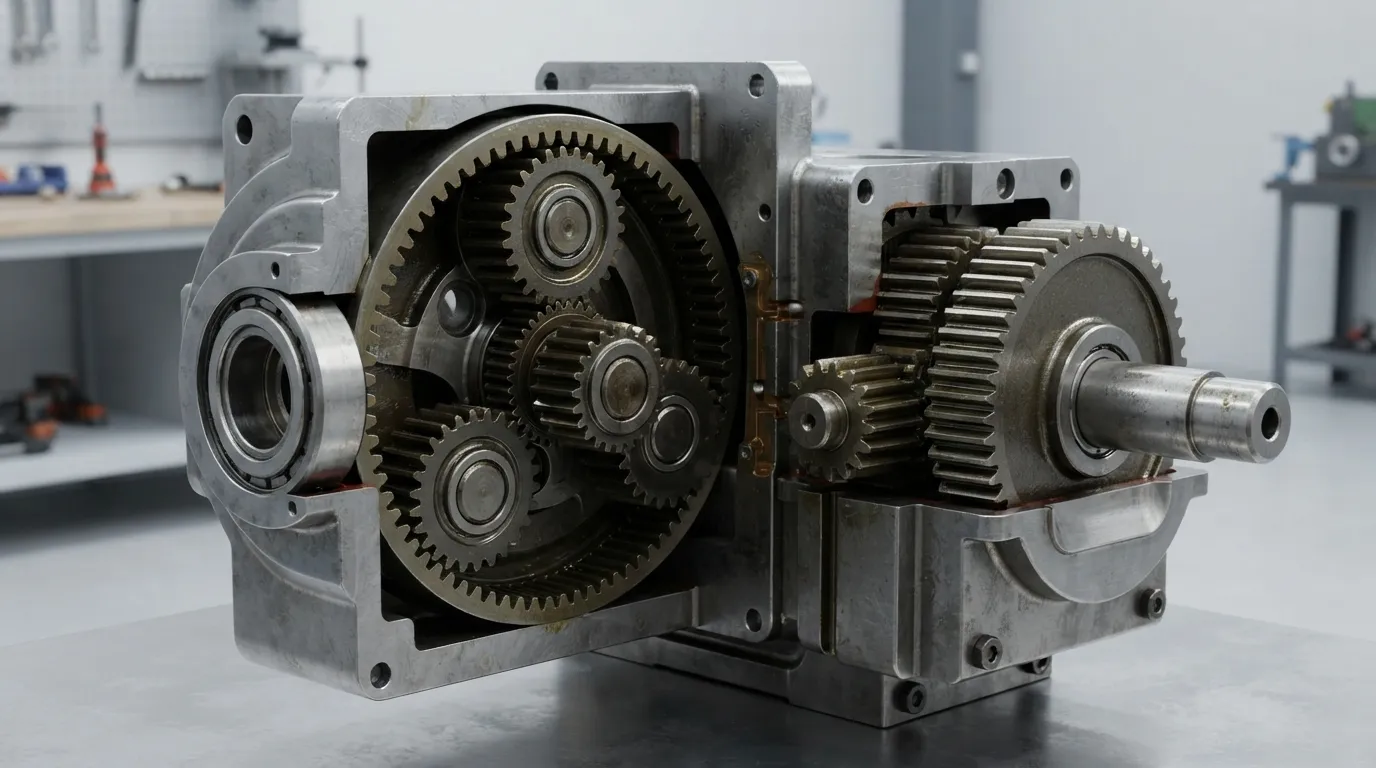
Planetary load sharing means the transmitted torque is divided among the planet gears instead of being carried by a single tooth pair. ZHAOWEI describes this as the reason planetary gearboxes reach high torque in a small package, because several gears carry the load at once.
That sharing is not perfectly equal, and this is the limit most comparisons skip. According to Patsnap Eureka, load sharing between planets can vary because of manufacturing tolerances, so a poorly toleranced unit may load one planet more heavily than the others. Planet count, carrier stiffness and assembly precision all affect how evenly the torque divides. The benefit is real, but it depends on manufacturing quality rather than being automatic.
[DIAGRAM: cutaway view of a planetary gear set — sun gear, three planet gears on a carrier, outer ring gear — beside a parallel-shaft spur gear pair, with load arrows showing multiple contact points versus a single tooth pair]
What Is a Spur Gearbox?
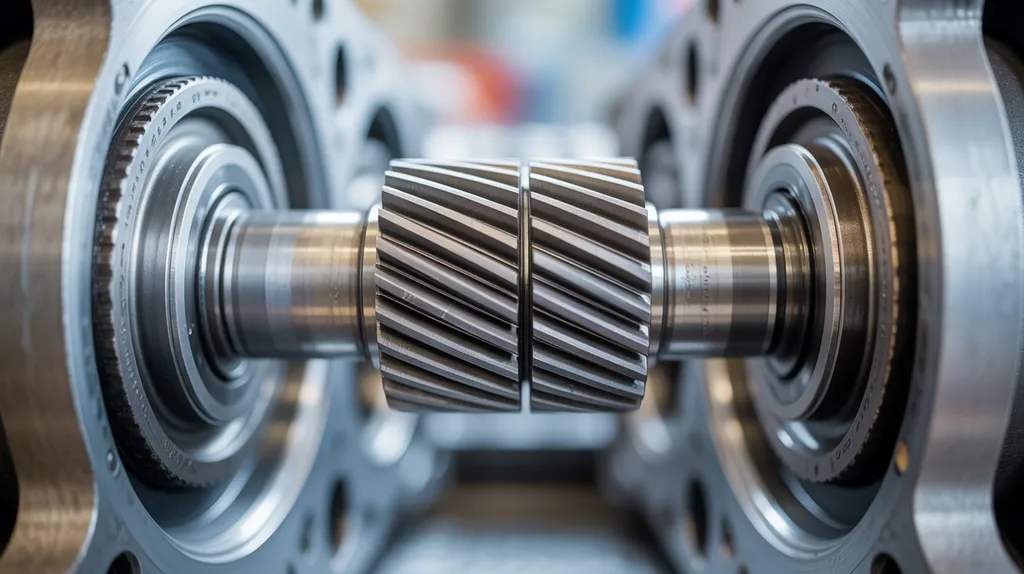
A spur gearbox is a reduction unit that uses straight-cut gears mounted on parallel, offset shafts. Each stage passes load through one meshing tooth pair, which keeps the design, the manufacturing process and the maintenance routine simple.
According to Haydon Kerk Pittman, this parallel offset shaft arrangement is the defining geometry of a spur gearbox. Precision Microdrives notes that spur gearboxes have a lower production cost than planetary types because they need fewer gears and a simpler manufacturing process. That cost advantage, not any performance edge, is what keeps spur stages in so many industrial drives.
Why single-stage spur designs are so common
A single-stage spur gearbox is common because one tooth pair per stage keeps losses low and construction straightforward. According to Haydon Kerk Pittman, single-stage gearboxes can deliver over 90% of input power — an efficient result reached without the tighter tolerances a planetary set requires.
The trade-off appears as soon as more reduction is needed. Every additional spur stage adds another pair of gears and lengthens the housing, while a multi-stage planetary unit adds stages along the same axis.
Side-by-Side Comparison: Planetary vs Spur Gearbox
Planetary and spur gearboxes diverge most on torque density, size, load distribution and cost, and least on per-stage efficiency and basic reliability. The table below compares the attributes that decide most industrial selections.
| Attribute | Planetary gearbox | Spur gearbox | Why it matters |
|---|---|---|---|
| Load path | Torque split across three or four planet gears | One tooth pair carries each stage | Sets torque density and envelope |
| Contact points | Multiple simultaneous contacts | Single contact per stage | Spreads stress versus concentrating it |
| Torque density | High torque in a compact envelope | Lower for the same envelope | Determines machine size and weight |
| Envelope and axial length | Coaxial, short; stages stack in the same footprint | Parallel offset shafts; housing lengthens per stage | Affects mounting layout and machine footprint |
| Per-stage efficiency | 94–98% (Cotta, LLC) | 96–99% (Cotta, LLC) | System efficiency depends on stage count |
| Noise and vibration | Quiet operation noted by Precision Microdrives | Straight-cut teeth are a common noise source | Matters for packaging and near-operator equipment |
| Backlash | Suits low-backlash requirements (Cotta, LLC) | Suits standard backlash tolerance (Cotta, LLC) | Critical for positioning and indexing duty |
| Ratio range and staging | Favoured above roughly 10:1 (Cotta, LLC) | Workable at lower ratios | Drives stage count and envelope |
| Heat dissipation | Higher heat density in compact housings (Cotta, LLC) | Better dissipation from open layouts (Cotta, LLC) | Decides continuous-duty viability |
| Lubrication | More complex; oil must reach multiple contact points (Patsnap Eureka) | Simpler, but can starve at high speed (Patsnap Eureka) | Affects reliability and service intervals |
| Maintenance | Often full assembly replacement or factory rebuild (Cotta, LLC) | Component-level repair with standard tools (Cotta, LLC) | Changes lifecycle cost and downtime |
| Production cost | Higher component count and complexity | Lower, with fewer gears (Precision Microdrives) | Drives upfront price |
| Known disadvantages | High bearing load, inaccessibility, design complexity (Precision Microdrives) | Bulkier for the same torque; noisier straight-cut teeth | Sets the honest limits of each choice |
| Typical duty | Compact high-torque, low-backlash drives | Simple, low-ratio, cost-driven drives | Matches architecture to application |
Load Sharing and Torque Density: Why Planetary Is Compact
A planetary gearbox is compact because several planet gears share the load at the same time, while a spur gearbox carries the same load through one tooth pair. That difference in contact area is the mechanical reason behind the size gap between the two architectures.
The contrast in stress is well documented. According to Patsnap Eureka, spur gear systems concentrate contact stress at a single point, which leads to pitting and spalling, whereas planetary systems distribute load across multiple gears. Distributing load across several teeth is what lets a smaller planetary envelope carry a comparable duty.
The limits are worth stating plainly. Load sharing depends on manufacturing tolerances (Patsnap Eureka), so a planetary unit built to loose tolerances loses part of its theoretical advantage. Planetary designs also impose higher bearing loads and are harder to access internally, according to Precision Microdrives — both direct consequences of packing the gears into a compact housing.
Multi-stage packaging widens the gap further. According to Cotta, LLC, multi-stage planetary designs stack coaxially and keep the same footprint, while multi-stage spur designs need longer housings as each stage is added.
[DIAGRAM: qualitative chart plotting relative torque capacity against relative package size for single-stage spur, multi-stage spur, single-stage planetary and multi-stage planetary]
Where spur still carries the day
A spur gearbox remains the better choice at low ratios and moderate loads, where the compactness of a planetary set buys nothing the machine needs. Cotta, LLC notes that ratios above 10:1 suit planetary gearboxes better, which means lower ratios often work well with spur gear systems.
Cost settles many of these cases. Precision Microdrives attributes the lower production cost of spur gearboxes to fewer gears and simpler manufacturing, and that saving is real whenever the envelope is not constrained.
Efficiency, Noise and Backlash
Per-stage efficiency is close between the two architectures. According to Cotta, LLC, planetary gearboxes run at 94–98% per stage and spur gearboxes at 96–99% per stage, so the numbers alone do not settle the choice.
Those figures explain an apparent contradiction in published comparisons. Some manufacturer guides frame planetary gearboxes as the higher-efficiency option, while per-stage data can favour spur. The two statements describe different things: per-stage efficiency versus system-level efficiency. A four-stage planetary unit multiplies its per-stage losses, while bearing losses and lubrication regime also shift the total. When comparing a real drive, calculate efficiency across the full stage count rather than reading one stage in isolation.
Noise and backlash are clearer. Precision Microdrives notes that planetary gearboxes offer quiet operation, and Cotta, LLC points to planetary designs for low-backlash requirements while standard backlash tolerance fits spur applications. Straight-cut spur teeth remain a common noise source, which is why quieter parallel-shaft duties usually move to a planetary vs helical gearbox comparison, where helical teeth offer a different noise and load profile.
Size, Mounting and Ratio: How Many Stages Do You Need?
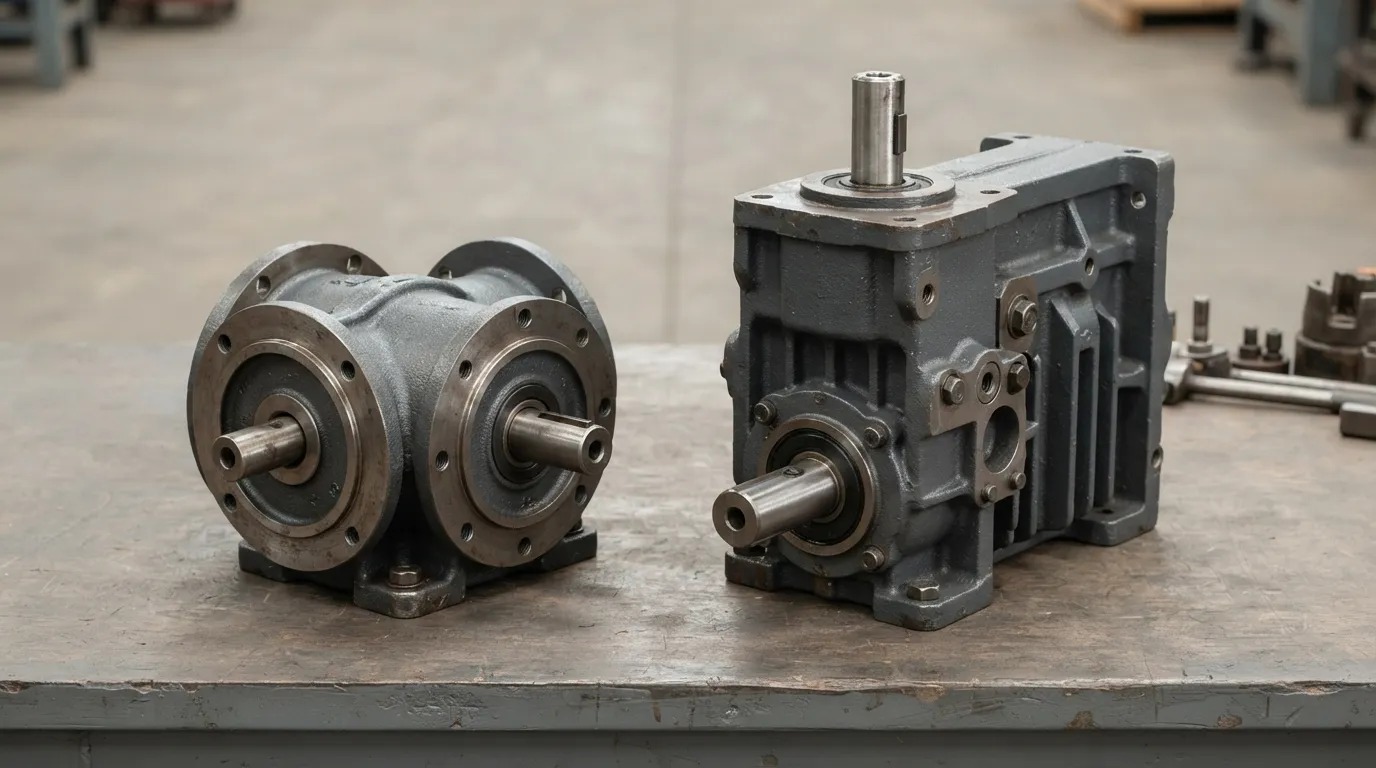
Ratios above roughly 10:1 favour a planetary gearbox, while lower ratios often work acceptably with a spur gearbox. According to Cotta, LLC, multi-stage planetary designs stack coaxially in the same footprint, whereas multi-stage spur designs require progressively longer housings.
Mounting layout often decides the question before torque does. A planetary gearbox is coaxial, so it sits inline with the motor and adds little axial length. A spur gearbox mounts on parallel offset shafts, which can suit machines that need the output shaft positioned away from the motor axis.
Work through stage count in this order:
- Fix the required output speed and output torque.
- Convert that to a required reduction ratio.
- Check whether the ratio exceeds roughly 10:1, the zone where Cotta, LLC places planetary designs.
- Compare envelope limits: a coaxial stack of planetary stages versus a housing that lengthens with each spur stage.
- Multiply per-stage efficiency by the number of stages to compare system efficiency, not just single-stage figures.
- Confirm backlash and heat duty for the application before fixing the architecture.
Stage count also changes the loss picture, which is the subject of the single stage vs multi stage gearbox comparison.
Cost, Maintenance and Heat in Real Installations
A spur gearbox costs less to build and is easier to repair on site, while a planetary gearbox costs more upfront and is harder to service in place. Those two facts often outweigh small differences in efficiency.
According to Precision Microdrives, spur gearboxes have a lower production cost because they use fewer gears and a simpler manufacturing process. Planetary gearboxes also carry documented disadvantages: higher bearing load, restricted internal access and greater design complexity. All three raise the cost of building and maintaining the unit.
Heat is the quiet constraint. Cotta, LLC notes that compact planetary housings create higher heat density, while spur gear trains with open layouts can dissipate heat better in continuous duty. For a continuously loaded drive in a warm plant, that difference can decide the selection.
Maintenance strategy differs in kind, not just degree. Cotta, LLC describes planetary units as often needing complete assembly replacement or factory rebuilding, while spur units allow component-level repair with standard tools. Lubrication follows the same pattern: Patsnap Eureka reports that planetary lubrication is more complex because oil must reach multiple contact points, while spur gearboxes have simpler lubrication but can suffer oil starvation at high speed.
| Cost and service factor | Planetary | Spur | Practical implication |
|---|---|---|---|
| Component count | Higher | Lower | More parts to manufacture and inspect |
| Manufacturing complexity | Greater, with tighter tolerances | Simpler process | Drives the upfront gap |
| Upfront cost tendency | Higher | Lower | Matters most on high-volume builds |
| Lubrication complexity | Multiple contact points to feed | Simpler, with high-speed starvation risk | Affects reliability and service intervals |
| Heat density | Higher in compact housings | Better dissipation in open layouts | Constrains continuous-duty duty rating |
| In-service repair | Often full assembly or factory rebuild | Component-level repair with standard tools | Changes downtime and spares planning |
| Spares strategy | Replace assemblies | Replace individual gears and bearings | Affects inventory holding |
Component count and manufacturing complexity are the main reasons the two designs land at different prices, a relationship explored further in this guide to industrial gearbox price factors.
When to Choose Each Gearbox
Choose a planetary gearbox when torque density, coaxial mounting, low backlash or higher ratios dominate the requirement. Choose a spur gearbox when simplicity, budget and service access dominate.
Choose a planetary gearbox if:
- The available envelope is compact and torque demand is high.
- The reduction ratio is above roughly 10:1 (Cotta, LLC).
- Low backlash is required for positioning or indexing duty.
- The drive must sit coaxially with the motor.
- The duty involves precision positioning or a compact high-torque drive.
- Multi-stage reduction is needed without lengthening the housing.
Choose a spur gearbox if:
- The ratio is low and the load is moderate.
- Lowest upfront cost is the priority.
- Parallel offset shafts suit the machine layout.
- Component-level repair on site is essential.
- Heat dissipation in continuous duty matters more than compactness.
- High-volume builds need a simple, manufacturable design.
One case fits neither architecture. If the drive needs a right-angle output or a self-locking characteristic, both planetary and spur designs are the wrong starting point, and a planetary vs worm gearbox comparison is the better shortlist.
Applications: Where Each Architecture Fits
Planetary gearboxes dominate compact, high-torque duty such as robotics, positioning systems and space-limited conveying, while spur gearboxes dominate simple, cost-driven, moderate-ratio drives. The allocation follows directly from the load path: shared load enables the compact planetary envelope, and single-tooth-pair simplicity enables the low spur cost.
Precision Microdrives associates planetary gearboxes with quiet operation and compact high-torque applications. A trade publication overview on Machine Design describes planetary gears as delivering high torque and speed reduction in a package that is compact compared with pinion-and-gear arrangements. Spur gearboxes remain common wherever a straightforward reduction is enough.
Industrial duty keeps the same split. Mingye supplies power transmission equipment to OEMs and plant engineers in plastics and rubber, mixing, conveying and material handling, packaging, mining, cement, power and ports — sectors where compact high-torque drives and simple low-cost drives both appear on the same machine. Detailed application mapping by gearbox type sits in this guide to planetary gearbox applications.
Supplier Note: Gearbox or Complete Gear Motor?
The comparison above describes the gearbox, but many industrial drives arrive as a complete geared motor, where the motor, gearbox and mounting are specified together. The architecture question stays the same, but the selection package is larger.
The gearmotor frame is also why so much published comparison material comes from small-motor suppliers and reads in terms of DC gearmotors rather than industrial reducers. Treat that material as a description of gear geometry, and specify the industrial drive — ratio, output torque, envelope, backlash, duty and mounting — as a separate exercise.
Mingye designs, makes and supplies industrial power transmission equipment from its CNC-equipped factory in Jinshan District, Shanghai. The range covers heavy-duty planetary reducers, HB series heavy-duty industrial gearboxes, R, S, K and F series helical gear motors, cylindrical gear reducers, NMRV worm gear motors, cycloidal pinwheel reducers, three-phase asynchronous motors and small gear motors, plus special reducers for rubber and plastic machinery, welding rotators and paddle mixers. Designs are modular and standardized, with OEM customization of mounting dimensions and transmission ratios, and normal delivery of 7–15 days. A helical geared motor is often the practical starting point when a parallel-shaft drive needs both the motor and the reducer packaged as one unit.
If you are weighing a planetary reducer against a cylindrical gear reducer for a specific machine, send Mingye the output speed, output torque, ratio, backlash requirement and mounting constraints, and the selection can be matched to the application.
FAQ
What is the main difference between a planetary gear and a spur gear?
The difference is the load path and the geometry. A planetary gear set uses a sun gear, several planet gears and a ring gear on a coaxial axis, splitting load across multiple planet gears. A spur gear set uses straight-cut gears on parallel offset shafts, with one tooth pair carrying each stage. That single difference drives every downstream trade-off in size, torque density and serviceability.
What are the downsides of using planetary gears?
Planetary gearboxes carry higher bearing loads, are harder to access internally and are more complex to design, according to Precision Microdrives. Cotta, LLC notes higher heat density in compact housings and a repair mode that often means full assembly replacement or factory rebuilding. Patsnap Eureka adds that load sharing can vary with manufacturing tolerances. Planetary designs are not automatically superior.
Why are planetary gears often described as better?
They are often described as better because of torque density, compactness and quiet operation rather than raw efficiency. Cotta, LLC lists planetary gearboxes at 94–98% per stage and spur gearboxes at 96–99% per stage, so per-stage efficiency can favour spur. The planetary advantage sits in size, torque capacity and noise, not in every performance metric.
What are the specifications of a planetary gearbox?
The main specifications are reduction ratio, number of stages, rated output torque, permissible input speed, backlash, efficiency, mounting interface and lubrication type. Start with the required ratio and output torque at the required output speed, then check envelope, backlash and duty. Exact figures are application-specific and come from the manufacturer's data sheet, not from a general comparison.
Does a smaller spur gear make it faster?
Yes. Changing tooth counts changes the ratio: a smaller driven gear relative to the driving pinion increases output speed while reducing available torque. For a given input power, speed and torque move in opposite directions in both spur and planetary trains, so the gear sizes must be matched to the required output duty.
Share on Social:


Contact Us
In This Article
Rubber Internal Mixer Gearbox: Read the Batch Load Profile, Not Just Motor kW
Oct 22, 2026
Hot Industrial Gearbox Coupling After Cold Alignment: What to Check
Oct 22, 2026
Hydraulic Slewing Drive Won't Rotate: Separate Motor, Brake and Gearbox Faults
Oct 22, 2026
Calender Roll Gap Changes: What Must the Drive Coupling Accommodate?
Oct 22, 2026