


 Home /
Cycloidal Gearbox vs Harmonic Drive: Differences in Robotics Applications
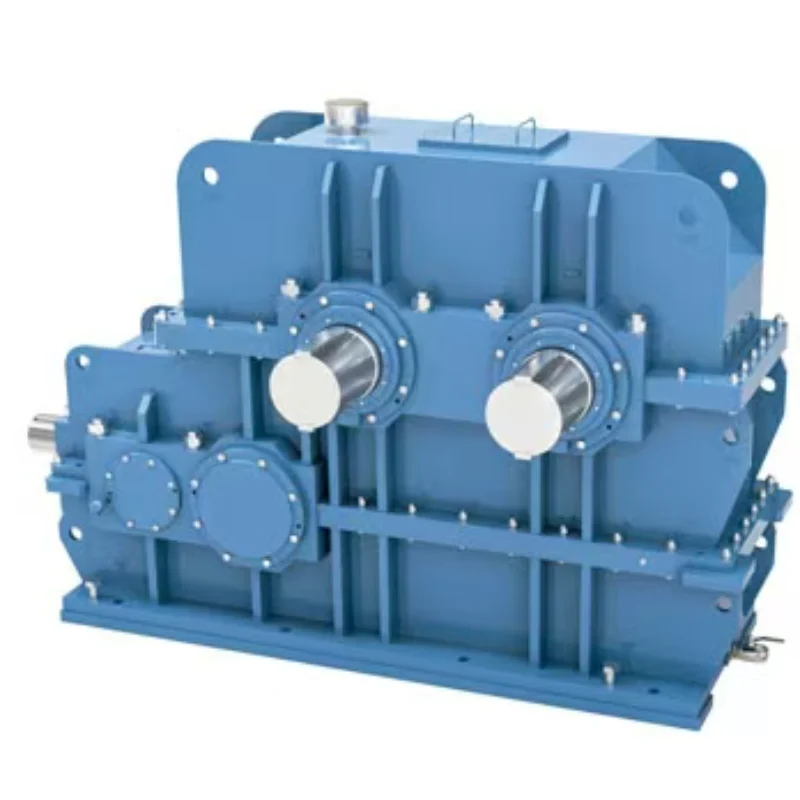
Rubber Internal Mixer Gearbox: Read the Batch Load Profile, Not Just Motor kW
Oct 22, 2026
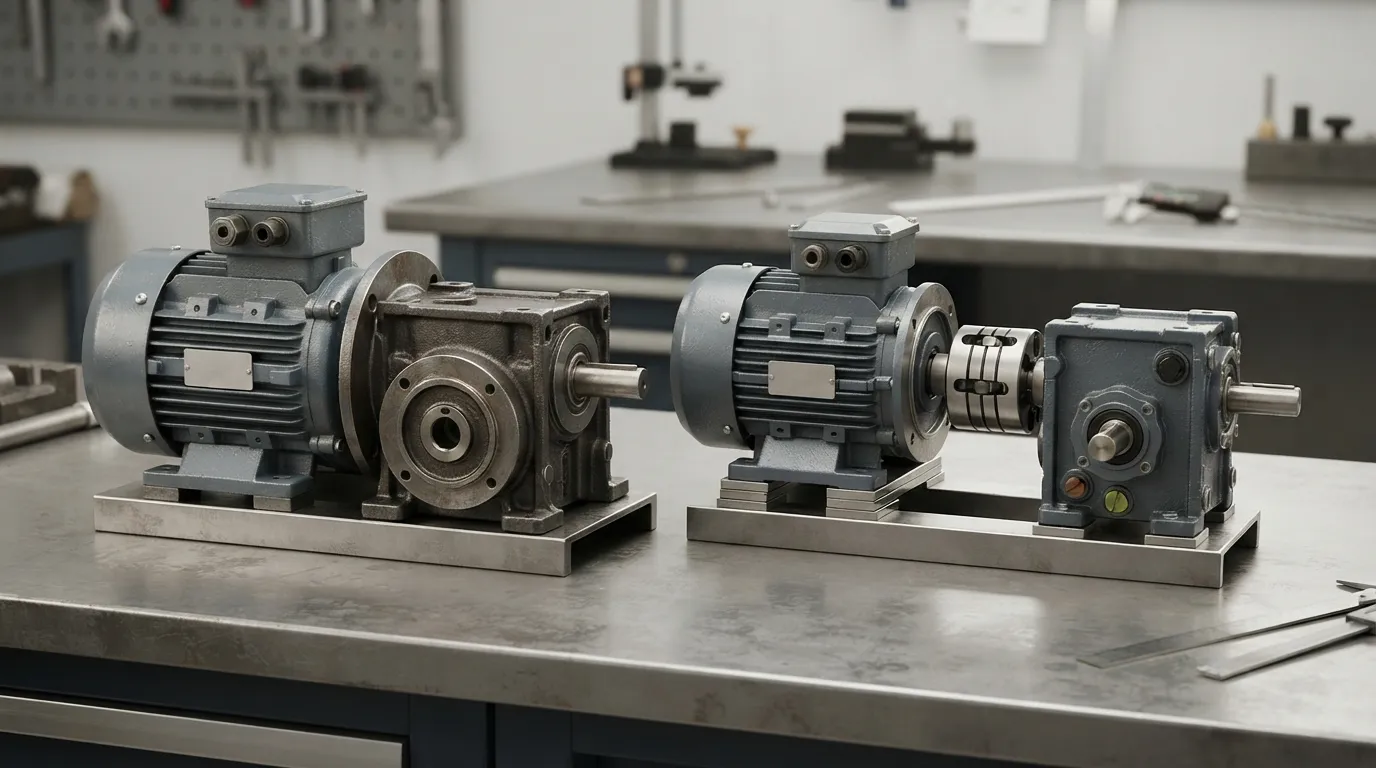
Hot Industrial Gearbox Coupling After Cold Alignment: What to Check
Oct 22, 2026
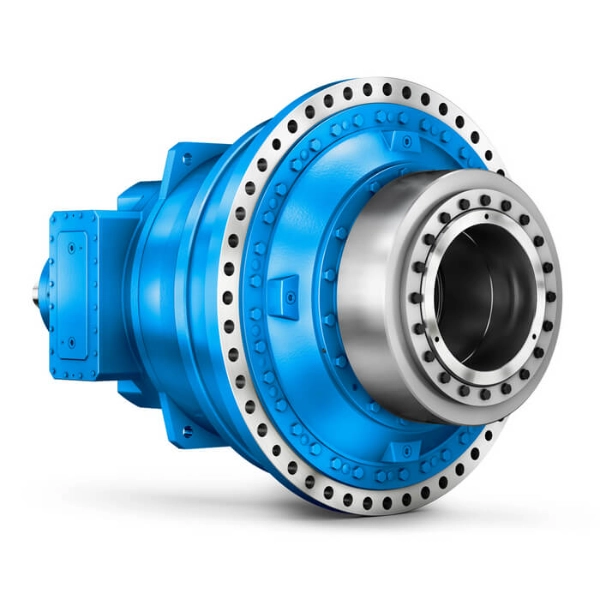
Hydraulic Slewing Drive Won't Rotate: Separate Motor, Brake and Gearbox Faults
Oct 22, 2026
Calender Roll Gap Changes: What Must the Drive Coupling Accommodate?
Oct 22, 2026
If you're choosing between a cycloidal gearbox and a harmonic drive for a robotic joint, the short answer is: harmonic drives win on compactness and near-zero backlash for lighter precision axes like wrists, while cycloidal gearboxes win on shock tolerance, stiffness, and lifespan for heavy-load axes like bases and shoulders. Both offer high reduction ratios in a single stage, but they achieve it through fundamentally different mechanisms that suit different joints and duty cycles.
Key takeaways:
- Mechanism difference: Harmonic drives use a wave generator, flexspline, and circular spline; cycloidal drives use an eccentric bearing and cycloidal disc with rolling pins — leading to different failure modes and load characteristics.
- Stiffness & shock: Cycloidal drives provide higher torsional stiffness and superior shock-load resistance (up to ~5× rated torque), making them better for heavy or impact-loaded joints.
- Backlash: Harmonic drives offer true zero-backlash operation; cycloidal drives achieve very low backlash (near-zero when preloaded) but not mathematically zero.
- Efficiency: Cycloidal drives typically achieve 3–5% higher efficiency than harmonic drives (85–92% vs 70–85%) due to reduced sliding friction.
- Robot axis mapping: Strain wave gears dominate wrists, elbows, and compact joints; cycloidal drives fit bases, shoulders, and high-inertia axes where shock load and life matter more than weight.
What Is a Cycloidal Gearbox?
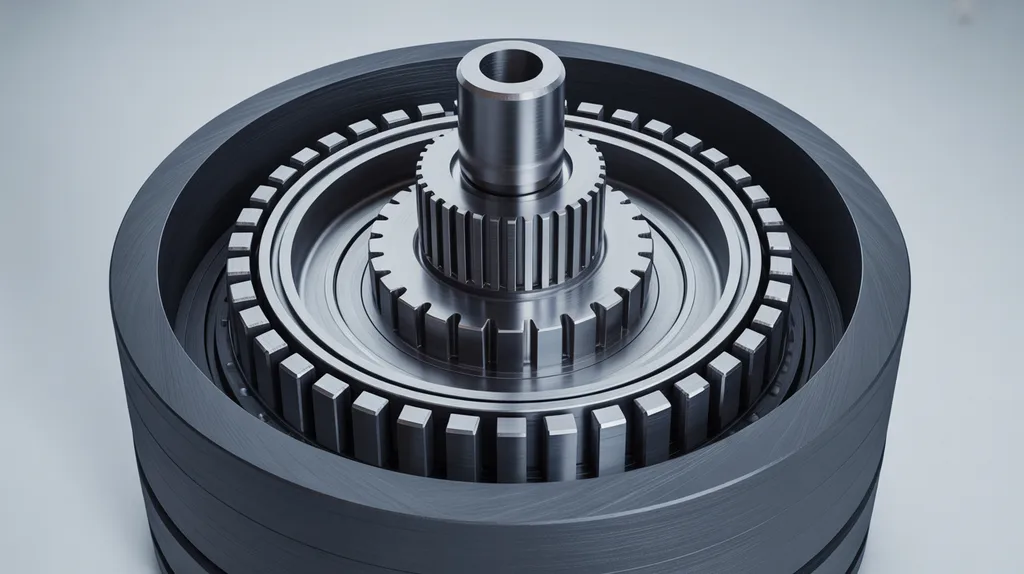
A cycloidal gearbox (also called a cycloidal drive or cycloidal reducer) is a speed-reduction mechanism that uses an eccentric bearing to drive one or more cycloidal discs, which roll against ring gear pins to convert high-speed input into high-torque output.
The key components are:
- Eccentric bearing/cam — mounted on the input shaft, it creates an eccentric (off-center) motion
- Cycloidal disc(s) — one or two lobed discs that roll inside the housing
- Ring gear pins/rollers — fixed pins inside the housing that the cycloidal disc contacts
- Output pins — transfer the orbital motion to the output shaft
Because multiple teeth on the cycloidal disc remain in contact with the ring gear pins simultaneously, the load is distributed across many contact points. According to Cone Drive, this multi-contact design gives cycloidal drives natural advantages in shock-load resistance, durability, and high torque capacity. The rolling contact — rather than sliding contact — is also what makes cycloidal drives more efficient than harmonic drives in most operating conditions.
Cycloidal gearboxes are widely used in industrial applications ranging from conveyor systems to heavy machinery. For a broader look at where these reducers fit across different sectors, see our guide to cycloidal gearbox applications.
What Is a Harmonic Drive (Strain Wave Gear)?
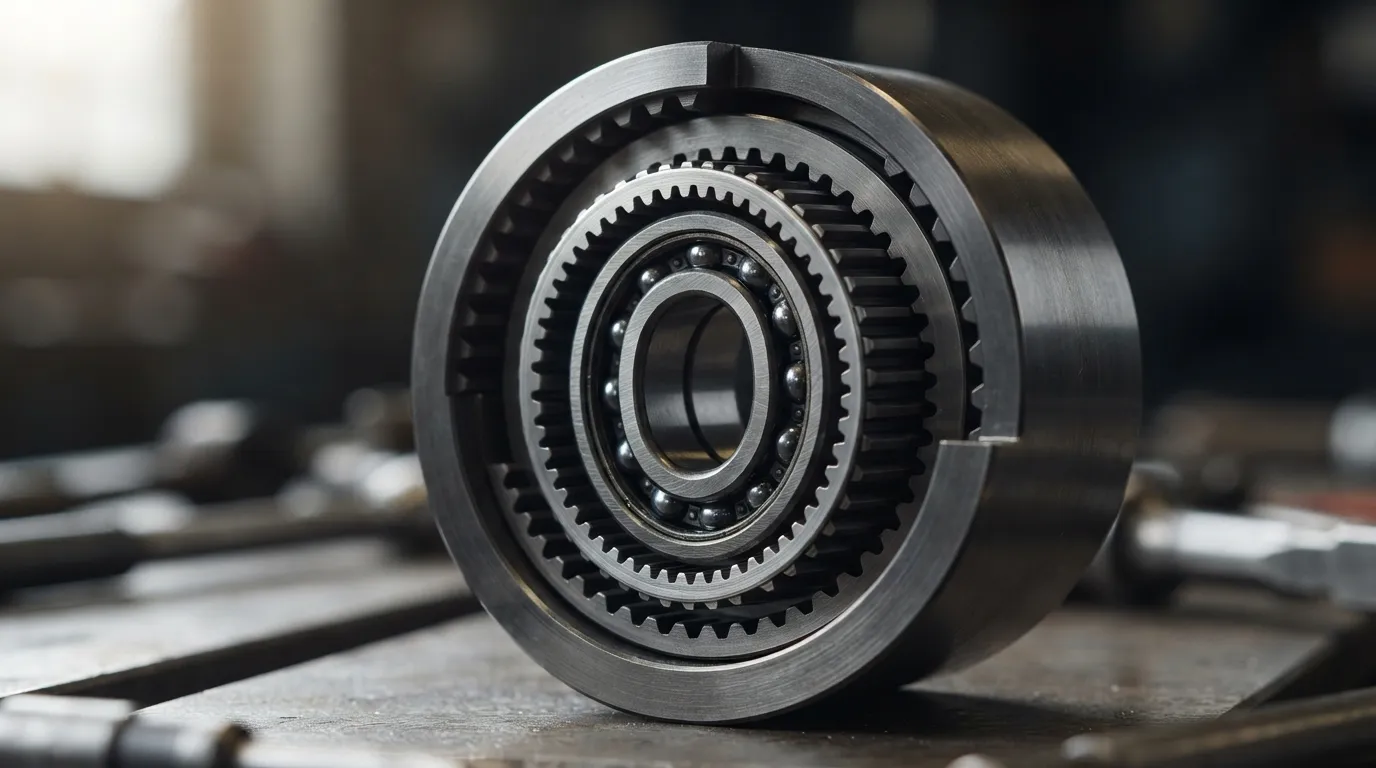
A harmonic drive — also called a strain wave gear — is a compact speed-reduction mechanism that uses a wave generator to elastically deform a flexible spline against a rigid circular spline, creating meshing teeth at two opposing points.
The three main components are:
- Wave generator — an elliptical cam with a bearing that fits inside the flexspline
- Flexspline — a thin-walled, flexible cylinder with external teeth on its outer surface
- Circular spline — a rigid ring with internal teeth that mesh with the flexspline
The wave generator rotates and elastically deforms the flexspline, causing it to mesh with the circular spline at two points. Because the flexspline has slightly fewer teeth than the circular spline, each rotation advances the output by a small increment — producing high reduction in a single, compact stage.
Harmonic drive technology was invented by C.W. Musser in 1957. According to Cone Drive, harmonic drives are favored in applications requiring zero backlash, high positional accuracy, and smooth motion — particularly in robotics, aerospace, and medical devices. The flexspline is the defining element: its elastic deformation enables the zero-backlash engagement, but it is also the component most susceptible to fatigue over time.
Cycloidal Gearbox vs Harmonic Drive: Head-to-Head Comparison
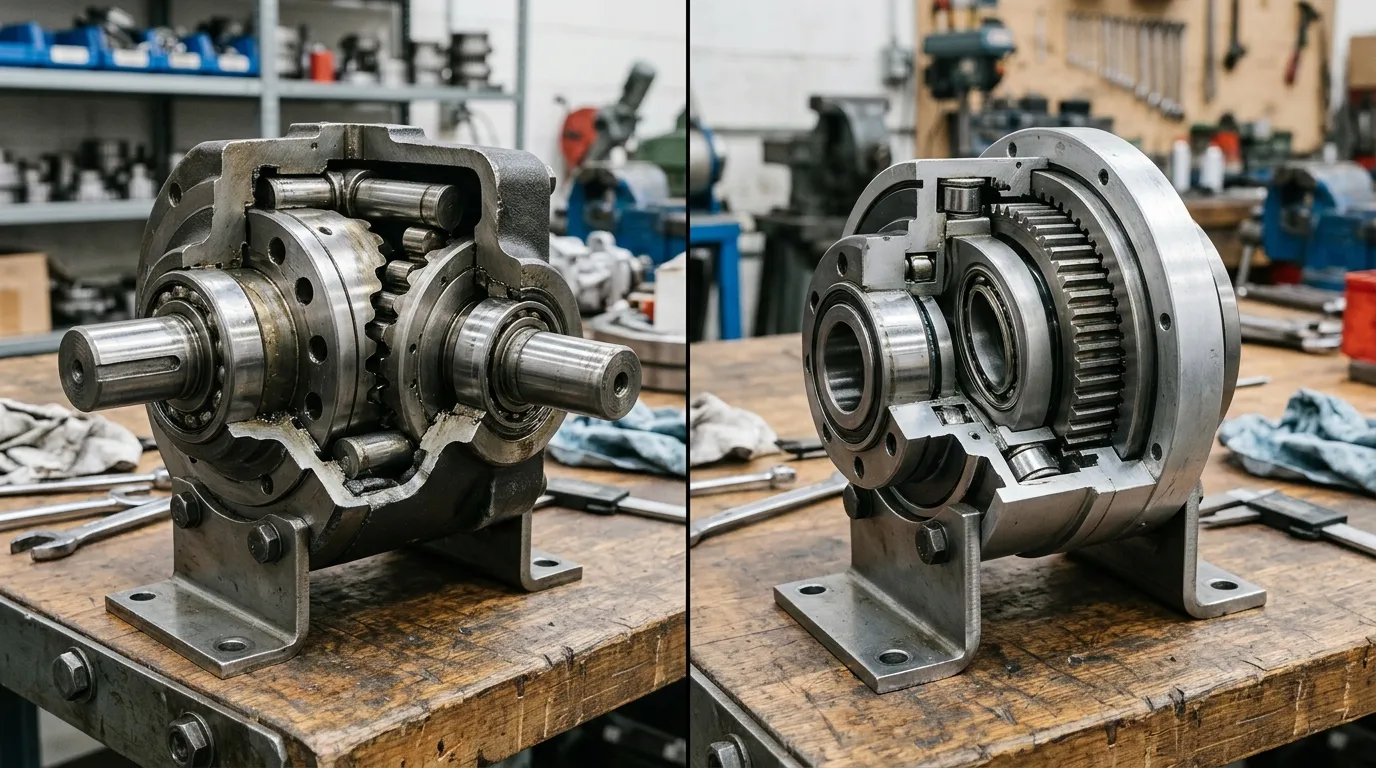
Cycloidal and harmonic drives differ fundamentally in backlash, stiffness, shock tolerance, efficiency, and lifespan. Cycloidal drives favor robustness and heavy loads, while harmonic drives favor compactness and precision.
| Parameter | Cycloidal Gearbox | Harmonic Drive |
|---|---|---|
| Backlash | Near-zero (preload-dependent) | True zero (by design) |
| Torsional stiffness | High | Moderate (flexspline compliance) |
| Shock load capacity | Excellent (~5× rated torque typical) | Limited (flexspline fatigue risk) |
| Efficiency | 85–92% | 70–85% |
| Reduction ratio | 30:1 to 300:1+ | 30:1 to 300:1+ |
| Size / weight | Larger, heavier | Compact, lightweight |
| Lifespan / wear | Long (rolling contact) | Limited (flexspline fatigue) |
| Noise | Low | Low |
| Cost trend | Moderate | Historically higher |
| Best-fit robot axes | Base, shoulder, high-inertia joints | Wrist, elbow, compact joints |
Neither technology is universally "better." The right choice depends entirely on what the joint must do — how much load it carries, how often it sees impact, how much space is available, and what precision level the application demands.
Backlash: Zero vs Near-Zero
Harmonic drives eliminate backlash entirely through mechanical design; cycloidal drives achieve very low backlash, which becomes effectively zero when preloaded.
According to Laifual Drive, strain wave gears offer true zero backlash by design, while cycloidal drives offer very low backlash that depends on design and preload. In practice, a properly preloaded cycloidal drive can perform indistinguishably from a harmonic drive in most positioning applications. However, if the application spec calls for "zero backlash" as a hard requirement — for example, in precision machining or inspection equipment — a harmonic drive is the only option that guarantees it mathematically.
Stiffness and Shock Tolerance
Cycloidal drives are stiffer and more shock-tolerant because they use multiple rolling contact points that distribute load, while harmonic drives rely on a thin flexspline that can fatigue under impact.
The stiffness difference comes from the flexspline itself. According to Laifual Drive, cycloidal drives can typically handle shock loads up to approximately 5× rated torque, while harmonic drives risk flexspline fatigue under the same conditions. The rolling contact in a cycloidal drive — where hardened pins roll against the cycloidal disc — provides long service life even in heavy-duty, impact-prone applications. In a harmonic drive, the flexspline flexes continuously during operation, and sudden shock loads can accelerate fatigue cracking.
For robot base and shoulder joints that must handle high inertia and occasional collisions, this difference is often decisive.
Efficiency Under Load
Cycloidal drives are generally 3–5% more efficient than harmonic drives because they use rolling contact instead of sliding friction.
According to Patsnap Eureka, modern cycloidal reducers deliver efficiency ratings between 85–92%, while harmonic drives achieve 70–85% — a difference of roughly 3–5 percentage points in typical operating conditions. A 2024 peer-reviewed study also found that cycloid drives and planetary gears generally show higher efficiency than comparable strain wave drives.
This efficiency gap matters most in three scenarios:
- Battery-powered robots, where every watt of energy loss reduces runtime
- Continuous-duty applications, where heat generation accelerates component wear
- High-reduction applications, where sliding friction losses compound
For heavy-load joints operating at high duty cycles, the efficiency difference can mean lower operating temperatures, longer component life, and smaller cooling requirements.
Which Robot Axes Use Cycloidal vs Harmonic Drives?
In industrial robotics, harmonic drives dominate wrists, elbows, and compact precision joints; cycloidal drives fit bases, shoulders, and heavy-load axes where shock tolerance and lifespan outweigh weight and size.
According to Source Robotics, harmonic drives are the industry standard for most industrial robotic arms. Their compactness and zero backlash make them ideal for the smaller, faster joints near the end of the arm. However, according to Laifual Drive, cycloidal drives are the better fit for base joints, large axes, and high-inertia joints where their stiffness and shock tolerance deliver clear advantages.
| Robot Axis | Typical Technology | Why |
|---|---|---|
| Base / J1 | Cycloidal | High inertia, shock loads, stiffness critical |
| Shoulder / J2 | Cycloidal or RV | High torque, gravity loads |
| Elbow / J3 | Harmonic or Planetary | Moderate torque, compactness matters |
| Wrist / J4–J6 | Harmonic | Compactness, zero backlash, precision |
| Cobot joints | Harmonic | Smoothness, backdrivability, compactness |
| Heavy payload industrial | Cycloidal / RV | Shock tolerance, lifespan, stiffness |
The pattern is consistent: the closer the joint is to the base, the more likely it is to use a cycloidal drive. Base and shoulder joints carry the full weight of the arm and payload, experience the highest torques, and absorb the most shock during starts, stops, and collisions. The compactness of a harmonic drive matters less at the base, where space is less constrained and the structure is already large.
For a deeper look at how cycloidal drives perform in robotic systems specifically, see our dedicated guide to cycloidal gearbox robotics.
How to Choose: Cycloidal or Harmonic for Your Robot Joint?
Choose a cycloidal drive when shock loads, stiffness, lifespan, or efficiency are priorities; choose a harmonic drive when compactness, zero backlash, or smoothness at low weight are non-negotiable.
Choose Cycloidal If…
- Your joint experiences shock loads or collisions (handles up to ~5× rated torque)
- You need high torsional stiffness for heavy or high-inertia loads
- Continuous duty cycles where efficiency (85–92%) reduces heat and energy costs
- Long service life with rolling contact wear (no flexspline fatigue)
- Base, shoulder, or large robot axes where weight is less critical
Choose Harmonic If…
- Zero backlash is a hard requirement (precision positioning, machining, inspection)
- Compactness and low weight are critical (wrists, cobots, mobile robots)
- Smooth, backlash-free motion is needed for low-speed precision moves
- You can accept lower efficiency (70–85%) and flexspline lifespan limits
- Budget allows for historically higher cost premium
There is also a third option worth considering: planetary gearboxes. They offer high efficiency and moderate backlash at a lower cost, though they generally provide lower reduction ratios per stage. If you're weighing this option alongside cycloidal and harmonic, compare our planetary vs cycloidal gearbox analysis.
For a structured, step-by-step selection process — including how to calculate required torque, service factor, and reduction ratio — read our complete guide on how to choose cycloidal reducer.
Practical Considerations: Cost, Maintenance, and Integration
Beyond performance specs, cost, maintenance, and integration complexity differ between the two technologies.
Cost. Harmonic drives have historically carried a cost premium due to the precision manufacturing required for the flexspline and wave generator. According to Source Robotics, harmonic drives remain relatively expensive, though the cost has decreased in recent years as more manufacturers have entered the market. Cycloidal drives are generally more cost-competitive, especially at larger sizes where the harmonic drive's manufacturing complexity increases.
Maintenance and lifespan. Cycloidal drives use rolling contact — hardened pins rolling against the cycloidal disc — which wears slowly and predictably. Harmonic drives rely on a flexing metal element that is subject to fatigue over time. In a heavy-duty application with shock loads, a cycloidal drive can outlast a harmonic drive by a wide margin simply because there is no flexing component to fatigue.
Integration. Cycloidal drives are larger and heavier for the same torque rating, which matters in the wrist and elbow joints where space is tight. Harmonic drives' compact form factor is their defining integration advantage. However, cycloidal drives are generally simpler to mount and align in base and shoulder positions, where the larger envelope is rarely a problem.
One limitation worth noting: according to Source Robotics, cycloidal reducers are inefficient at small gear ratios. They are designed for high reduction — typically 30:1 and above. If your application needs less reduction than that, a planetary gearbox may be a better fit. For a side-by-side comparison, see our planetary gearbox vs harmonic drive guide.
FAQ
Can cycloidal drives be backdriven?
Cycloidal drives can be backdriven, but with higher friction than harmonic drives. Backdrivability depends on reduction ratio, preload, and lubrication. In practice, cycloidal drives offer limited backdrivability, while harmonic drives are more readily backdrivable at moderate reduction ratios — an important consideration for collaborative robots and gravity-loaded axes.
Which is more expensive: cycloidal or harmonic drive?
Harmonic drives have historically carried a cost premium due to the precision manufacturing required for the flexspline and wave generator. Cycloidal drives are generally more cost-competitive, especially at larger sizes. However, pricing varies widely by brand, size, and volume — and harmonic drive prices have decreased in recent years as competition has grown.
Which lasts longer: cycloidal or harmonic drive?
Cycloidal drives typically last longer in heavy-duty applications because they use rolling contact instead of the flexing metal element that harmonic drives rely on. Flexspline fatigue is the primary wear mechanism limiting harmonic drive lifespan — especially under shock loads or continuous high-torque operation.
Both cycloidal gearboxes and harmonic drives are proven technologies for robotic joints, but they answer different engineering questions. If the priority is compactness, zero backlash, and smooth precision — look at harmonic drives. If the priority is shock tolerance, stiffness, and long service life under heavy load — a cycloidal drive is the more reliable choice. For most industrial robots, the optimal design uses both: cycloidal drives at the base and shoulder, harmonic drives at the wrist and elbow.
Mingye manufactures cycloidal pinwheel reducers in Shanghai with OEM customization options — if your application leans cycloidal, our team can help you size the right unit for your robot joint.
Share on Social:


Contact Us
In This Article
Rubber Internal Mixer Gearbox: Read the Batch Load Profile, Not Just Motor kW
Oct 22, 2026
Hot Industrial Gearbox Coupling After Cold Alignment: What to Check
Oct 22, 2026
Hydraulic Slewing Drive Won't Rotate: Separate Motor, Brake and Gearbox Faults
Oct 22, 2026
Calender Roll Gap Changes: What Must the Drive Coupling Accommodate?
Oct 22, 2026