


 Home /
Gear Motor vs Gearbox: Which One Do You Need?
Rubber Internal Mixer Gearbox: Read the Batch Load Profile, Not Just Motor kW
Oct 22, 2026
Hot Industrial Gearbox Coupling After Cold Alignment: What to Check
Oct 22, 2026
Hydraulic Slewing Drive Won't Rotate: Separate Motor, Brake and Gearbox Faults
Oct 22, 2026
Calender Roll Gap Changes: What Must the Drive Coupling Accommodate?
Oct 22, 2026
A gear motor combines an electric motor and gearbox in one integrated unit, while a standalone gearbox must be matched with a separate motor. Choose a gear motor for simpler installation, compact packaging and straightforward sourcing; choose a separate gearbox when motor interchangeability, system flexibility or replacement options matter more. The correct choice depends on speed, torque, ratio, duty and mounting requirements.
Gear Motor vs Gearbox: What Is the Difference?
A gear motor is an integrated drive that combines an electric motor with a gearbox. A gearbox is a mechanical transmission unit that changes shaft speed and torque through gears but normally requires a separate motor.
The two products are related, but they are not the same purchase:
- A gear motor includes the motor and reduction mechanism.
- A standalone gearbox includes the reduction mechanism but not the motor.
- A gear motor is usually selected as one coordinated assembly.
- A separate gearbox must be matched with a compatible motor, coupling, shaft arrangement and mounting system.
The term gear reducer is often used for a gearbox designed to reduce speed and increase output torque. However, a gearbox is a broader term, so a gearbox and a gear reducer are not always exact synonyms. See the detailed comparison of gearbox vs gear reducer for the terminology.
| Attribute | Gear motor | Separate gearbox |
|---|---|---|
| What is supplied | Motor and gearbox together | Gearbox only |
| Motor included | Yes | No |
| Main function | Complete powered reduction drive | Mechanical speed and torque conversion |
| Installation | Mount and connect the integrated unit | Mount the gearbox, select a motor and align the drive |
| Motor flexibility | Related to the selected assembly | Motor can be selected or replaced separately |
| Procurement | One coordinated drive | Separate components must be matched |
| Typical advantage | Simpler integration | Greater modularity |
How Do Gear Motors and Separate Gearboxes Work?
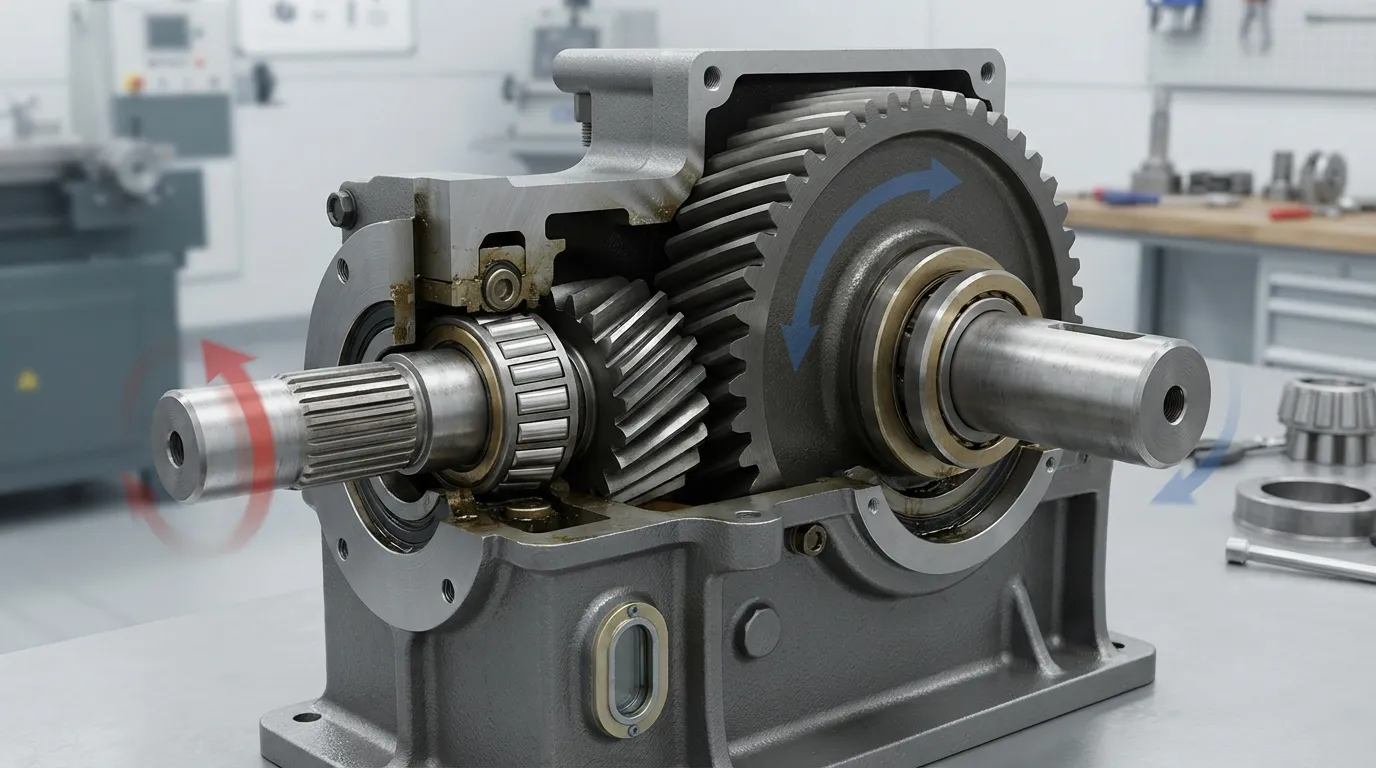
Both arrangements use gears to reduce input speed and transmit torque to an output shaft. The practical difference is whether the motor and reduction unit are selected and supplied as one integrated drive or as separate components.
For example, a 20:1 reduction can change a motor speed of 1,750 revolutions per minute to an output speed of 87.5 revolutions per minute. This is a simple ratio example, not a complete sizing calculation. Actual output torque and suitability also depend on motor power, gear design, duty cycle, load, efficiency and operating conditions.
According to Vortex Speed Reducers, a speed reducer is a type of gearbox. A gear motor adds the electric motor to that reduction unit, creating a complete drive package.
Gear motors can use alternating-current or direct-current motors, depending on the design. They can also use different arrangements:
- Inline gear motors place the motor and output shaft on the same general axis. Spur or planetary gears may be used in this type of arrangement.
- Right-angle gear motors change the direction of power transmission. Worm, bevel or hypoid gearing may be used.
- Helical gear motors are commonly used where a compact industrial drive and reliable power transmission are required.
A gear motor is therefore not simply a different name for a gearbox. It is a gearbox combined with a motor and configured for a complete powered application.
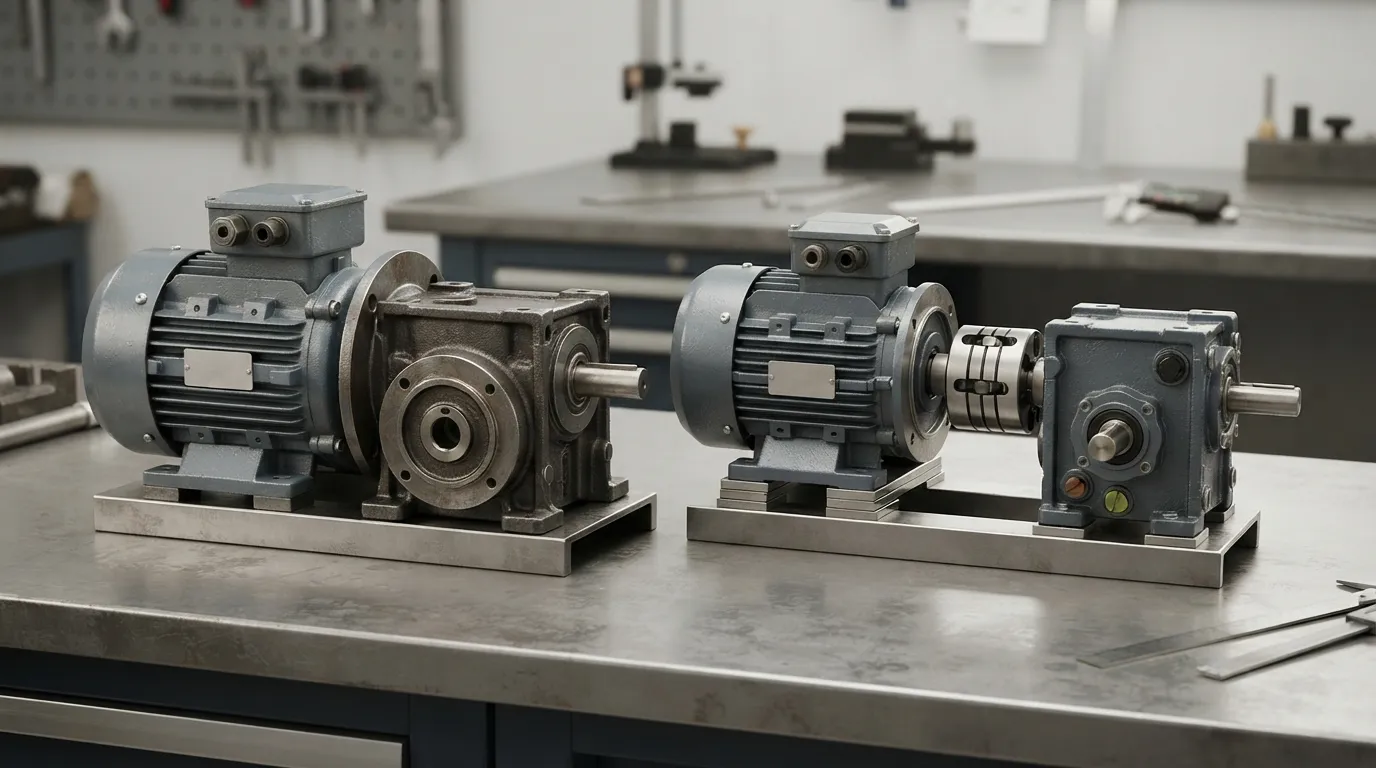
[DIAGRAM: Show an integrated gear motor on one side and a separate motor, coupling and gearbox on the other. Label input speed, reduction ratio, output speed, mounting and alignment points.]
Gear Motor vs Gearbox: Side-by-Side Comparison
A gear motor generally reduces integration and installation work because the motor and gearbox are supplied together. A separate gearbox gives the buyer more freedom to choose, replace or reconfigure the motor, but it introduces additional compatibility, coupling and alignment decisions.
| Decision criterion | Gear motor | Separate gearbox and motor | What it means for the buyer |
|---|---|---|---|
| Integration | Motor and gearbox supplied together | Components sourced and matched separately | A gear motor can simplify procurement |
| Footprint | One coordinated drive assembly | Motor, gearbox and possibly coupling must be accommodated | Compare the complete installed envelope |
| Mounting | Integrated mounting arrangement | Gearbox and motor mounting must work together | Confirm dimensions and orientation |
| Alignment | Often fewer separate alignment tasks | Coupling and alignment may be required | Alignment becomes an additional engineering check |
| Motor flexibility | Motor choice is linked to the selected unit | Motor can be selected independently | Separate systems suit unusual motor requirements |
| Replacement | Replace the integrated unit or matched components | Replace the motor or gearbox independently if compatible | Confirm the spare-parts strategy before purchase |
| Sourcing | One coordinated supplier or assembly | Multiple components may be sourced separately | Separate sourcing can increase coordination work |
| Customization | Depends on available integrated configurations | More modular combinations are possible | Check ratio, shaft and mounting constraints |
| Maintenance | Fewer separately coupled components | Individual parts may be serviced or replaced | Access and compatibility affect maintenance |
| Typical fit | Standardized, compact industrial equipment | Modular or highly customized machinery | Application data should decide the choice |
Neither configuration is automatically better in every application. A gear motor may reduce installation complexity, but a separate gearbox may be more suitable when the motor must remain interchangeable. Conversely, a separate assembly may offer flexibility while requiring more design and commissioning work.
Which Is Better for Footprint and Installation?
A gear motor is often the simpler packaging choice when the selected integrated unit fits the machine envelope. A separate gearbox can also be suitable, but the designer must account for the gearbox, motor, coupling, mounting arrangement, alignment and service access as one complete assembly.
The correct comparison is not simply the physical size of the gearbox against the physical size of the gear motor. Compare the complete installed arrangement, including:
- Overall length, width and height
- Motor clearance
- Output-shaft position
- Mounting flange or foot dimensions
- Shaft extension and coupling space
- Mounting orientation
- Lubrication and inspection access
- Space needed to remove the motor or gearbox later
A gear motor can reduce the number of separately mounted components. That may simplify installation, particularly in standardized OEM equipment. However, the integrated unit still needs correct mounting, adequate support and application-specific sizing.
A separate gearbox may require a coupling between the motor and gearbox. The coupling, shaft alignment and motor support then become part of the installation design. These requirements do not make a separate gearbox unsuitable, but they should be included in the engineering scope rather than treated as minor details.
Which Option Offers More Sourcing and Motor Flexibility?
A gear motor can simplify sourcing because the motor and gearbox arrive as a coordinated unit. A separate gearbox offers more flexibility when the machine requires a particular motor technology, control arrangement, supplier, frame size or future replacement approach.
A separate gearbox may be preferable when:
- The machine already uses a standard motor platform.
- The motor may need to be replaced independently.
- The application requires a particular brake, encoder or control arrangement.
- The equipment uses a preferred motor supplier.
- Future upgrades may change the motor without changing the gearbox.
- The design team wants to configure the motor and gearbox separately.
A gear motor may be preferable when:
- The motor type and output requirements are already defined.
- One supplier or one coordinated assembly simplifies procurement.
- The machine design is standardized.
- The available space favors a combined drive.
- The buyer wants to reduce separate motor-to-gearbox compatibility checks.
Integration does not mean that every gear motor is fixed or impossible to customize. The available motor, ratio, mounting and shaft configurations still need to be checked against the machine design.
Motor technology can also affect the selection. When the application has a defined electrical requirement, compare AC vs DC gear motors before choosing the complete drive.
When Is a Gear Motor the Better Buy?
A gear motor is usually the better buy when the machine needs a compact, coordinated drive with a defined motor type, ratio, output speed and mounting arrangement. It is especially suitable when simpler installation and one-source procurement matter more than maximum component interchangeability.
A gear motor is a practical starting point for:
- Standardized original equipment manufacturer machinery
- Conveyors and material-handling equipment
- Packaging machinery
- Mixers with defined speed and torque requirements
- Space-constrained machine layouts
- Repeated machine designs using the same drive configuration
- Projects where coordinated motor-and-reducer sourcing reduces engineering work
A gear motor is not automatically the better choice simply because it is integrated. The selected unit must still provide the required output torque and speed under the actual duty cycle. Starting torque, shock loading, reversing, heat, dust, moisture and available mounting space can change the decision.
For OEMs moving from a general comparison to detailed specifications, a gear reduction motor buying guide can help organize the required application data.
When Is a Separate Gearbox and Motor the Better Buy?
A separate gearbox is often the better buy when the machine needs a specific motor that may change independently, a modular drive architecture, unusual control requirements or a replacement strategy based on separate components. This flexibility comes with more responsibility for matching, mounting and alignment.
A separate gearbox and motor may suit:
- Existing machines where the motor or gearbox must be replaced independently
- Systems with a preferred motor supplier or control platform
- Designs requiring a particular motor frame, brake or encoder
- Equipment expected to be reconfigured or upgraded
- Applications where the motor and gearbox have different replacement cycles
- Machinery requiring a non-standard combination of motor and reduction unit
The separate arrangement is only flexible if the components are genuinely compatible. Confirm the gearbox input arrangement, motor frame, shaft dimensions, flange or foot mounting, coupling and operating requirements before purchase.
A separate gearbox also does not automatically provide a lower total cost. The buyer should consider the motor, gearbox, coupling, mounting hardware, installation time, alignment, future spares and maintenance access as part of the complete drive system.
What Specifications Should You Compare Before Choosing?
Compare required output speed and torque first, then verify ratio, duty cycle, load type, service factor, mounting, shaft details, motor power and operating environment. A gear motor or gearbox must be selected for the complete application, not from motor power alone.
Use this process before requesting a quotation or selecting a standard unit:
- Define the driven machine.
Identify whether the application is a conveyor, mixer, packaging machine, material-handling system or another type of load.
- Define the required output speed.
State the target output speed in revolutions per minute.
- Establish torque requirements.
Include continuous torque, starting torque, acceleration, reversing and any shock loads.
- Select the reduction ratio.
Compare the available motor speed with the required output speed.
- Check duty cycle and service factor.
Distinguish continuous, intermittent, reversing and peak-load operation.
- Confirm mounting and geometry.
Check foot or flange mounting, shaft dimensions, orientation, radial or axial loads and available space.
- Check the motor and control requirements.
Confirm voltage, frequency, alternating-current or direct-current type and any variable-frequency-drive, brake or encoder requirements.
- Verify the operating environment.
Document heat, dust, moisture, washdown, corrosive exposure and ambient conditions.
- Plan replacement and sourcing.
Decide whether future replacement should involve the complete gear motor or separate motor and gearbox components.
- Provide complete application data.
A supplier can make a more appropriate recommendation when the speed, torque, duty, mounting and environment are defined.
| Specification | Why it matters |
|---|---|
| Output speed | Determines whether the machine reaches its target operating speed |
| Output torque | Determines whether the drive can start and run the load |
| Reduction ratio | Relates motor speed to output speed |
| Motor power | Must support the load under the specified duty |
| Duty cycle | Affects thermal and mechanical loading |
| Load type | Identifies steady, variable, reversing or shock loading |
| Mounting and shaft details | Determines physical compatibility |
| Environment | Affects heat, sealing, lubrication and material requirements |
| Control requirements | Determines motor and accessory compatibility |
| Replacement strategy | Influences integrated versus modular sourcing |
What Are the Most Common Selection Mistakes?
The most common errors are choosing from motor power alone, ignoring starting or shock torque, overlooking mounting dimensions and assuming any motor will fit any gearbox. Buyers should also check duty, environment, replacement compatibility and the complete installed footprint.
Avoid these mistakes:
- Matching only horsepower or kilowatts.
Motor power does not describe every requirement at the output shaft.
- Ignoring starting torque and acceleration.
A drive that runs a load may still be unsuitable if it cannot start the load reliably.
- Treating the gear ratio as the only gearbox specification.
Ratio must be considered with speed, torque, duty, gear type and load.
- Forgetting shock loads or reversing.
Intermittent impacts and frequent direction changes can affect the required selection.
- Assuming motor and gearbox compatibility.
Shaft, flange, frame, coupling and mounting details must match.
- Omitting the physical installation envelope.
Include motor clearance, coupling space, service access and removal space.
- Comparing only the purchase price.
Installation, alignment, sourcing effort, spare parts and replacement strategy can affect total ownership considerations.
- Assuming an integrated gear motor is automatically superior.
Integration simplifies some decisions but may provide less motor interchangeability.
- Assuming separate components are always easier to maintain.
Independent replacement can help, but only when compatible spares are available.
- Failing to document the original drive.
Record speed, torque, ratio, mounting and shaft dimensions before ordering a replacement.
Gear Motor or Gearbox: A Practical Decision Rule
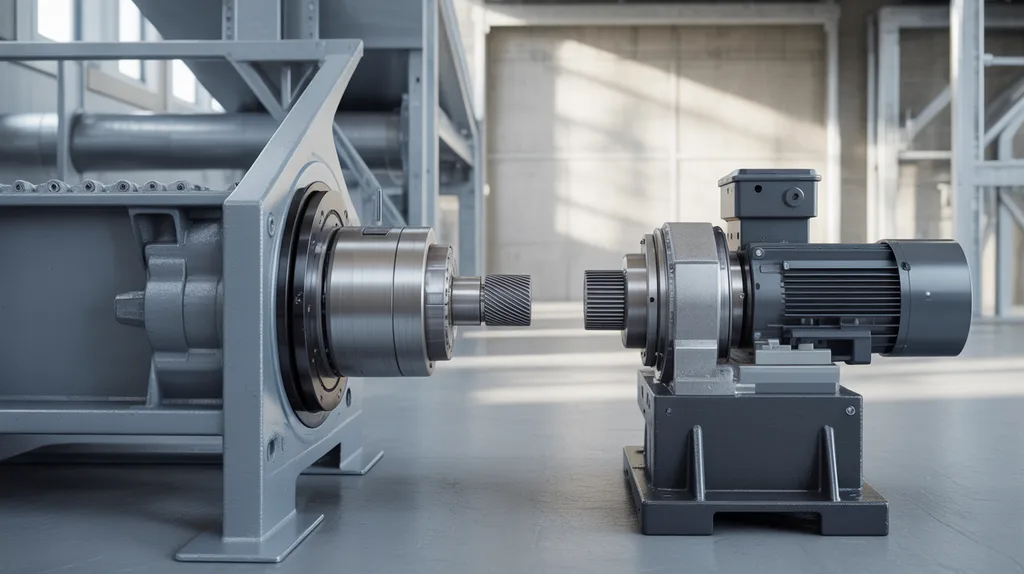
Choose a gear motor when the required motor, ratio, output speed and mounting arrangement are known and a compact, coordinated drive is the priority. Choose a separate gearbox when motor choice, component replacement or future machine reconfiguration is more important than one-piece integration.
| If your priority is... | Start by evaluating... |
|---|---|
| Simple procurement | Gear motor |
| Compact integrated packaging | Gear motor |
| Standardized OEM machine | Gear motor |
| Independent motor replacement | Separate gearbox |
| Specific motor or control platform | Separate gearbox |
| Modular future upgrades | Separate gearbox |
| Unusual mounting or ratio requirements | Compare customized configurations |
| Lowest overall project risk | The configuration fully checked against application data |
Before making the final choice, confirm:
- Required output speed
- Continuous and starting torque
- Reduction ratio
- Duty and load type
- Mounting and shaft dimensions
- Motor and control requirements
- Operating environment
- Replacement strategy
- Available service and installation space
For related information about helical configurations, see this overview of a helical geared motor. For a separate review of factors that can affect gearbox quotations, see industrial gearbox price; the final price still depends on the selected specification and application.
How Mingye Can Support an OEM Comparison
Mingye designs and supplies both motors and reducers, including gear motors, industrial gearboxes and specialized reducers. Its modular, standardized designs and stated OEM customization of mounting dimensions and transmission ratios can support buyers comparing an integrated or separate transmission solution.
Mingye’s range includes R, S, K and F series helical gear motors, HB series heavy-duty industrial gearboxes, heavy-duty planetary reducers, NMRV worm gear motors, cycloidal pinwheel reducers, cylindrical gear reducers, three-phase asynchronous motors and small gear motors. It also supplies special reducers for rubber and plastic machinery, welding rotators and paddle mixers.
Mingye builds motors and reducers in its own CNC-equipped factory in Jinshan District, Shanghai. Normal delivery is 7–15 days, subject to the product and order requirements.
OEMs and plant engineers can provide the required output speed, torque, ratio, duty, mounting dimensions and operating environment when comparing a gear motor with a separate gearbox. Mingye can then assess whether a standardized configuration or an OEM-customized mounting dimension or transmission ratio is appropriate for the application.
Share on Social:


Contact Us
In This Article
Rubber Internal Mixer Gearbox: Read the Batch Load Profile, Not Just Motor kW
Oct 22, 2026
Hot Industrial Gearbox Coupling After Cold Alignment: What to Check
Oct 22, 2026
Hydraulic Slewing Drive Won't Rotate: Separate Motor, Brake and Gearbox Faults
Oct 22, 2026
Calender Roll Gap Changes: What Must the Drive Coupling Accommodate?
Oct 22, 2026