


 Home /
Are Cycloidal Gearboxes Good for High Torque?
Right Angle Geared Motor: Matching Electrical Supply, Variable Speed and Braking
Oct 26, 2026
Planning a Bevel Reducer Installation: Turn Shaft Requirements Into a Practical Drive Layout
Oct 26, 2026
Choosing an Overhead Crane Gearbox by Its Hoisting or Travel Function
Oct 26, 2026
Replacing an Industrial Worm Gearbox: What to Keep and What to Reassess
Oct 25, 2026
Yes — cycloidal gearboxes are excellent for high torque, especially where shock loads and short overloads occur, because several lobes share the load simultaneously through rolling contact rather than sliding gear teeth. However, for continuous steady-state torque in the same physical envelope, a planetary gearbox can transmit more torque. The right choice depends on your duty cycle and impact exposure.
Key Takeaways
- Cycloidal gearboxes can absorb up to 500% of rated torque in emergency stop situations, according to Nabtesco.
- Roughly half of each cycloidal disc's lobes stay in constant contact with rollers, enabling high torque transmission with minimal stress concentration.
- Planetary gearboxes transmit more steady-state torque per unit volume, but cycloidal units handle shock and overload conditions significantly better.
- Cycloidal gearboxes offer higher durability, lower maintenance, and higher reduction ratios than planetary units of comparable size.
- Cycloidal gearboxes are built with bearing steel (100Cr6/100CrMo7) hardened to 63 HRC, giving excellent compressive load resistance.
How Does a Cycloidal Gearbox Achieve High Torque?
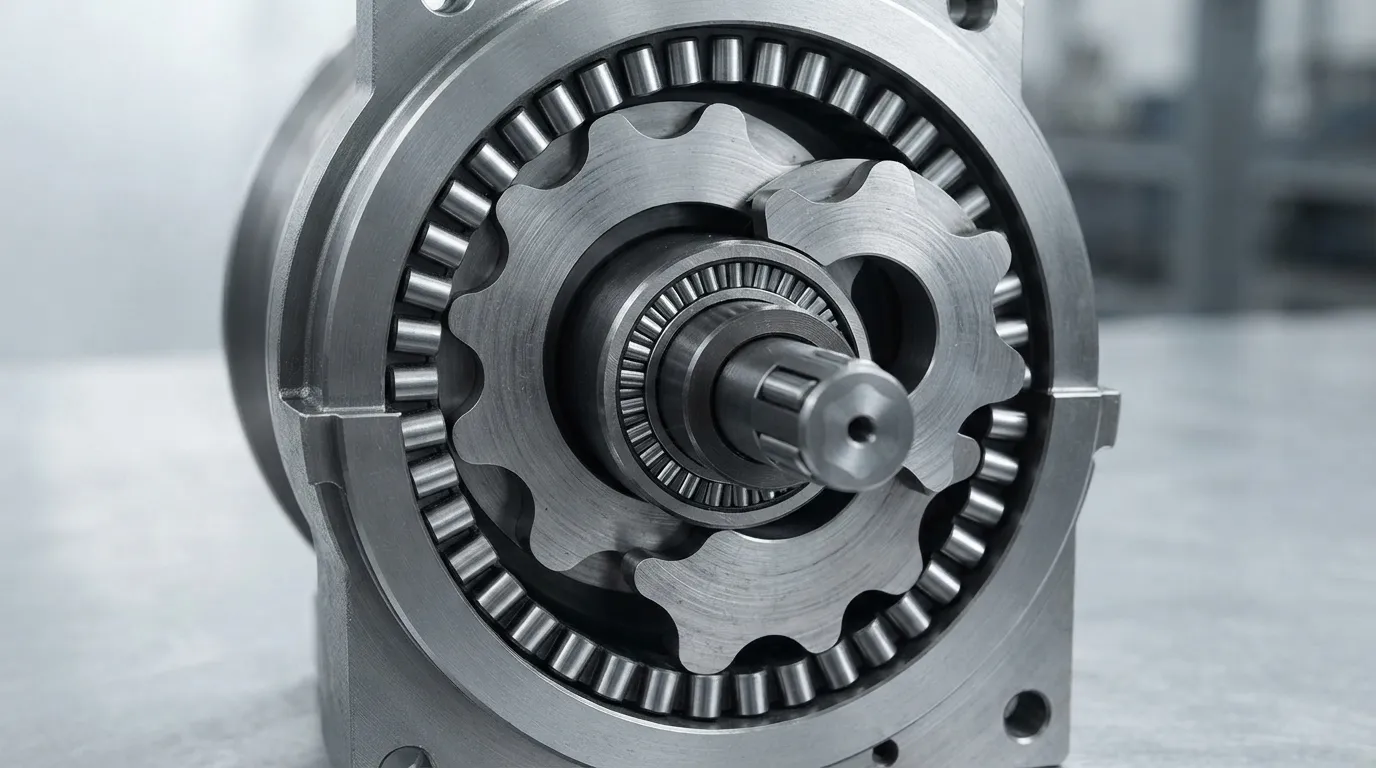
A cycloidal gearbox transmits torque through rolling contact across many lobes at once, not through one or two gear teeth — this spreads the load and prevents stress concentration.
The mechanism works through an eccentric bearing that drives one or two cycloidal discs in a wobbling motion. As the disc rotates, its lobes engage with rollers mounted on a ring gear, forcing the output shaft to rotate at a reduced speed. Because the load distributes across dozens of contact points simultaneously, no single component bears the full torque load.
According to Nabtesco, almost half of the cams of each cycloidal disc are in constant contact with the rollers at any moment. With two discs mounted 180° apart, this results in nearly a full circle of contact. Italian gearbox manufacturer Omme reports that the overlap factor — the percentage of surfaces in contact at the same time — can reach up to 70%.
This load-sharing design is fundamentally different from conventional gear transmissions. A cycloidal gearbox relies on compressive loads and pure rolling contact, while traditional gear teeth experience sliding stress and bending loads. Compressive stress is far better tolerated by hardened steel than bending stress, which is why cycloidal gearboxes can handle torque spikes that would fracture gear teeth.
How Much Torque Can a Cycloidal Gearbox Handle Compared to a Planetary?
In the same physical size, planetary gearboxes can transmit more steady-state torque — but cycloidal gearboxes absorb higher shock and overload conditions without damage.
| Feature | Cycloidal Gearbox | Planetary Gearbox |
|---|---|---|
| Steady-state torque per unit volume | Lower | Higher |
| Shock load / overload tolerance | Excellent (up to 500% rated torque) | Moderate |
| Bending moment capacity | ~250% higher than planetary | Baseline |
| Efficiency (single-stage) | ~93% | ~97% (typical) |
| Reduction ratio per stage | Up to 119:1 | Up to ~10:1 |
| Backlash | 0.1–0.2 arcmin | 3–10 arcmin (typical) |
| Maintenance | Low | Moderate |
| Noise | Low | Moderate |
The table above highlights the critical distinction engineers must understand: there are two different "torque" questions. If you need maximum continuous torque in a compact envelope, a planetary gearbox — sometimes called an epicyclic gearbox — is the better choice. According to Transcyko, cycloidal gearboxes have a lower torque capability than planetary gearboxes of the same physical dimensions.
However, if your application involves shock loads, reversing torque, or emergency stops, the cycloidal gearbox's overload tolerance becomes the decisive factor. Nabtesco reports that cycloidal gearboxes can absorb up to 500% of rated torque in emergency stop situations, and they handle around 250% higher bending moments than conventional planetary gearboxes of comparable size.
Efficiency also differs. Single-stage cycloidal drives approach 93% efficiency, while double-stage units reach approximately 86%, according to data cited on Wikipedia. Planetary gearboxes typically achieve around 97% efficiency per stage. For continuous high-torque operation, this difference matters.
Reduction ratios further separate the two technologies. Single-stage cycloidal reductions are available up to 119:1, and double-stage units reach 7,569:1, according to Wikipedia citing Sumitomo. A single-stage planetary gearbox typically maxes out around 10:1, so achieving equivalent reduction requires multiple stages.
Why Do Cycloidal Gearboxes Handle Shock Loads and Overloads So Well?
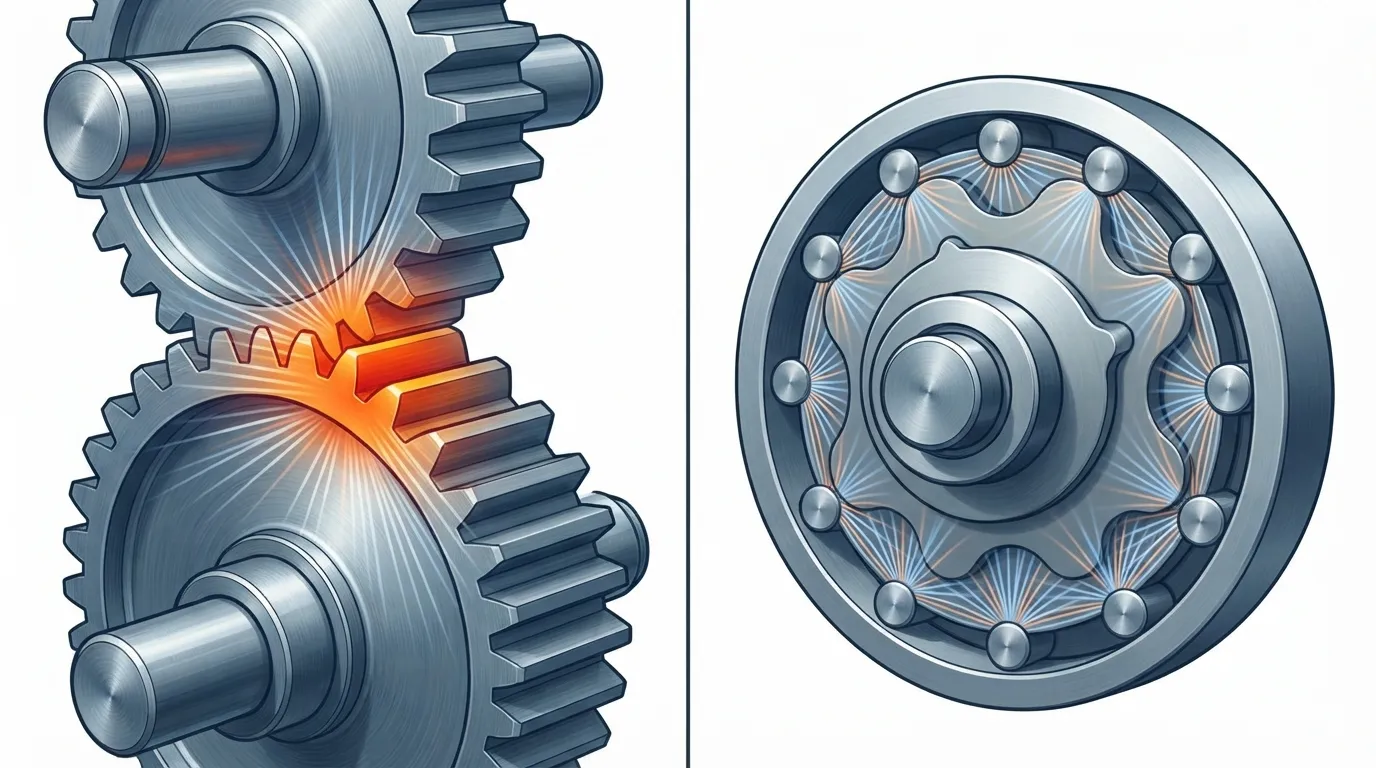
Cycloidal gearboxes absorb shock loads because the load distributes across many contact surfaces simultaneously, so no single component experiences enough stress to fail — allowing up to 500% of rated torque in emergency stops.
The physics are straightforward. When a sudden torque spike hits a conventional gear train, the force concentrates on one or two gear teeth. Those teeth must absorb the entire impact through bending stress, which is why gear breakage is a common failure mode in shock-loaded applications.
A cycloidal gearbox spreads that same impact across dozens of rolling contact points. With up to 70% of surfaces in contact simultaneously, according to Omme, the per-contact stress remains well within material limits even during severe overloads.
Material selection reinforces this advantage. The main torque-carrying components of a cycloidal gearbox are manufactured from bearing steel — 100Cr6 or 100CrMo7 — thermally treated to 63 HRC hardness, according to Omme. This is the same class of steel used in high-performance bearings, specifically chosen for its ability to withstand compressive loads and rolling contact fatigue.
This combination of load distribution and material hardness is why a cycloidal gearbox survives conditions that would destroy conventional gear reducers. For applications with frequent jams, reversing loads, or impact events, this shock tolerance directly translates into longer service life and fewer unplanned stoppages.
What Are the Limitations of Cycloidal Gearboxes for High Torque?
Cycloidal gearboxes have three main limitations for high-torque applications: they transmit less steady-state torque than planetary units of the same size, they struggle at high input speeds due to eccentric mass and vibration, and they typically cost more upfront than conventional reducers.
Lower torque density. If your application requires continuous, steady-state torque and space is constrained, a planetary gearbox will deliver more torque in the same physical envelope. According to Transcyko, this is the primary trade-off when selecting between the two technologies.
Input speed limitations. The eccentric bearing that drives the cycloidal disc creates inherent unbalanced mass. At high input speeds, this generates vibration and heat that can limit the gearbox's service life. Cycloidal gearboxes are best suited to applications where input speeds are moderate and the emphasis is on torque multiplication rather than high-speed operation.
Higher initial cost. The precision manufacturing required for cycloidal components — hardened bearing steel, tight tolerances, and specialized machining — results in a higher purchase price than many conventional reducers. According to Transcyko, this premium buys higher durability, better movement precision, lower noise, and lower maintenance requirements over the long term.
Size envelope at extreme torque ratings. For very high continuous torque requirements, planetary gearboxes achieve the same ratings in a more compact package because of their higher torque density per unit volume.
The practical decision rule: choose a cycloidal gearbox when torque is intermittent, reversing, or shock-prone; choose a planetary gearbox when torque is continuous and space is tight.
Which Applications Need the Shock-Loaded High Torque a Cycloidal Gearbox Provides?
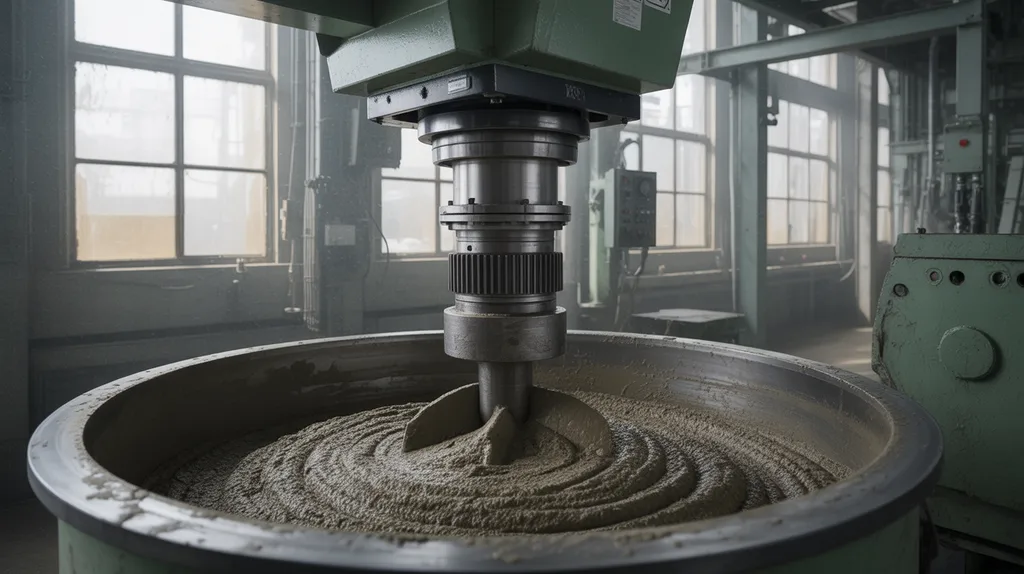
Cycloidal gearboxes excel in mixing, conveying, mining, cement, and material handling — applications with start-stop duty cycles, reversing loads, or impact conditions.
In paddle mixers and blending equipment, the load changes constantly as material consistency varies. Conveyor systems experience start-up torque spikes and occasional jams. Mining and cement equipment faces abrasive conditions and sudden load changes that would punish conventional gear teeth. Welding rotators require smooth, precise rotation under heavy and unevenly distributed loads.
A cycloidal gearbox in these applications absorbs the abuse that would eventually crack gear teeth in a conventional reducer. The result is fewer breakdowns and lower maintenance costs over the equipment's life. For a detailed breakdown of where cycloidal gearboxes deliver the most value, see our guide to cycloidal gearbox applications.
Are Cycloidal Gearboxes Backdrivable?
Yes, cycloidal gearboxes can be backdriven, but the torque required depends on the reduction ratio, the number of stages, and internal friction — higher ratios resist backdriving more.
In a single-stage cycloidal unit with a lower ratio, backdriving may occur relatively easily. In multi-stage units or those with high reduction ratios, the internal friction and mechanical advantage make backdriving significantly more difficult. Precision-grade cycloidal gearboxes designed for robotics and automation often have optimized geometries that can affect backdriving characteristics.
If backdrivability is a critical requirement for your application, specify this to your gearbox manufacturer and verify the actual behavior with a prototype. There is no single answer that applies across all cycloidal designs.
How to Choose Between a Cycloidal Gearbox and a Planetary for High Torque
Compare your duty cycle first, not just the torque rating — if you have shock loads or overloads, choose cycloidal; if you need maximum continuous torque in minimal space, choose planetary.
Follow these steps to make the right selection:
- Define your peak torque and how often it occurs. Continuous operation at high load favors planetary. Intermittent peaks, reversing torque, or emergency stops favor cycloidal.
- Assess shock exposure. If your application involves jams, impacts, or sudden load changes, the cycloidal gearbox's 500% overload tolerance is a decisive safety margin.
- Compare envelope sizes. Measure the available space. If the gearbox must fit in a tight envelope and run continuously at high torque, planetary has the advantage.
- Evaluate precision needs. If you require low backlash and high positioning accuracy, cycloidal gearboxes offer 0.1–0.2 arcmin backlash compared to 3–10 arcmin for typical planetary units.
- Factor in lifecycle cost. Consider the total cost of ownership: initial price, maintenance intervals, downtime costs, and replacement frequency. Lower maintenance requirements can offset a higher upfront price.
For a complete comparison of planetary gearboxes in high-torque applications, see our explanation of planetary gearbox high torque capabilities. If you need a gearbox that handles severe duty cycles and repeated shock loads, our guide to the best gearbox heavy duty applications provides additional context.
Understanding the cycloidal reducer gear ratio options available is also essential, since the reduction ratio directly affects torque output, efficiency, and backdriving characteristics.
FAQ
What is the maximum reduction ratio of a cycloidal gearbox?
Single-stage cycloidal reducers are commercially available up to 119:1, while two-stage units can reach 7,569:1. The high ratio per stage is a key advantage when you need both high torque and high reduction in a compact package. This compares favorably to planetary gearboxes, which typically max out around 10:1 per stage.
Are cycloidal gearboxes more expensive than planetary gearboxes?
Cycloidal gearboxes typically have a higher upfront cost than planetary units of comparable torque rating due to the precision manufacturing of bearing steel components and tight tolerances. However, lower maintenance and longer service life can offset the initial investment over the equipment's lifetime. For applications with shock loads, the reduced downtime often justifies the premium.
Can a cycloidal gearbox replace a planetary gearbox for high-torque applications?
Only if the application involves shock loads, overloads, or requires high reduction ratios in a compact design. For continuous, steady-state torque at high load, planetary gearboxes transmit more torque per unit volume and are the better choice. Evaluate your duty cycle carefully — the wrong selection leads to premature failure or unnecessary cost. To work through the selection criteria systematically, follow our guide on how to choose cycloidal reducer options for your specific application.
Share on Social:


Contact Us
In This Article
Right Angle Geared Motor: Matching Electrical Supply, Variable Speed and Braking
Oct 26, 2026
Planning a Bevel Reducer Installation: Turn Shaft Requirements Into a Practical Drive Layout
Oct 26, 2026
Choosing an Overhead Crane Gearbox by Its Hoisting or Travel Function
Oct 26, 2026
Replacing an Industrial Worm Gearbox: What to Keep and What to Reassess
Oct 25, 2026