


 Home /
Hydraulic Winch Gearbox Selection: Matching Motor Displacement, Pressure and Gear Ratio
Rubber Internal Mixer Gearbox: Read the Batch Load Profile, Not Just Motor kW
Oct 22, 2026
Hot Industrial Gearbox Coupling After Cold Alignment: What to Check
Oct 22, 2026
Hydraulic Slewing Drive Won't Rotate: Separate Motor, Brake and Gearbox Faults
Oct 22, 2026
Calender Roll Gap Changes: What Must the Drive Coupling Accommodate?
Oct 22, 2026
A hydraulic Winch Gearbox should not be selected from torque capacity alone. In practical winch design, motor displacement, system pressure, pump flow, gearbox ratio, drum diameter, line pull, duty cycle and brake capacity must operate within the same performance envelope.
From Mingye's perspective, the most reliable selection method starts at the drum and works backward toward the hydraulic motor. This avoids a common problem: a Winch Gearbox that looks adequate on a datasheet but cannot deliver the required pulling force, rope speed or thermal stability in the real machine.
Start With Line Pull, Not Motor Power
The basic drum torque requirement is:
Drum Torque = Line Pull × Effective Drum Radius
A 20 kN line pull produces very different torque requirements as rope layers build on the drum.
| Rope Position | Effective Radius | Static Drum Torque |
| First layer | 0.15 m | 3,000 Nm |
| Mid layer | 0.20 m | 4,000 Nm |
| Outer layer | 0.25 m | 5,000 Nm |
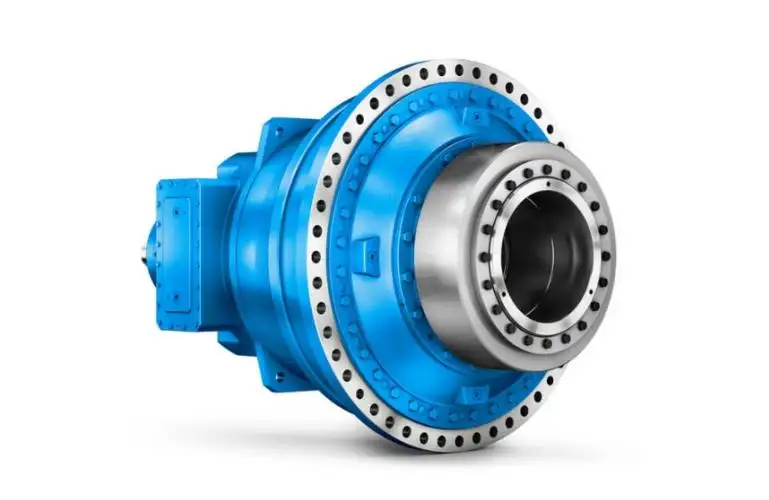
The load remains 20 kN, yet the Winch Gearbox torque demand rises by about 67% from the first to the outer layer.
For this reason, Mingye recommends evaluating at least:
•Rated line pull
•Maximum or stall line pull
•Drum core diameter
•Maximum winding diameter
•Rope diameter
•Starting and acceleration load
•Shock loading
•Duty cycle
•Required service margin
A gearbox should never be sized only from empty-drum conditions.
Hydraulic Motor Displacement and Pressure Must Be Matched Together
Hydraulic motor output torque is primarily determined by pressure differential and displacement:
Motor Torque ≈ Pressure × Displacement ÷ 2π × Mechanical Efficiency
This relationship creates a real engineering trade-off.
Larger Motor Displacement
Advantages:
•More torque at lower pressure
•Lower dependence on peak system pressure
•Potentially better heavy-load performance
Trade-offs:
•Lower motor speed at the same flow
•Larger hydraulic motor size
•Higher flow demand if higher speed is required
Smaller Motor Displacement
Advantages:
•Higher motor speed for the same flow
•More compact motor package
Trade-offs:
•Higher pressure required for the same torque
•Greater demand on pump, valve, hose and motor pressure ratings
•Higher risk of continuous relief-valve operation if poorly sized
This is why selecting a Winch Gearbox and hydraulic motor independently often leads to inefficient operation.
Gear Ratio Connects Motor Torque to Drum Torque
The gearbox acts as the mechanical bridge between the hydraulic motor and drum.
In simplified form:
Gearbox Output Torque = Motor Torque × Gear Ratio × Gearbox Efficiency
Drum Speed = Motor Speed ÷ Gear Ratio
A higher Winch Gearbox reduction ratio increases torque multiplication but reduces drum speed. Therefore, a higher ratio is not automatically better.
| Design Change | Effect on Torque | Effect on Speed | Main Engineering Risk |
| Increase motor displacement | Higher motor torque | Lower motor speed | Insufficient line speed |
| Increase system pressure | Higher motor torque | Little direct effect | Heat and pressure stress |
| Increase gearbox ratio | Higher output torque | Lower drum speed | Slow operation |
| Increase hydraulic flow | Little direct torque effect | Higher motor speed | Larger hydraulic components |
The correct solution is normally a balanced combination rather than maximizing one parameter.
Flow Determines Whether the Winch Reaches the Required Rope Speed
Hydraulic pressure mainly influences torque. Hydraulic flow mainly influences speed.
Motor speed can be approximated as:
Motor Speed ≈ Hydraulic Flow ÷ Motor Displacement
The selection process should therefore calculate speed in reverse:
Required Rope Speed → Drum RPM → Gear Ratio → Motor RPM → Hydraulic Flow
This check is essential because a Winch Gearbox may have sufficient torque but still fail the application if the motor must run above the gearbox input-speed limit.
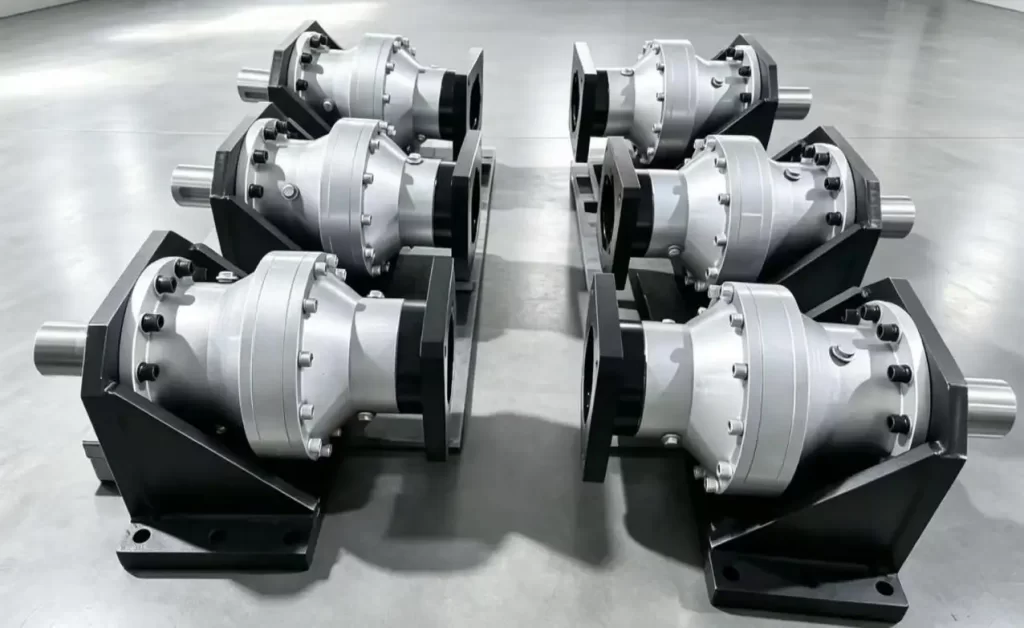
For Mingye's GMR Series planetary drive, published data includes:
•Reduction ratio: 33.6:1
•Maximum output torque: 9,000 Nm
•Maximum input speed: 1,000 r/min
•Reduction stages: 2
•Brake opening pressure: 2.4 MPa
•Listed brake torque: 7,617.12 Nm
•Hydraulic motor: GRS-250
These figures provide useful design boundaries, but final approval still requires actual load, speed and duty data.
Fixed vs. Variable Hydraulic Motors
Mingye's GMR Series can be integrated with constant or variable hydraulic motors, which allows the Winch Gearbox to be adapted to different operating strategies.
Fixed-Displacement Motor
Better suited to:
•Stable line-pull requirements
•Predictable rope speed
•Simpler hydraulic circuits
•Cost-sensitive machinery
•Variable-Displacement Motor
Better suited to:
•Wide speed ranges
•Rapid unloaded rope movement
•High torque under load
•Variable operating cycles
The motor type should therefore be selected from the machine duty, not simply from maximum torque.
Match the Motor, Winch Gearbox and Drum as One Drive System
A professional selection sequence should follow this order:
- Define line pull.
- Calculate torque at maximum effective drum radius.
- Define required rope speed.
- Calculate drum RPM.
- Select a practical Winch Gearbox ratio.
- Calculate required motor torque.
- Determine motor displacement and pressure.
- Check required hydraulic flow.
- Verify gearbox input speed.
- Verify output torque and duty cycle.
- Verify brake holding capacity.
This workflow prevents one parameter from being optimized at the expense of another.
Brake Capacity Is a Separate Safety Calculation
A Winch Gearbox that can pull a load does not automatically have enough holding capacity to keep that load stationary after hydraulic pressure is removed.
Brake evaluation should include:
•Static holding torque
•Emergency pressure-loss condition
•Brake release pressure
•Load-control or counterbalance valve behavior
•Brake engagement sequence
•Dynamic stopping load
Mingye lists a brake opening pressure of 2.4 MPa for the GMR configuration. This must not be confused with the hydraulic motor operating pressure.
Likewise, the published 7,617.12 Nm brake torque should be checked against the exact torque reference point and application before being used in a final winch calculation.
Installation Conditions Can Change Gearbox Life
Even a correctly sized Winch Gearbox can fail prematurely if installation conditions are ignored.
Important checks include:
•Motor-to-gearbox alignment
•Drum connection and output shaft loading
•Radial and overhung load
•Bearing load generated by rope tension
•Seal condition
•Lubricant condition
•Oil temperature
•Hydraulic contamination
•Hose and valve pressure losses
Thermal performance is particularly important in high-duty winches. Maximum torque is not the same as continuous thermal capacity.
Standards Should Be Checked at Machine Level
Hydraulic system design can reference ISO 4413:2010 for hydraulic fluid-power safety requirements.
Machine risk assessment can reference ISO 12100:2010.
Where the winch forms part of crane or hoisting equipment, additional standards may apply to:
•Duty classification
•Wire-rope selection
•Drum dimensions
•Safety factors
•Brake requirements
The applicable standard depends on whether the Winch Gearbox is used in construction machinery, marine equipment, mining equipment, cranes or another machine category.
What Buyers Should Send Mingye Before Requesting a Winch Gearbox
For a meaningful technical quotation, buyers should provide:
•Rated and maximum line pull
•Drum core and maximum winding diameter
•Rope diameter
•Required rope speed
•Hydraulic working and maximum pressure
•Pump flow
•Preferred motor type
•Duty cycle
•Brake requirement
•Mounting orientation
•Drum or shaft interface
•Ambient temperature
•Operating environment
For hydraulic winch applications requiring a compact planetary transmission, the Mingye GMR Series Winch Gearbox provides a practical starting point with a 33.6:1 ratio, 9,000 Nm maximum output torque and hydraulic motor integration.
However, final Winch Gearbox selection should always be based on the complete load, drum and hydraulic-system data rather than catalog torque alone.
For a new hydraulic winch project, engineers can review the Mingye GMR Series Planetary Slewing Drive and submit your operating parameters to Mingye for motor, ratio, brake and gearbox matching.
FAQs
Q1. What type of Winch Gearbox does Mingye offer for hydraulic winch applications?
Mingye offers the GMR Series planetary slewing drive, which can be applied as a compact planetary Winch Gearbox for hydraulic winches and other heavy-duty drive systems.
Q2. What is the gear ratio of the Mingye GMR Series Winch Gearbox?
The GMR configuration uses a 33.6:1 reduction ratio, providing substantial torque multiplication between the hydraulic motor and winch drum.
Q3. What is the maximum output torque of the Mingye GMR Winch Gearbox?
Mingye offers a maximum output torque of 9,000 Nm for the GMR Series. Continuous allowable torque should still be confirmed according to duty cycle and operating conditions.
Q4. What is the maximum input speed of the GMR Series?
The maximum input rotation speed is 1,000 r/min. Motor speed should therefore be checked against this limit during Winch Gearbox selection.
Q5. Can Mingye match the Winch Gearbox with different hydraulic motors?
Yes. Mingye's GMR planetary drive can be integrated with constant-displacement or variable-displacement hydraulic motors depending on operating requirements.
Share on Social:


Contact Us
Rubber Internal Mixer Gearbox: Read the Batch Load Profile, Not Just Motor kW
Oct 22, 2026
Hot Industrial Gearbox Coupling After Cold Alignment: What to Check
Oct 22, 2026
Hydraulic Slewing Drive Won't Rotate: Separate Motor, Brake and Gearbox Faults
Oct 22, 2026
Calender Roll Gap Changes: What Must the Drive Coupling Accommodate?
Oct 22, 2026