


 Home /
 Backlash Control in Special Reducer for Welding Turning Rolls
Rubber Internal Mixer Gearbox: Read the Batch Load Profile, Not Just Motor kW
Oct 22, 2026
Hot Industrial Gearbox Coupling After Cold Alignment: What to Check
Oct 22, 2026
Hydraulic Slewing Drive Won't Rotate: Separate Motor, Brake and Gearbox Faults
Oct 22, 2026
Calender Roll Gap Changes: What Must the Drive Coupling Accommodate?
Oct 22, 2026
Welding turning rolls are used to rotate tanks, pipes, pressure vessels, and other cylindrical workpieces during circumferential welding. Although the rollers contact the workpiece directly, rotation quality depends on the complete drive system, including the motor, reducer, coupling, shafts, wheels, controls, frame, and workpiece position.
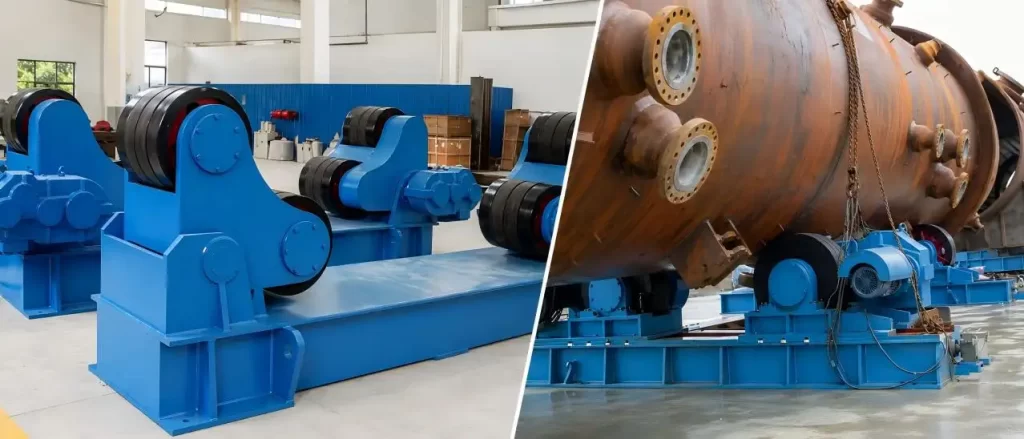
At Mingye, we regard the special reducer as an important link between motor input and controlled roller movement. The reducer reduces high-speed motor output while simultaneously delivering enhanced torque to the drive wheels.
Gear backlash is one of the many factors that affect the reducer. Backlash will help with lubrication, allow for thermal expansion, and assist in the smooth engagement of gears' contact. However, excessive or inconsistent backlash will negatively affect the response and repeatability of the welding turning rolls.
What is Backlash in Welding Turning Rolls?
Backlash is the term used for the small amount of clearance between the non-working surfaces of two mating gears. In general terms, gears should not operate with both tooth surfaces in continuous contact; thus, some clearance is required.
In welding turning rolls, backlash will become evident during startup, stopping, speed adjustment, changes in load, or reversal of direction.
•Start up response: Excessive backlash may allow the input shaft to move before torque is transmitted to the output shaft.
•Low-speed movement: Engagement of gears will become so irregular that it will be difficult to control roller rotation.
•Stopping accuracy: Lost motion will make it impossible to reliably position a welding joint.
•Direction changes: When direction is reversed, the clearance is evident.
•Load changes: Eccentric or unevenly distributed weight of the vessel will create a change in the direction of the forces acting on the drive train.
Unstable rotation may be caused by other factors in addition to backlash. Coupling wear, shaft misalignment, wheel slip, frame movement, and control settings may produce similar symptoms.
Why Backlash Control Matters in Welding
During circumferential welding, the welding torch often remains relatively fixed while welding turning rolls rotate the workpiece beneath it. Roller speed therefore contributes directly to welding travel speed.
Constant workpiece rotation facilitates a uniform position of the torch relative to the weld joint. Localized welding conditions Sudden workpiece movements can adversely affect localized welding conditions. by sudden workpiece movements.
| Rotation Behavior | Possible Welding Effect |
| Smooth, steady turning | Supports a consistent welding travel rate |
| Delayed startup | May complicate arc-start positioning |
| Hesitation followed by movement | Can influence local heat input and bead appearance |
| Repeated speed fluctuation | May make multi-pass alignment more difficult |
| Uncontrolled stopping movement | Can reduce joint-positioning repeatability |
The actual effect also depends on the welding process, workpiece geometry, torch settings, roller traction, and operator control. For this reason, we assess backlash as part of the complete welding turning rolls system rather than as an isolated parameter.
How Mingye Handles Backlash Control
At Mingye, backlash control starts with the design of the reducer and continues through selection of materials, gear processing, heat treatment, assembly, and final inspection.
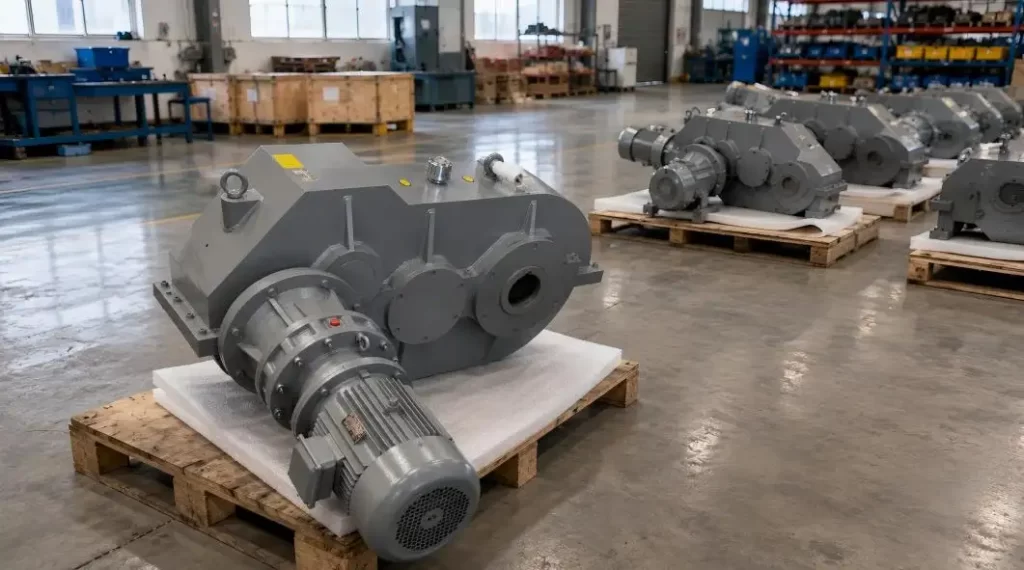
Gear Design and Transmission Configuration
The reducer's design begins with the turning speed and torque specifications, equipment arrangement, and workpiece range.
•Reduction ratio: The ratio must be selected to equate the motor speed to the output speed of the rollers.
•Gear Arrangement: A gear arrangement should be constructed to transmit torque while requiring minimal movement and concentration of load.
•Center Distance: The distance separating the centers of gears affects both the engagement of the teeth and the clearances necessary for satisfactory functioning.
•Shaft Support: The bearing and housing should support the shaft in such a way that variable loads produce only a small degree of displacement of the shaft.
•Thermal allowance: Clearance must be provided to account for changes in length due to operating temperature rise.
Gear Manufacturing and Heat Treatment
Our JA, JB, and JC series reducers are developed as dedicated mechanical drive devices for welding rotator systems. According to our published product information, the main structural parts use high-strength alloy steel.
The gears are made from low-carbon alloy steel and processed through carburizing and quenching. The listed tooth-surface hardness is 58–62 HRC.
•Carburized surface: A hardened surface layer on gear teeth renders them resistant to wear from contact.
•Tougher gear core: A tough core aids in load-carrying capability.
•Controlled machining: Gear engagement consistency is influenced by the profile, pitch, runout, and alignment.
•Grade 6 accuracy: Our product data claims Grade 6 gear accuracy. The relevant inspection standard should be referenced in the course of the project.
Assembly and Inspection Considerations
Accurate motion is not a given with accurately processed gears if assembly is poorly controlled. Reducer assembly requires strict control of shaft position, bearing and tooth contact, and operational clearance.
The following considerations Manufacturing and inspection include the following considerations:
•Bearing placement: Proper placement preserves gear-center distance under load.
•Shaft positioning: Controlled positioning facilitates more uniform contact across the tooth width.
•Backlash inspection: Backlash is to be measured after the gear set is assembled.
•Contact pattern inspection: Marks of tooth contact are a means to indicate load distribution.
•Operational indicators: Noise, vibration, temperature, and behavior of the output are all observed and noted during testing.
These controls help support predictable transmission, but final performance also depends on how the reducer is installed in the welding turning rolls.
Installation Factors That Affect Rotation
In the course of our application troubleshooting, we found that some cases of apparent backlash occur outside the gearbox.
•Condition of couplings: Backlash can occur due to loose or worn couplings.
•Rigidity of the mounting structure: A mounting structure with low rigidity can deform under torque.
•Roller Alignment: Misaligned rollers can result in uneven travel of the carriage.
•Wheel Adhesion: Slipping is a result of poor adhesion, as well as the presence of oil and scale.
•Eccentricity of Workpiece: Eccentricity is caused by flanges, nozzles, and internal components.
•Control settings: Clearance in the drive can be caused by frequent and sudden changes in the drive speed.
Mechanical and control systems should always be assessed in their entirety before any reducer is adjusted or replaced.
Matching the Reducer to Welding Turning Rolls
Mingye provides bolt-adjustable rotators, self-aligning rotators, lead-screw-adjustable rotators, and fit-up rotators in JA, JB, and JC series reducers.
Typically, the following is assessed to determine appropriate configuration:
•Rotator design: Structure of the equipment, arrangement of rollers, and direction of mounting.
•Workpiece parameters: Diameter, length, total weight, and distribution of weight.
•Speed: The turning speed, the range of adjustment, and the frequency of reverse.
•Motor characteristics: Power, input speed, method of control, and how the motor is coupled.
•Operating conditions: The length of time the system may be operated continuously, the frequency of starts, and the conditions in the workshop.
•Replacement details: Drawings, shaft dimensions, photographs, nameplate information, or existing reducer models.
Conclusion
From Mingye's manufacturing perspective, effective backlash control does not mean eliminating all gear clearance. The objective is to maintain a suitable and repeatable clearance that allows lubrication and thermal movement while supporting stable torque transmission.
When the reducer is correctly designed, manufactured, assembled, and integrated, welding turning rolls can provide smoother workpiece rotation, more repeatable positioning, and more consistent low-speed movement. Selecting the reducer according to the actual rotator structure and operating load is therefore an important part of maintaining welding accuracy.
FAQ
Q1. What is a welding rotator reducer backlash?
Backlash refers to gaps in rotary systems for engaging gears.
Q2. Why is backlash important?
Backlash is important for aiding the even spread of lubricant, thermal expansion, and the engagement of gears without jamming.
Q3. Can too much backlash cause accuracy problems in welding?
Yes. Too much backlash causes delays in the movements of the welding machine, affecting the precision of the machine.
Q4. What is the effect of backlash on the welding turning rolls?
Backlash affects the response of the system during engagement, the precision of the system during disengagement, and the stability of the system during low-speed operations.
Q5. Does less backlash mean that the performance is improved?
No. A small backlash causes high friction, gears to jam, and heating of the gears, leading to rapid wear of the gears.
Share on Social:


Contact Us
In This Article
Rubber Internal Mixer Gearbox: Read the Batch Load Profile, Not Just Motor kW
Oct 22, 2026
Hot Industrial Gearbox Coupling After Cold Alignment: What to Check
Oct 22, 2026
Hydraulic Slewing Drive Won't Rotate: Separate Motor, Brake and Gearbox Faults
Oct 22, 2026
Calender Roll Gap Changes: What Must the Drive Coupling Accommodate?
Oct 22, 2026