


 Home /
 Torque Distribution in a Double-Shaft Paddle Mixer Special Reducer
Right Angle Geared Motor: Matching Electrical Supply, Variable Speed and Braking
Oct 26, 2026
Planning a Bevel Reducer Installation: Turn Shaft Requirements Into a Practical Drive Layout
Oct 26, 2026
Choosing an Overhead Crane Gearbox by Its Hoisting or Travel Function
Oct 26, 2026
Replacing an Industrial Worm Gearbox: What to Keep and What to Reassess
Oct 25, 2026
A double-shaft paddle mixer uses two counter-rotating paddle shafts to move powders or granules in radial, axial, and cross-flow directions. Between the shafts, the paddles create a fluidized or near-weightless mixing zone in which particles are repeatedly lifted, dispersed, and redistributed.
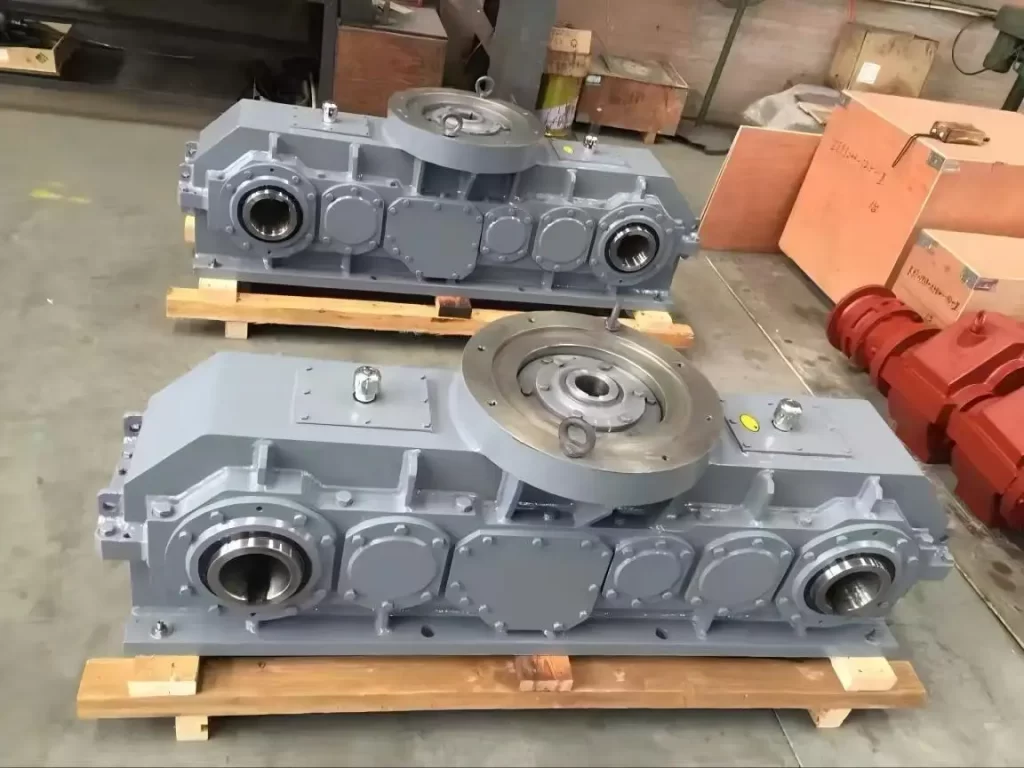
For this process to remain stable, the drive system must provide controlled low-speed rotation, sufficient starting torque, and synchronized output to both shafts. From Mingye's manufacturing perspective, reducer selection should therefore begin with mixer volume, paddle diameter, material characteristics, starting conditions, and shaft-center distance—not motor power alone.
Why Output Speed Matters
Rotational speed influences particle circulation, mixing time, power demand, dust generation, and mechanical loading. Research into double-shaft paddle mixing indicates that impeller speed is an important operating variable affecting mixing quality, mixing time, and energy consumption.
Mingye's double-shaft paddle mixer reducer series provides nominal output speeds of approximately 30–50 rpm, depending on the model and reduction ratio. This speed range is typical of most industrial paddle mixers. However, the speed must still be optimized for paddle size and the behavior of the materials.
•Fluidized mixing zone: The appropriate paddle speed moves materials into the center cross-mixing area and prevents the formation of cross-mixing walls and excessive dust.
•Predictable shaft timing: The two output shafts are mechanically synchronized for all the mixing cycles due to a fixed gear relationship.
•Stable process conditions: With constant gear ratios, the only contributors to variable shaft speed are motor slip, changes in voltage, or changes in the setting on the VFD.
•Controlled paddle tip speed: Paddle diameter also affects tip speed and paddle movement with shaft paddle rpm.
Torque is the most demanding during mixing start-up, mixing dense materials, materials that are difficult to mix, and after the addition of a liquid component. A double-shaft paddle mixer reducer is purpose-built to accommodate torque division and drive two outputs from a single gearbox.
Key transmission characteristics are the following:
•Nominally balanced output: The gearbox supplies both shafts from the same input while maintaining matched rotational timing.
•Dynamic load sharing: The torque on each shaft is instantaneously determined by paddle resistance, and thus, the load is not equal at every instant.
•Reduced external components: Twin hollow-shaft outputs reduce the need for shaft couplings, supports, and alignment.
•Starting-Load Capacity: When designing reducers, factors like material compaction, loaded starts, and service factors should also be taken into account, in addition to steady-state motor power, to avoid underdesigning for shock loads.
Gear Design for Continuous Mixing Duty
For this series of double-shaft paddle mixers, Mingye utilizes a four-stage gear transmission. Based on the published specifications, these gears are produced using low-carbon alloy steel and are subjected to carburizing and quenching. The specifications for the surface hardness of the gears are given as 58 – 62 HRC, and the gears are classified as grade 6 in terms of precision.
A carburized hardness of 58 – 62 HRC is in line with the values that are generally accepted for case-hardened industrial gears. This treatment is used to improve tooth-surface wear resistance and contact-fatigue performance while retaining a comparatively tougher core.
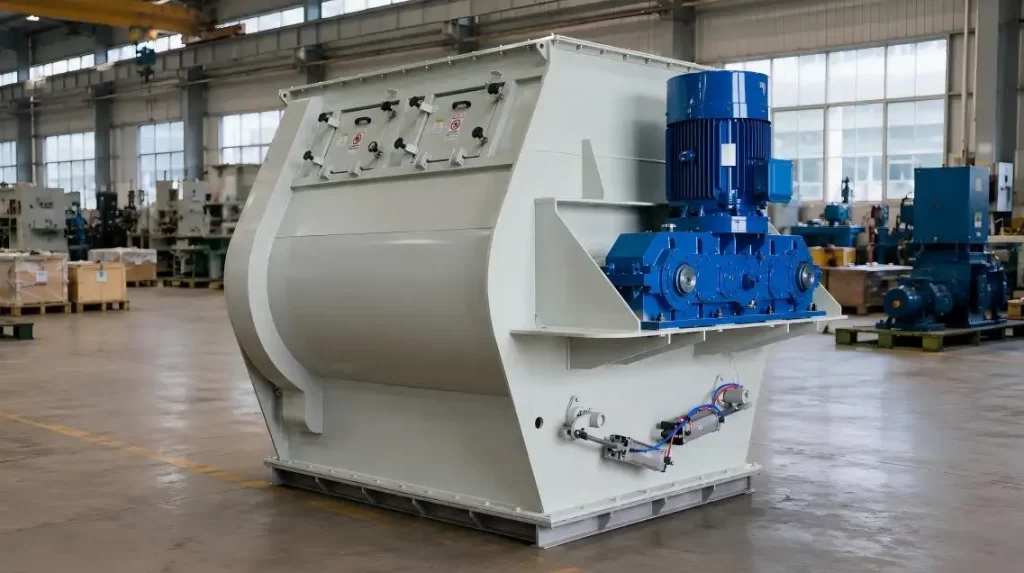
The dedicated housing combines the reduction stages and two output shafts in one assembly. For machine builders, this arrangement can:
•Simplify the mixer-frame design.
•Reduce the required installation space.
•Limit the number of external transmission components.
•Improve control of output-shaft spacing and alignment.
•Provide more accessible maintenance points.
Representative Output Parameters
The following specifications are based on Mingye's published model data. The torque values are theoretical torque per shaft, calculated using the following:
Torque per shaft = 9550 × motor power ÷ output speed ÷ 2
These figures do not include gearbox efficiency, motor overload limits, service factors, or unequal instantaneous loading.
| Model | Center Distance | Motor Power | Ratio | Output Speed | Mixer Volume | Theoretical Torque per Shaft |
| YHJ450-30-AM132 | 450 mm | 7.5 kW | 30 | 50 rpm | 0.25–0.5 m³ | 716 Nm |
| YHJ570-35-AM180 | 570 mm | 18.5 kW | 35 | 41 rpm | 0.5–0.75 m³ | 2,155 Nm |
| YHJ890-50-AM225 | 890 mm | 37 kW | 50 | 30 rpm | 2–4 m³ | 5,889 Nm |
| YHJ1050-50-AM225 | 1,050 mm | 45 kW | 50 | 30 rpm | 6–8 m³ | 7,163 Nm |
| YHJ1360-50-AM280 | 1,360 mm | 90 kW | 50 | 30 rpm | 12–15 m³ | 14,325 Nm |
The table shows that larger double-shaft paddle mixer systems generally retain relatively low shaft speeds while requiring substantially greater torque. However, working volume alone does not determine reducer size. Bulk density, paddle geometry, fill ratio, cycle frequency, startup method, and liquid addition can all change the required torque margin.
Selecting a Reducer for the Actual Process
For a new double-shaft paddle mixer or a retrofit project, Mingye typically evaluates several operating factors:
•Process material: Bulk density, abrasiveness, moisture, flowability, and tendency to compact.
•Mixer geometry: Factors to consider include working volume, spacing of shafts, dimensions of paddles and shafts, and preferred direction of installation.
•Operating cycle: The term refers to required mixing time, number of starts per hour, required system duty cycle (continuous or intermittent), and loaded start.
•Drive conditions: Take into account the parameters of the drive motors (such as speed & power capabilities, etc.), use of the VFD, output speed requirements, and the space constraints of available mounting positions.
•Maintenance requires these considerations, including arrangement of lubrication, access for inspection, alignment of shafts, and compatibility of replacement parts.
An appropriate double-shaft paddle mixer reducer provides more than just low rpm. It should allow for shaft synchronization, provide a torque reserve, fit the mixer configuration, and allow for the thermal and mechanical limits of the complete drive system.
Mingye's approach seeks to match these drive characteristics to the actual conditions of mixers, not seeing the reducer as a component for conditions of mixers or a component of general use.
FAQ
Q1. What is the typical output speed of a Double Shaft Paddle Mixer?
Output speeds of many Double Shaft Paddle Mixer systems range between 30 and 50 rpm. These rates vary with paddle diameter, the properties of the mixing material, and the capacity of the mixer.
Q2. Why are Double Shaft Paddle Mixers designed for high torque?
Mixing high-volume, dense, and compacted materials requires high starting and operational torque to maintain the mixer's speed under load.
Q3. What is the process for determining mixing shaft torque?
Theoretical torque can be determined for each mixing shaft by division of the output shaft motor power and rotational speed. Consideration must be given to the efficiency of the gear box.
Q4. Do all output shafts have the same torque?
The gear reducer is designed for balanced torque transmission to each output shaft. Due to varying material resistance, torque to each output shaft may momentarily be unbalanced.
Q5. Is it possible to change the output speed?
With certain constraints to the mixing process and components, like the reducer and lubrication, output speed is changeable with a variable-frequency drive.
Share on Social:


Contact Us
In This Article
Right Angle Geared Motor: Matching Electrical Supply, Variable Speed and Braking
Oct 26, 2026
Planning a Bevel Reducer Installation: Turn Shaft Requirements Into a Practical Drive Layout
Oct 26, 2026
Choosing an Overhead Crane Gearbox by Its Hoisting or Travel Function
Oct 26, 2026
Replacing an Industrial Worm Gearbox: What to Keep and What to Reassess
Oct 25, 2026