


 Home /
Right Angle Bevel Gearbox Efficiency: Where Power Losses Occur in 90-Degree Drives
Right Angle Geared Motor: Matching Electrical Supply, Variable Speed and Braking
Oct 26, 2026
Planning a Bevel Reducer Installation: Turn Shaft Requirements Into a Practical Drive Layout
Oct 26, 2026
Choosing an Overhead Crane Gearbox by Its Hoisting or Travel Function
Oct 26, 2026
Replacing an Industrial Worm Gearbox: What to Keep and What to Reassess
Oct 25, 2026
A Right Angle Bevel Gearbox is often selected when machinery needs to turn power through 90 degrees while maintaining high torque density and a compact drive layout. But "high efficiency" should never be treated as a fixed percentage independent of operating conditions.
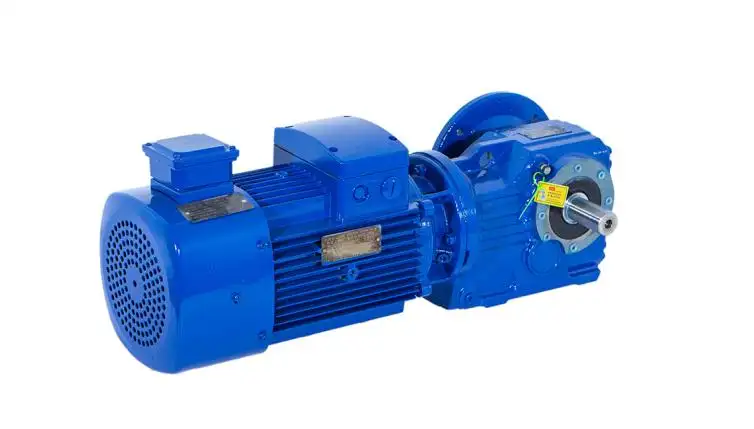
In a real drive system, efficiency changes with torque, input speed, gear ratio, lubricant viscosity, oil level, bearing condition, temperature, mounting accuracy, and duty cycle. Understanding where power is lost helps engineers size the gearbox correctly and avoid unnecessary heat, motor load, and lifecycle cost.
What Occurs to Power in a Right Angle Bevel Gearbox?
For any gearbox: Efficiency (η) = Output Power / Input Power
The input and output power gap is mechanical loss which is primarily transformed into heat energy.
Input power encounters many mechanical contacts in a helical-bevel Right Angle Bevel Gearbox:
Motor → Bevel Gear Mesh → Bearings → Helical Gear Stage → Output Shaft
Each contact has some loss.
| Loss Type | Mechanism | Influencing Factors |
| Gear mesh | Rolling and sliding friction | Torque, tooth geometry, lubrication |
| Bearings | Rolling/sliding friction | Load, preload, speed |
| Oil churning | Gears moving through oil | RPM, oil depth, viscosity |
| Shaft seals | Contact friction | Shaft speed, seal design |
| Misalignment | Uneven tooth/bearing loading | Installation, shaft alignment |
This explains why a warm gearbox does not necessarily indicate low efficiency. Box housing temperature depends on the ambient temperature and airflow, operating time, surface area of the housing, and the amount of heat that can be released.
Gear Mesh Loss Starts at the Tooth Contact
A Right Angle Bevel Gearbox redirects torque through the bevel gear set. The gear teeth experience both rolling and sliding during engagement.
Friction at this contact depends on:
• Transmitted torque;
• Tooth surface finish;
• Contact pattern;
• Lubricant film;
• Gear geometry;
• Manufacturing accuracy.
After directional transmission, the helical stage reduces speed more, while increasing torque. Moreover, progressive tooth engagement helps to spread the load, but still results in some degree of friction.
Poor tooth contact, profile error, and misalignment can result in a higher contact stress, and an increased level of vibration and temperature with an even faster rate of wear.
For this reason, gear accuracy becomes significant because it helps maintain a consistent load distribution, and thus, results in more predictable behavior in the transmission of motion.
Speed Can Increase Loss Even When Torque Does Not Change
Some Right Angle Bevel Gearbox losses are load-dependent; others exist even at light load.
At higher input speeds:
• Bearings rotate faster;
• Shaft seals experience greater sliding velocity;
• Gears accelerate more lubricant;
• Oil splash becomes more intensive;
• Churning losses may increase.
This creates an important engineering distinction.
Load-Dependent Losses
Primarily associated with:
• Gear tooth friction;
• Loaded bearings;
• Torque transmission.
Load-Independent or Weakly Load-Dependent Losses
Typically include:
• Oil churning;
• Seal drag;
• Certain bearing losses.
This explains why an oversized gearbox running continuously at very low load is not automatically the most energy-efficient solution.
Partial-Load Efficiency Matters in Real Machinery
Many industrial machines rarely operate continuously at rated torque.
Consider a conveyor sized for a peak production condition but normally running at 30–50% load. Oil, seals, and bearings still consume power even though useful output decreases.
As useful output power falls, fixed losses represent a larger percentage of total input power.
For this reason, Right Angle Bevel Gearbox efficiency should be evaluated near the actual operating point, not simply at theoretical maximum load.
Engineers should define:
• Normal running torque;
• Peak torque;
• Input RPM;
• Output RPM;
• Starts per hour;
• Daily operating hours;
• Shock-load characteristics.
Right Angle Bevel Gearbox vs. Worm Gearbox
Both architectures can provide 90-degree transmission, but their loss mechanisms are different.
| Engineering Factor | Helical-Bevel Drive | Worm Drive |
| Tooth interaction | Rolling with controlled sliding | Higher sliding component |
| Thermal behavior | Strongly dependent on load, RPM and lubrication | Sliding friction can generate substantial heat |
| Continuous operation | Well suited when properly sized | Thermal capacity requires careful review |
| Very high single-stage ratio | Limited | Strong advantage |
| Self-locking capability | Normally not required | Possible with certain geometries |
| Typical selection focus | Efficiency, torque, compact right-angle layout | High ratio, compactness, motion characteristics |
The correct choice depends on the duty. A worm gearbox can be appropriate when high ratios or specific self-locking behavior matter. A Right Angle Bevel Gearbox is often preferred where continuous torque transfer and reduced drivetrain losses are priorities.
Lubrication Is an Efficiency and Reliability Decision
Lubrication should never be optimized for efficiency alone.
Higher-viscosity oil can improve film thickness under demanding tooth loads, but excessive viscosity increases resistance through bearings and rotating gears.
Likewise:
Oil level too high → Deeper gear immersion → Greater oil displacement → Higher churning loss
But:
Oil level too low → Inadequate lubrication → Wear, temperature rise, and possible gear damage
Oil selection must therefore consider:
• Operating RPM;
• Torque;
• Ambient temperature;
• Gearbox temperature;
• Mounting position;
• Duty cycle;
• Manufacturer recommendations.
Lower drag is useful only when adequate lubrication remains available.
Match the Right Angle Bevel Gearbox to the Complete Drive System
Gearbox selection should start with the relationship between power, torque, and speed:
P = T × ω
After reduction, output torque is approximately influenced by:
Input Torque × Gear Ratio × Transmission Efficiency
A practical Right Angle Bevel Gearbox selection therefore requires more than maximum torque.
For Continuous Conveyors
Prioritize:
• Continuous output torque;
• Operating temperature;
• Thermal balance;
• Duty cycle;
• Actual running load.
For Packaging and Automated Machinery
Also consider:
• Frequent starts;
• Acceleration torque;
• Positioning stability;
• Variable-speed operation.
For Lifting and Heavy Industry
Evaluate:
• Shock loading;
• Peak torque;
• Service factor;
• Bearing loads;
• Mechanical safety margin.
Service factor is not efficiency. It represents operating severity and mechanical reserve.
Installation Can Create Losses That Were Not Designed Into the Gearbox
A correctly engineered Right Angle Bevel Gearbox can still operate inefficiently if installation changes internal loading.
Typical causes include:
• Coupling misalignment;
• Excessive external shaft load;
• Incorrect mounting orientation;
• Incorrect oil quantity;
• Foundation distortion;
• Contaminated lubricant.
During maintenance, temperature should not be evaluated alone. More reliable diagnosis comes from comparing:
Temperature + Vibration + Noise + Motor Current + Lubricant Condition
A gradual increase across several indicators can reveal rising mechanical resistance before catastrophic failure occurs.
Mingye's Manufacturing Approach to Stable Gear Transmission
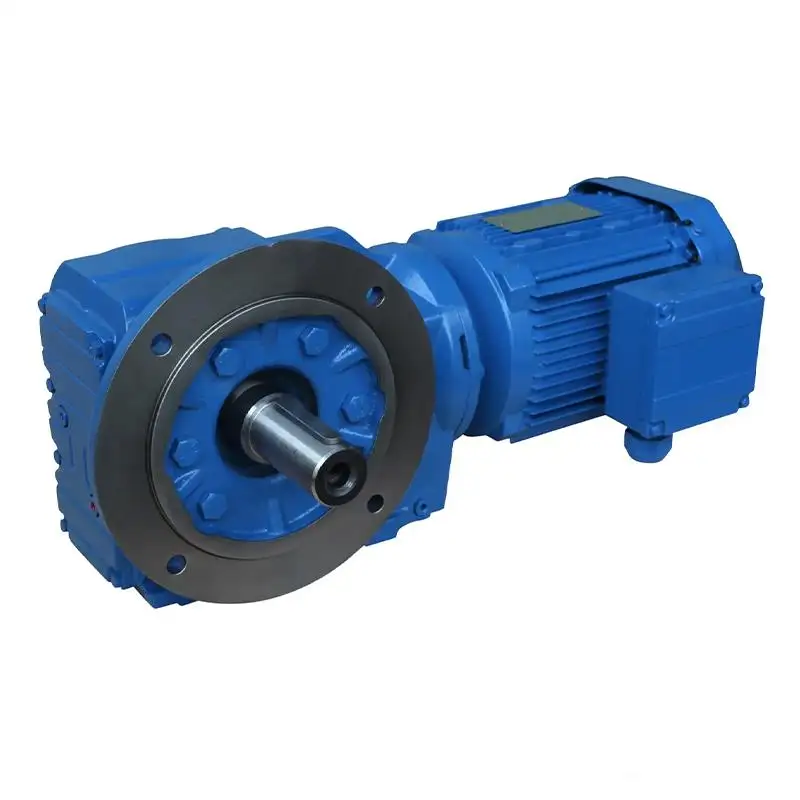
Mingye's K Series Helical Bevel Gear Motor uses a bevel stage for right-angle power transfer followed by a helical stage for speed reduction and torque transmission.
For gears and gear shafts, Mingye lists forging, carburizing and quenching, HRC 58–62 hardness, tooth grinding, Grade 6 tooth profile/lead/pitch inspection, magnetic-particle inspection, and component traceability. The housing is inspected using CMM equipment. These manufacturing controls are relevant because gear geometry, hardness, surface condition, and alignment all influence load distribution and long-term transmission stability.
However, buyers should still distinguish manufacturing quality from a specific measured efficiency percentage.
Final Words
A Right Angle Bevel Gearbox needs to have a balance of all qualities like efficiency, thermal capacity, torque margin, lubrication, installation and service life. All of these factors need to work together as one system.
For 90 degree drive applications, packaging equipment, material handling, and plastic machines, Mingye offers the K Series Helical Bevel Gearbox Motor. This is designed with hardened and ground gearing and controlled manufacturing processes. Engineers can provide their power, ratio, speed, torque and mounting requirements to Mingye and they will assist best in making a selection based on the application as opposed to simply selecting a gearbox by nominal power.
FAQs
Q1. What type of Right Angle Bevel Gearbox does Mingye offer?
Mingye offers K Series Helical Bevel Gear Motors that combine a bevel gear stage for 90-degree power transmission with helical gearing for speed reduction and torque transfer.
Q2. What applications are Mingye Right Angle Bevel Gearbox solutions suitable for?
They can be used in conveyors, packaging machinery, material handling systems, plastic machinery and other industrial equipment requiring compact right-angle transmission.
Q3. How does Mingye improve gear accuracy in its Right Angle Bevel Gearbox?
Mingye uses gear grinding and inspections of tooth profile, lead and pitch. Its published K Series manufacturing information specifies Grade 6 gear accuracy.
Q4. What gear hardness does Mingye use for its helical-bevel gear systems?
Mingye states that gears and gear shafts are carburized and quenched to approximately HRC 58–62 to support wear resistance and load-carrying performance.
Q5. Does Mingye offer a fixed efficiency percentage for its Right Angle Bevel Gearbox?Mingye's K Series acts as a high-efficiency drive solution, but buyers should request operating-point data rather than assume one efficiency percentage applies to every ratio, speed and load.
Share on Social:


Contact Us
In This Article
Right Angle Geared Motor: Matching Electrical Supply, Variable Speed and Braking
Oct 26, 2026
Planning a Bevel Reducer Installation: Turn Shaft Requirements Into a Practical Drive Layout
Oct 26, 2026
Choosing an Overhead Crane Gearbox by Its Hoisting or Travel Function
Oct 26, 2026
Replacing an Industrial Worm Gearbox: What to Keep and What to Reassess
Oct 25, 2026