


 Home /
OEM Cycloidal Gearbox Manufacturer: What Can Be Customized for Industrial Machinery?
Right Angle Geared Motor: Matching Electrical Supply, Variable Speed and Braking
Oct 26, 2026
Planning a Bevel Reducer Installation: Turn Shaft Requirements Into a Practical Drive Layout
Oct 26, 2026
Choosing an Overhead Crane Gearbox by Its Hoisting or Travel Function
Oct 26, 2026
Replacing an Industrial Worm Gearbox: What to Keep and What to Reassess
Oct 25, 2026
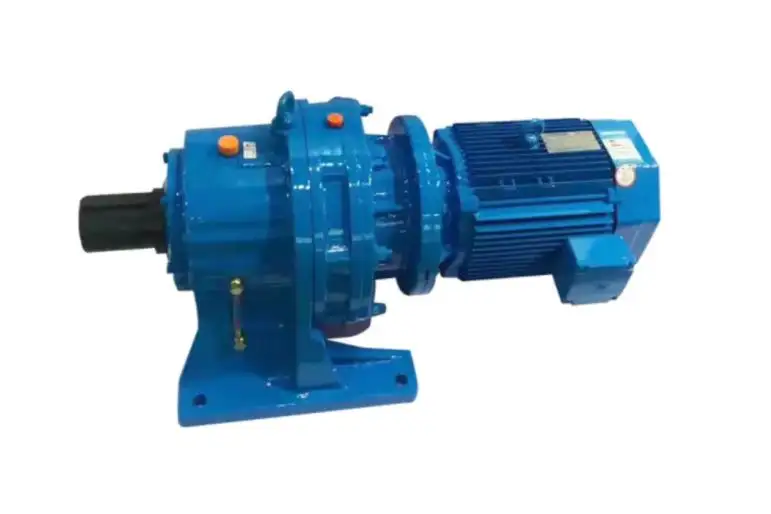
For industrial machinery OEMs, selecting a Cycloidal Gearbox Manufacturer is not simply a matter of matching motor power and reduction ratio. A reducer may produce the required output speed but still be unsuitable because of shaft geometry, mounting position, shock loading, radial load, duty cycle, or machine-space limitations.
From Mingye's engineering perspective, OEM customization should begin with one question:
Which parameters can be modified while keeping the gearbox mechanically reliable and serviceable?
Mingye develops cycloidal reducers around WB, BLD, and BWD platforms, with support for special transmission ratios, mounting dimensions, and application-specific configurations.
Why Standard Cycloidal Gearboxes Often Fail to Match OEM Machinery
A standard reducer is usually designed around a defined combination of ratio, torque, shaft arrangement, and mounting dimensions. Problems appear when the machine introduces conditions outside those assumptions.
Typical cases include:
• The ratio does not produce the required output speed;
• The output shaft is too short, too small, or incompatible with the driven component;
• The reducer center height conflicts with the machine frame;
• Belt or chain transmission creates excessive overhung load;
• Frequent starts, reversals, or shock loads exceed normal duty;
• A replacement gearbox must match an existing bolt pattern and shaft position.
A capable Cycloidal Gearbox Manufacturer therefore evaluates the gearbox as part of the complete drivetrain rather than treating customization as dimensional machining only.
How Ratio, Torque, Shaft Load and Housing Design Interact
Cycloidal gearboxes use an eccentric input mechanism to drive a cycloidal disc against a fixed pin arrangement. Multiple contact points share load simultaneously, which is one reason cycloidal reducers are commonly selected for high-ratio and shock-load applications.
The basic ratio relationship is:
i = n₁ / n₂
where:
• n₁ = input speed
• n₂ = output speed
• i = reduction ratio
For a 1,500 rpm motor with a 50:1 reduction ratio:
Output speed ≈ 30 rpm
Approximate output torque can be estimated as:
T₂ ≈ 9550 × P × η / n₂
However, a higher ratio does not mean unlimited torque. The actual allowable torque depends on the complete load path:
Cycloidal Disc → Pins → Output Mechanism → Shaft → Bearings → Housing
For an OEM Cycloidal Gearbox Manufacturer, this relationship is critical because changing one component may require rechecking several others.
What Can Mingye Customize?
Reduction Ratio
Special transmission ratios may be required when standard combinations cannot achieve the target machine speed.
A ratio change may influence:
• Output torque;
• Number of reduction stages;
• Internal speed;
• Thermal load;
• Gearbox dimensions;
• Transmission efficiency.
For very high ratios, a two-stage arrangement may be more practical than forcing the ratio into a single stage.
Output Shaft Geometry
Common OEM requests include:
• Larger or smaller shaft diameter;
• Longer shaft extension;
• Keyway modification;
• Special coupling interface;
• Machine-specific connection geometry.
A longer shaft must not be treated as a cosmetic change.
If the overhung distance increases, bending moment also increases:
Longer Shaft → Higher Bending Moment → Higher Bearing Reaction → Lower Bearing Life
This becomes especially important with pulleys, sprockets, or chain drives.
Mounting and Housing Interface
Mingye can evaluate changes to:
• Mounting-hole positions;
• Center height;
• Flange dimensions;
• Motor interface;
• Installation footprint;
• Machine-side connection.
For retrofit projects, dimensional compatibility may be just as important as torque capacity.
Standard, Semi-Custom or Full Custom?
| Solution | Typical Changes | Engineering Complexity | Best Use |
| Standard | None | Low | New machines with flexible layout |
| Semi-Custom | Ratio, shaft, flange, mounting | Medium | Most OEM equipment |
| Full Custom | Housing and internal architecture | High | Special-purpose machinery |
For many customers, a semi-custom gearbox based on an existing platform gives a better balance of reliability, cost, lead time, and future replacement.
WB, BLD and BWD Platform Selection
Before customization, the correct cycloidal platform should be selected.
| Series | General Positioning | Typical Selection Focus |
| WB | Micro cycloidal reducer | Compact equipment, limited installation space |
| BLD | Cycloidal pinwheel reducer | General industrial machinery |
| BWD | Planetary cycloidal reducer | Higher-duty industrial transmission |
A Cycloidal Gearbox Manufacturer should first determine:
• Required torque;
• Ratio;
• Installation space;
• Mounting orientation;
• Load profile;
• Shaft load.
Customization should follow platform selection, not replace it.
Continuous Torque Is Not Enough
One of the most common OEM selection errors is using only rated motor power or continuous torque.
Mingye recommends checking:
• Continuous torque — Normal operating load;
• Peak torque — Startup, jamming, or temporary overload;
• Service factor — Correction for actual operating severity;
• Starts per hour — Affects fatigue and thermal loading;
• Reversing frequency — Important for cyclical machines;
• Duty cycle — Determines continuous thermal demand.
A conveyor, mixer, and indexing machine can all use the same motor power but require different gearbox ratings.
Typical Load Characteristics
| Application | Typical Load Concern |
| Conveyor | Startup torque, continuous operation |
| Mixer | Variable torque, shock loading |
| Packaging equipment | Frequent starts and reversals |
| Crusher auxiliary drive | High peak load |
| Automation equipment | Positioning and backlash |
Direct Coupling, Belt and Chain Drives Require Different Shaft Checks
Output coupling determines load bearing ability.
• Direct Coupling: Minimal radial load; maintain alignment.
• Belt Drive: Flexible layout; increased radial load due to unconstrained tension of the belt.
• Chain Drive: Excellent torque transfer, Yet, shock and radial loads should be considered.
For this reason, a professional Cycloidal Gearbox Manufacturer should request sprocket or pulley diameter, belt tension, overhung distance, and load direction when designing a custom output shaft.
Vertical and Horizontal Mounting Are Not Equivalent
Mounting direction affects more than machine layout.
Changing orientation may alter:
• Lubricant distribution;
• Bearing lubrication;
• Seal position;
• Breather arrangement;
• Maintenance access.
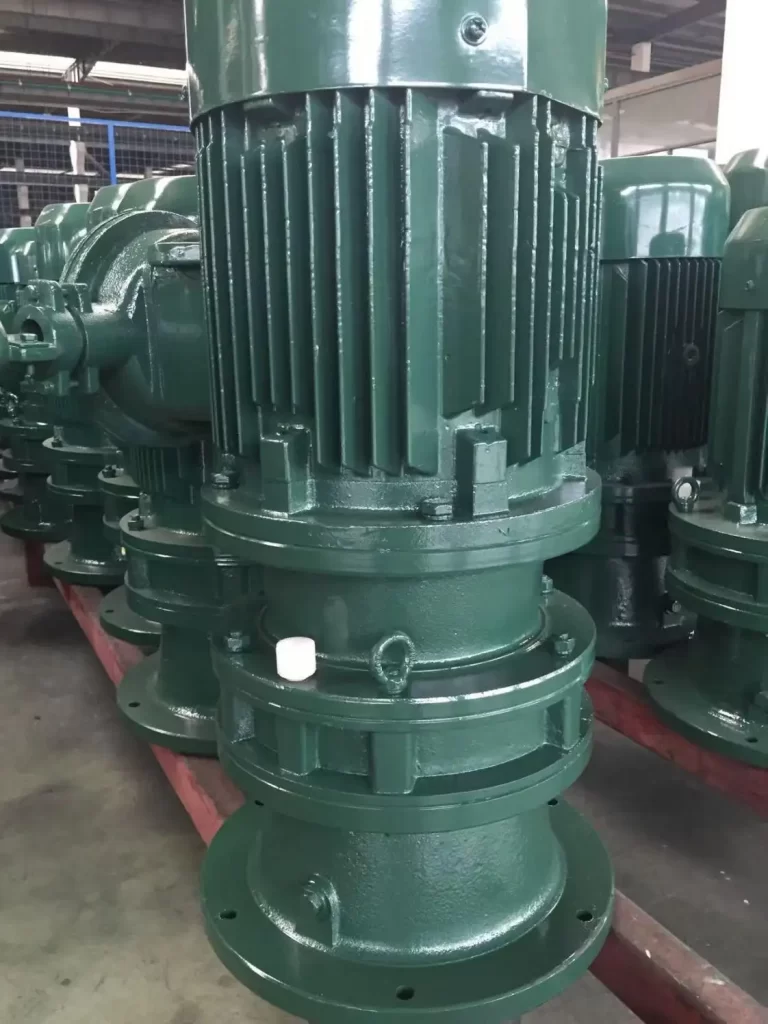
The Mingye WB range includes both vertical and horizontal configurations, illustrating why installation orientation should be confirmed before production.
For retrofit work, buyers should provide:
• Shaft diameter and extension;
• Center height;
• Bolt spacing;
• Flange and pilot dimensions;
• Motor interface;
• Available installation envelope.
Manufacturing Accuracy Must Be Combined With Performance Validation
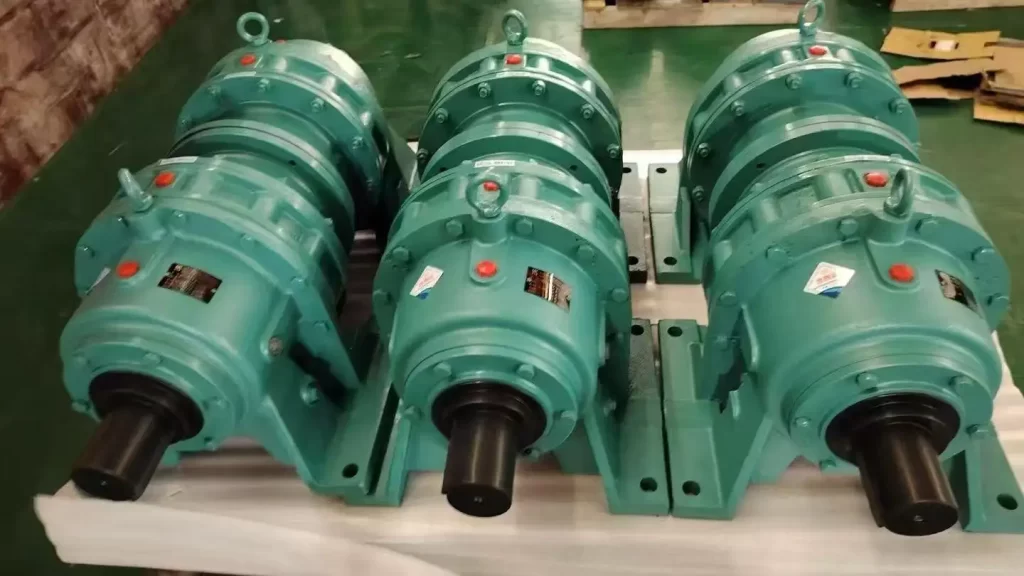
Mingye uses CNC shaft machining, housing machining, gear-processing equipment, and CMM inspection to control dimensional accuracy.
However, dimensional inspection alone does not confirm service life.
An OEM gearbox should also be evaluated for:
• Bearing load capacity;
• Shaft stress;
• Lubrication grade;
• Thermal condition;
• Peak torque;
• Expected operating duty.
Applicable references may include ISO 281 for bearing life and ISO 3448 for industrial lubricant viscosity classification, while cycloidal disc and pin capacity should be verified using manufacturer design calculations and application data.
Engineering the Gearbox Around the Machine
At Mingye, OEM customization is not simply about changing dimensions. The goal is to retain a proven cycloidal transmission structure while adapting ratio, shaft geometry, mounting, and machine interfaces to the actual operating condition.
With WB, BLD, and BWD cycloidal platforms, combined with CNC machining and dimensional inspection capability, Mingye can support both new machinery and replacement projects.
For an OEM or retrofit application, send Mingye your operating data, installation drawing, and interface requirements through mygearmotor.com so the appropriate standard or customized cycloidal gearbox configuration can be evaluated before production.
FAQs
Q1. Does Mingye offer cycloidal gearboxes for retrofit projects?
Mingye can evaluate replacement and retrofit applications when buyers provide existing gearbox dimensions, ratio, shaft information, mounting details, motor data, and operating loads.
Q2. What cycloidal gearbox series does Mingye manufacture?
Mingye's cycloidal gearbox range includes WB Series micro cycloidal reducers, BLD Series cycloidal pinwheel reducers, and BWD Series planetary cycloidal reducers.
Q3. Can Mingye customize the reduction ratio of a cycloidal gearbox?
Yes. Mingye can evaluate special transmission ratios according to required input speed, output speed, torque, gearbox size, and application conditions.
Q4. Can Mingye customize the output shaft?
Output shaft diameter, extension length, keyway, and machine-side connection can be evaluated for OEM projects. Shaft changes should also consider bending moment and bearing load.
Q5. Can Mingye customize cycloidal gearbox mounting dimensions?
Yes. Depending on the application, Mingye can evaluate customized mounting dimensions, flange interfaces, center heights, mounting-hole positions, and machine connection requirements.
Share on Social:


Contact Us
In This Article
Right Angle Geared Motor: Matching Electrical Supply, Variable Speed and Braking
Oct 26, 2026
Planning a Bevel Reducer Installation: Turn Shaft Requirements Into a Practical Drive Layout
Oct 26, 2026
Choosing an Overhead Crane Gearbox by Its Hoisting or Travel Function
Oct 26, 2026
Replacing an Industrial Worm Gearbox: What to Keep and What to Reassess
Oct 25, 2026