


 Home /
 Energy Efficiency and Green Manufacturing in Worm Drive Gearbox Design
Rubber Internal Mixer Gearbox: Read the Batch Load Profile, Not Just Motor kW
Oct 22, 2026
Hot Industrial Gearbox Coupling After Cold Alignment: What to Check
Oct 22, 2026
Hydraulic Slewing Drive Won't Rotate: Separate Motor, Brake and Gearbox Faults
Oct 22, 2026
Calender Roll Gap Changes: What Must the Drive Coupling Accommodate?
Oct 22, 2026
A worm drive gearbox remains useful where machinery requires a compact right-angle drive, a high reduction ratio, smooth running, and controlled low-speed output. However, the sliding contact that gives the design its characteristic motion also creates friction and heat. Energy efficiency therefore depends on more than motor power or reduction ratio.
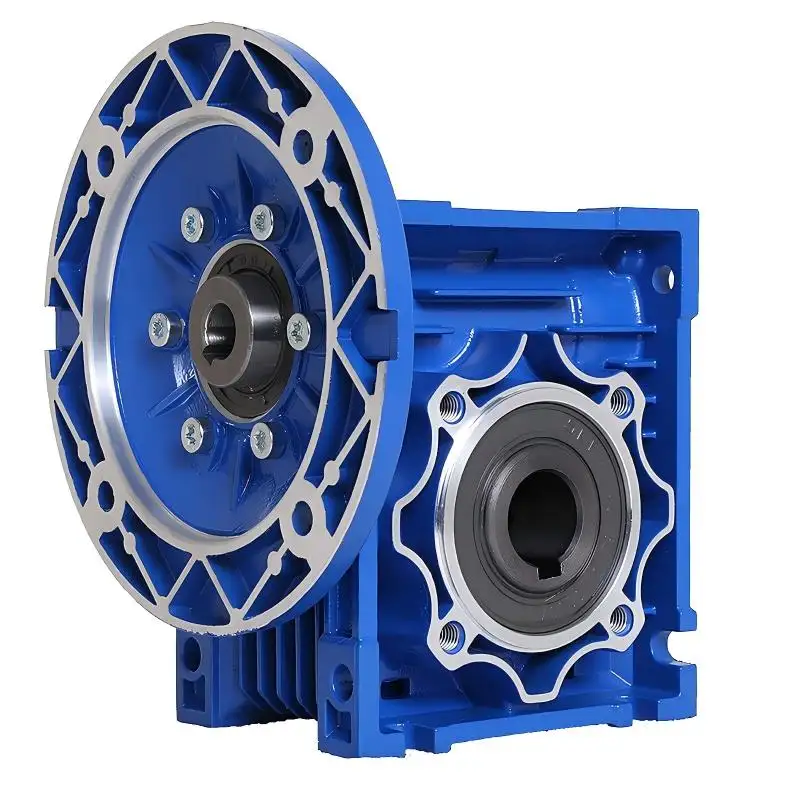
From Mingye's engineering perspective, a more sustainable worm drive gearbox should be considered across its life cycle: material selection, machining, lubrication, thermal control, correct sizing, maintenance, and material recovery.
Why Worm Drive Gearbox Efficiency Varies
A conventional worm drive gearbox commonly uses a hardened steel worm meshing with a bronze worm wheel. Unlike helical gears, which transmit more motion through rolling contact, the worm set operates with substantial sliding. Though frictional losses are increased, quiet operation is achieved. Further, large ratios can be accommodated within a small overall size.
Worm gears typically show a wide spread of efficiencies due to lead angle, friction, load, accuracy, and lubrication. Rather than a single efficiency figure, KHK provides a broad reference of 60 to 95% efficiency for lead angles of 5° to 40°. In worm gear sets, starting efficiency is especially likely to be less than the efficiency observed during normal operation.
Specific design features are the following:
•Lead angle and ratio: Efficiency can be improved with a larger lead angle. A smaller lead angle may create more resistance to back-driving.
•Load: A worm drive, designed for a load far exceeding the actual load, would not be expected to operate within a close range of its efficiency.
•Tooth accuracy: A high degree of accuracy of tooth surfaces can facilitate the creation of a full lubricant-film contact.
•Bearing and seal losses: The total losses of a gearbox are due to bearing pre-load, seal friction, and oil churning.
•Operating temperature: High temperatures can be detrimental for lubricant life and affect seals and gaps and cause wear.
Self-locking also requires careful treatment. A worm drive gearbox is not automatically self-locking. Back-driving behavior depends on lead angle, material pairing, surface condition, bearing arrangement, lubrication, vibration, and operating conditions. Where holding safety is critical, the drive should be validated for the application or combined with a suitable brake.
Designing a More Energy-Efficient Worm Drive Gearbox
At Mingye, efficiency improvement begins with matching the gearbox to the actual operating duty rather than simply increasing the frame size.
1. Choose the Appropriate Ratio and Service Factor
The output speed, starting torque, duty cycle, shock load, and daily operating hours must be considered together. Proper selection of the service factor prevents the use of inefficiently sized motors and reduces the excessive thermal loading.
2. Optimize the Contact Surfaces
Localized friction is reduced during the running-in phase if a controlled worm-thread finish is employed. The precise geometry of the gears also helps in even distribution of the load among the worm wheel teeth.
3. Use the Right Lubricant for the Right Purpose
The right lubricant must be selected for the operating conditions, including considerations for viscosity, base oil, additive chemistry, compatibility with bronze, temperature, and operating speed.
For high-sliding worm technology applications, a synthetic or polyglycol-based gear oil can be effective. Despite the fact that changes to lubricant systems must be compatible with the materials of the gearbox, seal systems, and the operational environment, the controlled supplier testing performed has shown that reference oils in the mineral oil group provide efficiency benefits in a number of applications.
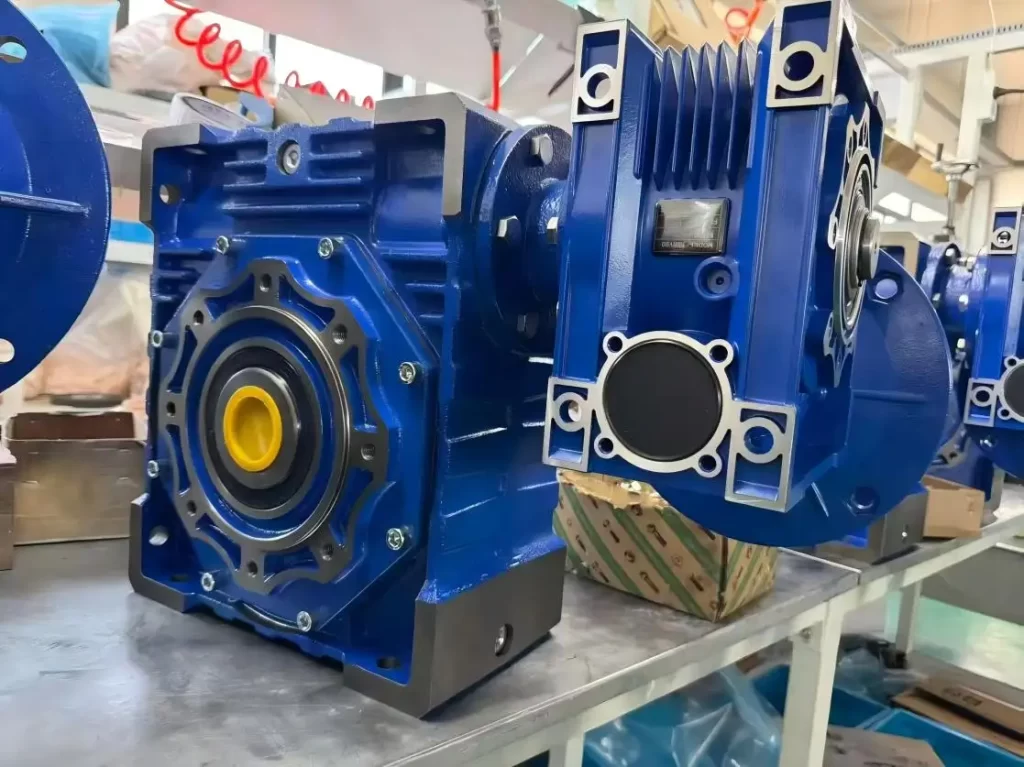
4. Control Heat Production
The thermal behavior of a component is affected by ribbing, the amount of oil, and the placement of the component. A cooler-running worm drive gearbox can help preserve lubricant condition, protect seals, and support more stable operation.
Green Manufacturing Priorities
Green manufacturing includes material yield, process stability, maintenance demand, and product life—not only electricity use within the factory.
Mingye has practical engineering goals of:
•Near-net-shape blanks: Near-net-shape blanks can reduce the machining time and the volume of chips and the energy used by the machine.
•Standardized components: Sharing shafts, bearings, seals, and mounting interfaces eliminates unnecessary tooling and reduces the complexity of managing spare parts.
•Reduction of discontinuous fluid use: Using less fluid and more effective delivery of coolants or minimum-quantity lubrication can reduce fluid use in some machining operations.
•Separated materials: Effective and cost-efficient recovery of materials can be achieved by separating steel, cast iron, bronze, and aluminum chips.
•Surface protection: When choosing the coating, the protection against corrosion and process emissions, the repairability, and the following operational conditions of the elements should be considered.
•Instructions: Clearly defined instructions regarding the mounting, alignment, and oiling of components will help to avoid the need for replacements and will minimize the risk of excessive wear.
These measures do not remove every environmental impact. Instead, they reduce avoidable material consumption and support a longer, more predictable gearbox service life.
Lessons from Mingye's B Series Helical Gearbox Experience
Mingye's experience with the B Series Helical Gearbox provides transferable knowledge in housing stiffness, modular design, shaft interfaces, gear accuracy, and low-noise transmission.
These principles do not make a helical gearbox and a worm drive gearbox mechanically identical. However, they strengthen engineering discipline across both product families.
| Feature | Worm Drive Gearbox | B Series Helical Gearbox |
| The shaft arrangement | Usually right-angled. | Parallel, inline, or application-specific |
| Primary tooth contact | High sliding component | Predominantly rolling and sliding |
| Ratio capability | High ratio possible in one stage | Broad ratios through one or more stages |
| Efficiency | Strongly affected by lead angle and friction. | Generally higher under comparable conditions |
| Back-driving | May resist back-driving; verification required | Normally back-drivable unless a brake is added |
| Typical value | Compact layout and smooth low-speed motion | Efficient continuous torque transmission |
This comparison helps users select a gearbox according to operating needs rather than assuming that one transmission type is suitable for every machine.
Practical Value for Users
A well-specified worm drive gearbox can reduce more than electricity use. It may also lower:
•Heat generation and thermal stress
•Lubricant degradation
•Seal and bearing wear
•Maintenance frequency
•Risk of unplanned downtime
•Premature gearbox replacement
For users, the most useful sustainability measures are therefore practical: accurate sizing, compatible lubrication, consistent manufacturing quality, and accessible maintenance instructions.
Closing Perspective
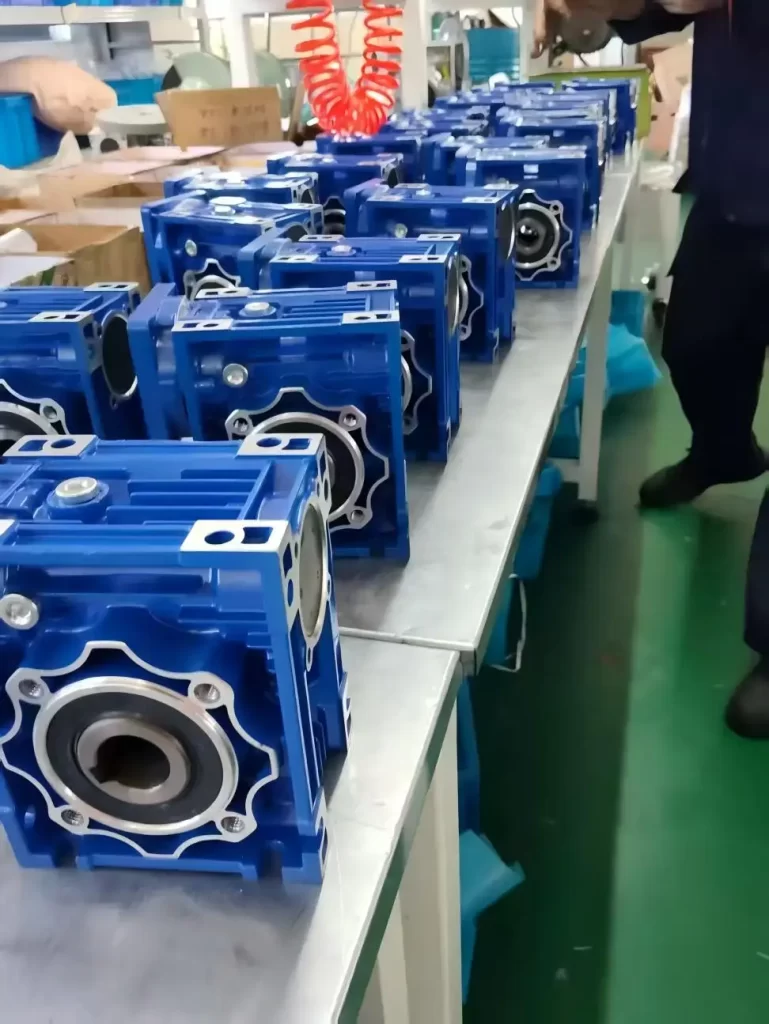
Mingye treats worm drive gearbox development as an ongoing engineering process. The goal is not to claim zero environmental impact, but to reduce avoidable losses while preserving the compact layout, ratio capability, smooth transmission, and operating stability for which worm gearing is selected.
By combining responsible manufacturing practices with application-based gearbox selection, a worm drive gearbox can contribute to both dependable machinery performance and more efficient resource use throughout its service life.
FAQs
Q1. What is the application of a Worm Drive Gearbox?
Compact right-angle designs. It is also useful for speed reduction and increasing output torque.
Q2. Is a Worm Drive Gearbox an example of an energy efficient design?
Efficiency is variable depending on ratio, lead angle, load, lubrication, and operating temperature.
Q3. What causes heat generation in a Worm Drive Gearbox?
The cause is sliding friction primarily, between the worm and the worm wheel.
Q4. Will the use of synthetic oil allow for improved efficiency of the Gearbox?
As a synthetic lubricant, it has the potential to be friction reducing and thermally more efficient, so yes.
Q5. Are all Worm Drive Gearboxes self-locking?
Not all, it is dependent on many factors including lead angle, friction, lubrication, load, and operating conditions.
Share on Social:


Contact Us
In This Article
Rubber Internal Mixer Gearbox: Read the Batch Load Profile, Not Just Motor kW
Oct 22, 2026
Hot Industrial Gearbox Coupling After Cold Alignment: What to Check
Oct 22, 2026
Hydraulic Slewing Drive Won't Rotate: Separate Motor, Brake and Gearbox Faults
Oct 22, 2026
Calender Roll Gap Changes: What Must the Drive Coupling Accommodate?
Oct 22, 2026