


 Home /
 Metallurgy and Heat Treatment for Durable Twin Shaft Paddle Mixer Gearbox Gears
Rubber Internal Mixer Gearbox: Read the Batch Load Profile, Not Just Motor kW
Oct 22, 2026
Hot Industrial Gearbox Coupling After Cold Alignment: What to Check
Oct 22, 2026
Hydraulic Slewing Drive Won't Rotate: Separate Motor, Brake and Gearbox Faults
Oct 22, 2026
Calender Roll Gap Changes: What Must the Drive Coupling Accommodate?
Oct 22, 2026
A twin-shaft paddle mixer depends on more than paddle geometry and motor power. Its gearbox needs to change the fast motor speed into two slow and coordinated outputs while managing the force when starting, changes in material density, and multiple mixing cycles.
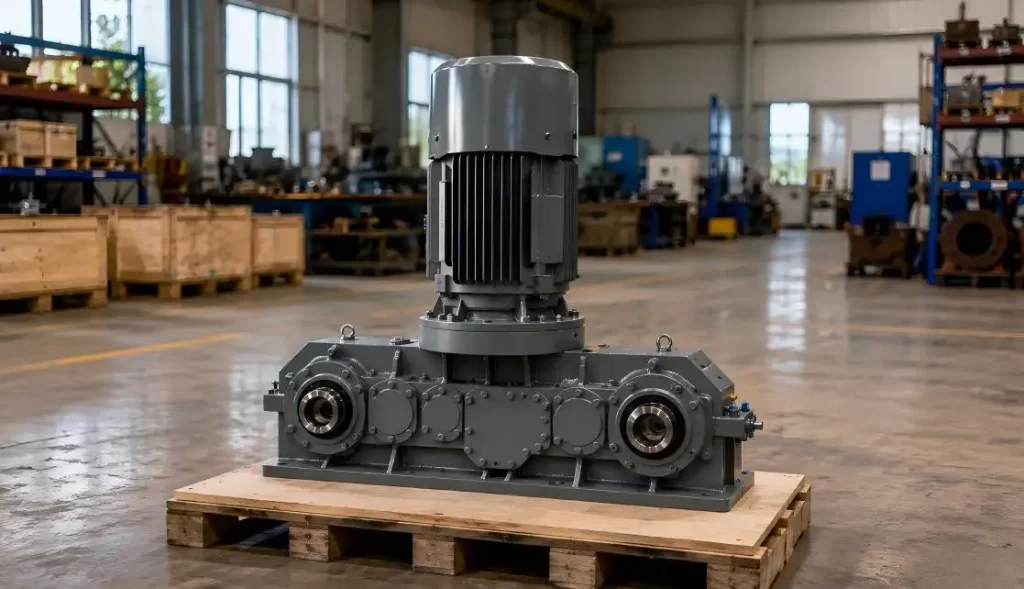
At Mingye, we regard gear metallurgy and heat treatment as central to the operating stability of a twin-shaft paddle mixer. The goal is not simply to make a gear hard, but to balance surface hardness, core toughness, tooth accuracy, lubrication, and dimensional stability.
How the Gearbox Supports a Twin-Shaft Paddle Mixer
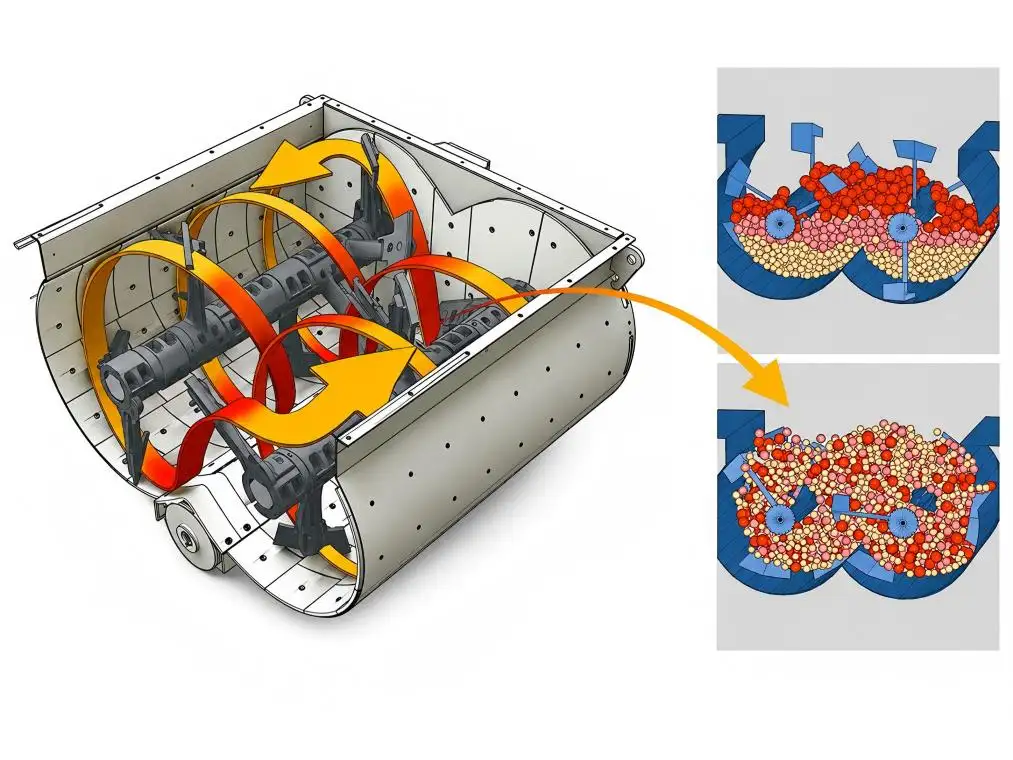
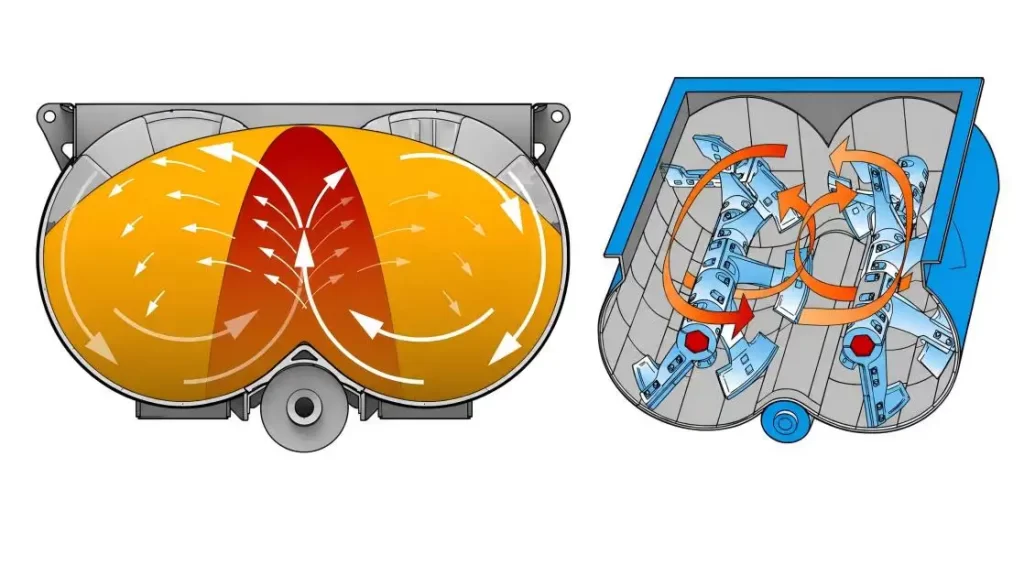
A twin-shaft paddle mixer uses two counter-rotating shafts fitted with angled paddles. The movement of the device generates a mixing zone that is fluidized using radial, axial, and cross movements of the powders or granules made by the device. The description of the box shows that:
•Movement is synchronized since both paddle shafts are kept in the precise relative position by a fixed gear relationship.
•Balanced torque is achieved since the input power is split between two output paths.
•Controlled speed is attained since paddle mixing requires a slow speed, which is a result of the reduction stages.
•The gear train has an inherent load response to changing material loads and has a fixed resistance to start up.
The toughness and hardness of the YHJ gear have been incorporated into its design.
Why Gear Material Needs Hardness and Toughness
When gear teeth come into contact and start to bend, the pressure creates contact stress at the flanks and bending stress at the roots. If a material is rugged and hard, the material can resist wear and has good impact resistance; however, that material could be very tough and wear out quickly.
For the YHJ gear, low-carbon alloy steel is used and supports the case hardening and provides the following:
•Hardened case: tough core material that can absorb startup torque and the batch-to-batch variation in the loads; however, the case is quite hard and provides good resistance to the wear of the teeth.
•Alloyed structure: offers an improvement in hardenability of larger sections of the gear.
•Machinable blank: This means that it is possible to cut the teeth of the gear in the blank before further processing and heat treatment.
This case-and-core structure is widely used in industrial gearing because carburizing can produce a durable martensitic surface around a tougher, lower-carbon core. Quenching Explained
During carburizing, a low-carbon steel gear is heated in a carbon-rich atmosphere. Carbon diffuses into the outer layer while the core remains lower in carbon. Quenching then transforms the enriched surface into a hard martensitic case.
Mingye specifies a surface-hardness target of 58–62 HRC for Twin Shaft Paddle Mixer gearbox gears. The specified range is typical of case-hardened industrial gears and helps define both the wear resistance and the contact-load capacity. This includes:
•Case Hardening: Custom gear module and case tooth size-specific hardening case depth.
•Quenching Distortion Control: This process will provide consistency and accuracy for leads and gear profiles.
•Tempering: Assists in reducing brittleness and locks the structure.
•Post-Heat Treatment Tooth Geometry Repair: Better finishing.
•Inspection: Assurance of runout and hardness of the tooth and accuracy of the contact pattern.
Assurance of Precision of Gears and Shaft Synchronization
The design of tooth geometry that ensures precision and a high degree of reliability in gear operation is characterized by smooth operation with uniform loads and minimal vibration. It is reported that Mingye has committed to Grade 6 gears for the affected products.
Due to the many differences in gear accuracy systems, the relevant standard should be quoted in the order documentation. For example, ISO 1328-1:2013 defines the flank tolerances for individual cylindrical involute gears and individual cylindrical involute gears and which is expected to be applicable after the 2024 review.
The paddle mixer features precision control of gear choice, which enables the following:
•Relative stable timing: Both shafts can be designed to keep the required relationship for the entire revolution of each shaft.
•Uniform tooth engagement: The gear's face width is subjected to a more even loading.
•Reduction of dynamic imbalance: The precision of the pitch, profile, and helix is immensely greater.
•Consistent Torque: The degree of uniformity of the interaction of the gears for the entire operating cycle is immensely more.
How Metallurgy Works with Gearbox Design
Heat-treated gears cannot perform reliably in isolation. Their service depends on the complete reducer structure. Mingye's YHJ Twin Shaft Paddle Mixer gearbox combines the following:
•Twin hollow-shaft outputs: Simplify connection to the mixer shafts and save installation space.
•Four-stage reduction: Produces the required low speed in a purpose-built layout.
•Matched bearings and housing: Maintain shaft position and gear alignment under load.
•Lubrication management: Separates tooth surfaces, carries away heat, and limits wear.
•Application-based configuration: Allows seals, bearings, mounting, and lubrication to be reviewed for the actual duty.
Representative YHJ Configurations
| Model | Center Distance | Motor Power | Ratio | Output Speed | Mixer Volume |
| YHJ570-35-AM160 | 570 mm | 11/15 kW | 35 | 41 rpm | 0.5–0.75 m³ |
| YHJ700-33-AM180 | 700 mm. | 18.5/22 kW | 33 | 45 rpm | 1–1.5 m³ |
| YHJ890-50-AM225 | 890 mm | 37 kW | 50 | 30 rpm | 2–4 m³ |
| YHJ1230-50-AM280 | 1,230 mm | 75 kW | 50 | 30 rpm | 8–10 m³ |
These are representative matching values rather than universal selection rules. Actual output speed can vary slightly with the rated speed and slip characteristics of the selected motor.
A twin-shaft paddle mixer employed in the production of dry mortars differs in operating loads and contamination conditions when compared to mixers used in feeds, food ingredients, ceramics, chemicals, battery powders, etc. Therefore, when assessing the gearboxes, the following must be considered:
•Characteristics of Materials: Evaluate bulk density, flow tendency, moisture content, and abrasiveness.
•Design of Mixers: Analyze how working volume, filling rate, and the spacing and diameter of paddles on the shaft impact operations.
•Conditions of Starting: Review the starting condition of the mixer, i.e., the empty or loaded condition.
•Regimen of Operation: Estimate the total operating time and the total number of starting and batching cycles of the mixer for the day.
•Installation Environment: Consider the effects of all reasonably anticipated conditions on the mixer, including temperature, dust, moisture, and the means of cleaning.
•Mechanical Interface: Verify the dimensions of the shaft and the location and method of mounting.
For replacement projects, Mingye can better evaluate if the parts will fit together by looking at the photos and drawings you provide, along with the information from the nameplate, shaft sizes, and details about the motors.
Closing Words
The durable twin-shaft paddle mixer transmission starts with a hard, wear-resistant tooth surface supported by a tougher core. Low-carbon alloy steel, controlled carburizing, quenching, tempering, rigorous finishing, and dimensional inspection work together to support synchronized dual-shaft operation.
From Mingye's manufacturing perspective, gearbox selection should combine internal gear quality with actual process conditions. Matching the reducer to the mixer volume, material behavior, starting load, operating schedule, and installation layout provides a stronger basis for long-term operation than selecting by motor power alone.
FAQs
Q1. What issues result in premature gear wear?
This can be caused by a lack of lubrication, excess loading, contamination, misalignment, and insufficient upkeep.
Q2. Why is carburizing the process of choice for gearbox gears?
The process of carburizing results in a wear resistant surface and an untreated tough core.
Q3. What is the typical surface hardness of gears?
Most case hardened gears are around 58-62 HRC.
Q4. Why is heat treatment necessary for gearbox gears?
Heat treatment reduces wear and increases fatigue strength and load capacity.
Q5. What effect does gear accuracy have on the operation of a mixer?
Higher accuracy gears improve the quality of the operation of a mixer by reducing meshing, improving timing, and decreasing vibrations.
Share on Social:


Contact Us
In This Article
Rubber Internal Mixer Gearbox: Read the Batch Load Profile, Not Just Motor kW
Oct 22, 2026
Hot Industrial Gearbox Coupling After Cold Alignment: What to Check
Oct 22, 2026
Hydraulic Slewing Drive Won't Rotate: Separate Motor, Brake and Gearbox Faults
Oct 22, 2026
Calender Roll Gap Changes: What Must the Drive Coupling Accommodate?
Oct 22, 2026