


 Home /
 High Torque Density Explained: The Inline Planetary Gearbox for Compact Heavy Loads
Rubber Internal Mixer Gearbox: Read the Batch Load Profile, Not Just Motor kW
Oct 22, 2026
Hot Industrial Gearbox Coupling After Cold Alignment: What to Check
Oct 22, 2026
Hydraulic Slewing Drive Won't Rotate: Separate Motor, Brake and Gearbox Faults
Oct 22, 2026
Calender Roll Gap Changes: What Must the Drive Coupling Accommodate?
Oct 22, 2026
When presented with the necessity of achieving the transfer of high torque within an extremely condensed space, the Inline Planetary Gearbox is often the solution of choice for engineers. In contrast to the sequential parallel-shaft reducers, the inline planetary design achieves the highest torque density -- that is, the highest amount of torque in relation to the volume or the weight of the gear. How is it possible for the system to be compact, and at the same time, able to withstand high loads? The objective of this paper is to present the main engineering concepts of high torque density. The main design concepts will be presented and substantiated with real-life examples, such as the Mingye Machinery GMR Series Planetary Slewing Drive.
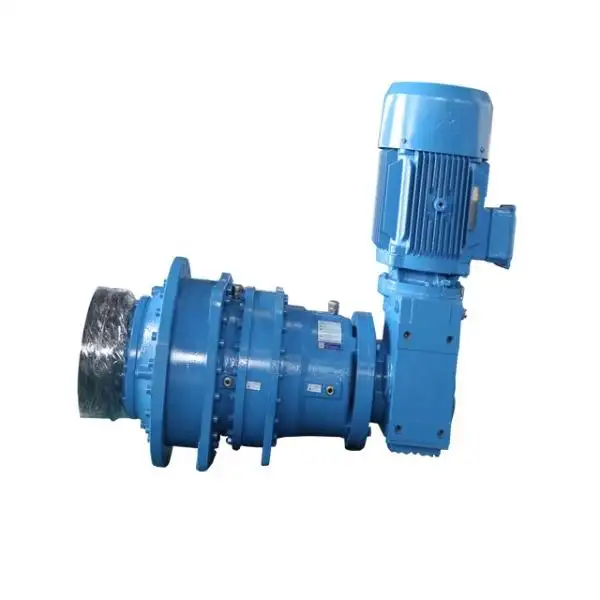
1. Torque Density: Size is Crucial
In measuring torque density, the output torque of the gearbox is compared to the mass and overall dimensions of the gearbox. The machinery that incorporates gearboxes with high torque density is significantly smaller, and consumes less energy, and is easier to fit into crowded spaces in a factory or on a vehicle.
•The main advantage for engineers: higher torque density lessens the total weight of gear such as drilling rigs, crawler drives, and winches, and in turn improves fuel efficiency and portability.
•The main issue: higher torque generally requires larger gears and stronger casings and is therefore contradictory to the need for compactness. The Inline Planetary Gearbox addresses this by combining optimization of geometry and load sharing.
2. The Power and the Compactness of the Planetary Gear Arrangement
In most Inline Planetary Gearboxes, a sun gear is surrounded by a multiple set of planetary gears which in turn is surrounded by a ring gear. This coaxial design permits the planetary gears to share the load and the torque is distributed along many paths of gear alignment.
•Load distributing mechanism: The torque is shared among more planet gears (usually between three and five). Every gear's teeth carry less than the full load which leads to less stress and allows for a smaller module for the same load capacity.
•Colinear input/output: The shafts have co-aligned input and output shafts which reduces colinear offsets and reduces radial size, increasing applicability in rotary drilling rigs or milling machines.
•Greater reduction in fewer stages: A single planetary stage can easily achieve a reduction ratio of 3:1 to 10:1 and two stages a ratio of 100:1, all in a compact axial length. This reduces the required number of shafts and bearings in comparison to helical gearboxes.
3. Material Science and Heat Treatment – Enabling Extreme Loads
A compact design cannot be used alone; the material used needs to be able to sustain contact stresses. Manufacturers of high-quality Inline Planetary Gearboxes invest in advanced metallurgy.
•Case hardened alloy steel: The gears are made from 20CrMnTi, which is carburized and quenched to give surface hardness of 58–62 HRC while keeping the core of the gear tough to avoid pitting and breaking of the gear under shock loading.
•Precision Grinding: The teeth flanks are heat treated and ground to an AGMA quality of 12 or greater. This provides an advantage by smooth fitting with better load dispersion and reduced surface roughness that helps keep the lubrication film in place.
•Mingye Machinery GMR series planetary slewing drive: The carrier is made from Nodular Cast Iron or Forged Steel. The carrier should not deflect with bending or twisting. That shows a good weight/risk balance.
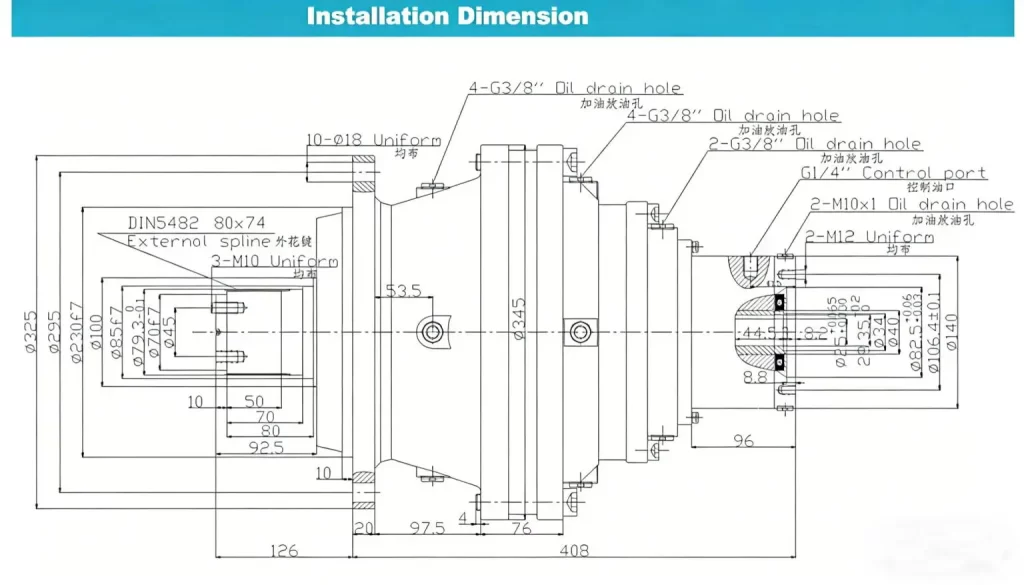
4. Bearing and Lubrication Layout – Catering for Overhung Loads
In heavy-duty applications, radially acting loads from sprockets/pinions on an Inline Planetary Gearbox must be addressed by the bearing system without increasing the axial length.
•Tapered roller bearings or cylindrical roller bearings: In the flange output of the GMR series from Mingye, the output structure incorporates a large diameter bearing for the support of slewing motions.
•Forced circulation or grease lubrication: For applications with continuous operations (track drives, winches, etc.), the heat generated is removed by oil splash or forced oil cooling. Lubrication reduces friction losses enabling the design to maintain high torque efficiencies (typically >97% per stage).
•Sealing strategy: For the harsh operations of mining and tunneling, the use of several lip seals or cassette seals provides a means of preventing the ingress of water or dust.
5. Housing and Thermal Management – Compact Does Not Mean Overheating
A small envelope means designers must optimize the trade-off between wall thickness and the use of cooling ribs and conductivity of the material used.
•Optimized housing topology: Using finite element analysis (FEA), ribs are added near bearing seats and low-stress areas of the housing are removed. This design reduces the weight of the housing and increases stiffness.
•Integrated cooling channels: Some heavy-duty inline planetary gearboxes have integrated water or oil cooling circuits. For continuous operations in drilling rigs and road rollers, the GMR series addresses thermal rise with its cast housing design.
•Surface-to-volume ratio: A more compact gearbox means a higher surface-to-volume ratio, which helps natural convection if the outer casing is ribbed. Thermal dissipation is also a function of material selection (aluminum for lower loads, cast iron for high damping).
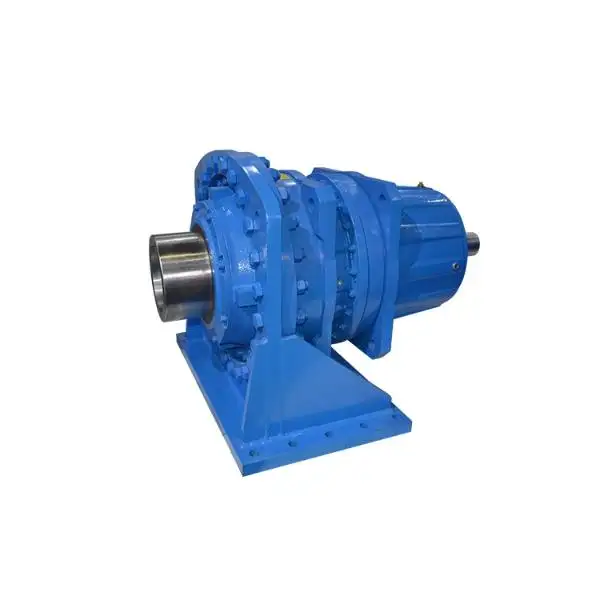
6. Real-World Example: Mingye Machinery GMR Series Planetary Slewing Drive
Mingye Machinery's GMR Series Planetary Slewing Drive is a good example of a commercially available product that has concentrated a lot of high torque density. It is specially designed for rotating systems that require a robust and steady output of torque.
•High torque output: Advanced design of the planetary gears allows high torque transmission and is ideal for use in cranes, milling machines, and tunnel boring machines, among others.
•Compact and sturdy design: The GMR series drives have been designed with an optimal size target which allows a smaller installation footprint and mechanical strength to operate reliably under continuous shock loads.
•Variable design: The input interface of the drive allows the use of constant and adjustable hydraulic motors, allowing the design engineer the flexibility to mesh the torque-speed characteristics of the hydraulic drive and the gearbox without hydraulic gearbox modifications.
•Reliable hydraulic brake system: A spring-applied, hydraulically released brake system provides fail-safe holding torque and increases safety on sloped conveyors or crane slewing drives.
•Emergency mechanical clutch: Some models have a mechanical disengagement clutch, which is an essential feature for the underground mining vehicles that allows safe towing of the vehicle during the failure of the hydraulic system.
•Wide application range: The GMR series proves that a concentrated high torque density can be applied to a diverse range of systems, from rotary drilling rigs and crawler track drives to road rollers and plastic mixers.
7. Application Examples Where Torque Density Matters Most
The real test of an Inline Planetary Gearbox is with heavy equipment, and this is where it needs to perform best.
•Rotary drilling rigs: The gear box must provide high torque at low speed to rotate a large drill bit. The compact design allows the gear drive to be mounted inside the narrow mast structure.
•Crawler track drives: Each track needs a separate inline planetary drive. The drive must be compact enough to fit within the space of the track frame. With the high torque density, the vehicle can be designed to be narrower.
•Winches and hoists: A short axial length of the gearbox allows a larger drum diameter. The brake can be mounted in the gearbox to eliminate the need for external components.
•Mixing and agitation equipment: For a variable load, a gear train with low backlash and high rigidity is needed to deliver high torque. The GMR series is used in various industrial mixers and blenders.
Conclusion – Balancing Art and Science
High torque density in an Inline Planetary Gearbox is not a single trick but a system-level achievement: optimal gear geometry, advanced heat treatment, rigid carriers, compact bearings, and effective thermal management. Manufacturers like Mingye Machinery have the GMR Series Planetary Slewing Drive, which adds great features (hydraulic motor compatibility, braking, emergency clutch) without enlarging the size.
When dealing with motion control systems, there are several parameters that can be analyzed, such as torque density, duty cycles, operating environment, and serviceability. Something like an inline planetary gearbox would deliver the best power-to-size ratio.
FAQs
Q1 Torque density for Inline Planetary Gearbox, what is it?
A: Torque density refers to the volume or weight measure of the maximum torque. The higher the density the more compact the design can be.
Q2: Why an inline planetary gearbox over a parallel shaft planetary gearbox?
A: Inline designs are coaxial for input and output which results in a smaller radial footprint. They also facilitate the optimum distribution of loads, which is beneficial for heavy and limited space equipment.
Q3: Can the GMR Series be operated with fixed and variable hydraulic motors?
A: Yes, Mingye's GMR Series can operate with both for adjustable torque and speed.
Q4: Is a Brake system built in the Gearbox?
A: For fail-safe holding and enhanced safety, a spring applied, hydraulically released brake can be added.
Q5: What are some of the high torque density inline planetary gearboxes applications?
A: Mining, drilling, crawler drives, road rollers, cranes, milling machines, tunnel boring and material handling.
Share on Social:


Contact Us
In This Article
Rubber Internal Mixer Gearbox: Read the Batch Load Profile, Not Just Motor kW
Oct 22, 2026
Hot Industrial Gearbox Coupling After Cold Alignment: What to Check
Oct 22, 2026
Hydraulic Slewing Drive Won't Rotate: Separate Motor, Brake and Gearbox Faults
Oct 22, 2026
Calender Roll Gap Changes: What Must the Drive Coupling Accommodate?
Oct 22, 2026