


 Home /
Gear Reduction Ratio and Output Torque: What to Check Before Selecting a Motor
Right Angle Geared Motor: Matching Electrical Supply, Variable Speed and Braking
Oct 26, 2026
Planning a Bevel Reducer Installation: Turn Shaft Requirements Into a Practical Drive Layout
Oct 26, 2026
Choosing an Overhead Crane Gearbox by Its Hoisting or Travel Function
Oct 26, 2026
Replacing an Industrial Worm Gearbox: What to Keep and What to Reassess
Oct 25, 2026
A buyer specifies a 60:1 ratio gear reduction motor with a 1.5 kW motor. The logic seems sound: a higher ratio means more torque multiplication, and 60:1 should deliver plenty of torque for the application. The gearbox arrives, installs, and runs — but within two months, the gear teeth show pitting and the bearings begin to growl. The ratio was correct, the motor power was adequate, and the load was within the calculated torque. What went wrong?
The answer is that “ratio × motor torque = output torque” is a theoretical formula with three real-world limits that buyers frequently overlook. This article breaks down the three most common miscalculations about ratio and torque, explains why they lead to premature failure, and provides a framework for checking whether a proposed ratio and motor combination will actually work in service.
Miscalculation 1: “Higher Ratio Means More Torque” — True in Theory, Limited in Practice
The Theory
The basic torque multiplication formula is:
Output Torque ≈ Motor Rated Torque × Ratio × Efficiency
This formula is mathematically correct. If a motor delivers 10 N·m of rated torque, and the gearbox has a 30:1 ratio with 90% efficiency, the theoretical output torque is:
10 × 30 × 0.90 = 270 N·m
Increase the ratio to 60:1, and the theoretical torque doubles to 540 N·m. So far, so good.
Limit 1: Gearbox Rated Torque Is the Hard Ceiling
Every gearbox has a maximum rated output torque — the highest torque the gear teeth, shaft, and bearings are designed to transmit continuously. This is a mechanical limit determined by the gear geometry, material strength, heat treatment, bearing capacity, and housing design.
If the theoretical output torque (motor torque × ratio × efficiency) exceeds the gearbox’s rated torque, the gearbox is overloaded — regardless of what the math says. The gear teeth will experience stress beyond their design limit, leading to pitting (surface fatigue), bending fatigue, or tooth fracture.
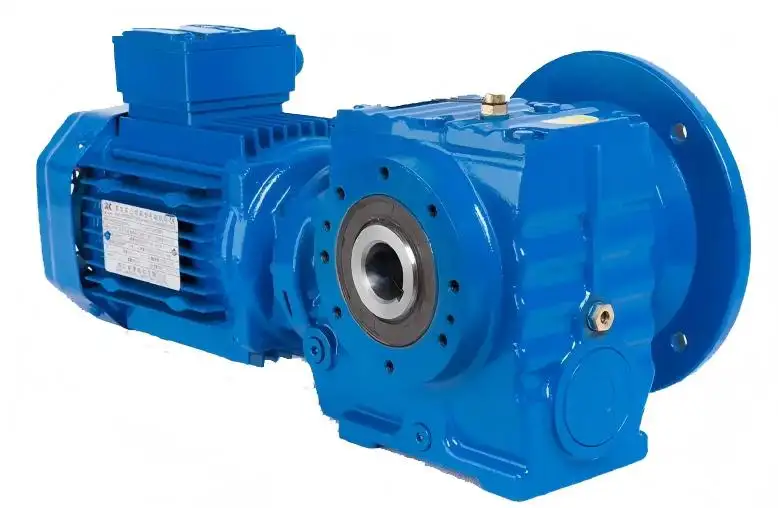
Real-world example: A buyer selects a compact gearbox with a 60:1 ratio and a 1.5 kW motor. The theoretical output torque is 540 N·m. But the gearbox’s rated output torque is only 350 N·m. The gearbox is overloaded by 54% — even though the math says it should work. The gear teeth pit and fail within months.
The takeaway: Always check the gearbox rated torque against the calculated output torque. The rated torque is found in the manufacturer’s selection table for the specific model and ratio — not calculated from the formula alone. The formula tells you what the motor can deliver; the rated torque tells you what the gearbox can survive.
Calculated your output torque but not sure if the gearbox rating matches? Send your motor rated speed and power, target output speed, and load description. We can verify the ratio, check the gearbox rated torque against the calculated output torque, and confirm the efficiency at the specific ratio — so you know the selection is sound before ordering.
Limit 2: Higher Ratios Require More Stages — and Each Stage Loses Efficiency
A single-stage spur gearbox is practically limited to approximately 10:1 ratio — beyond that, the driving gear becomes too small to effectively transmit torque (the number of teeth in contact drops, and the tooth size decreases). To achieve higher ratios, multiple stages are needed.
Each additional stage introduces another gear mesh, and each mesh has its own efficiency loss. A single-stage gearbox may have 97% efficiency; a two-stage version may have 94%; a three-stage version may be lower still. This means:
- A 10:1 single-stage gearbox at 97% efficiency delivers: Motor Torque × 10 × 0.97 = 9.7 × Motor Torque
- A 60:1 three-stage gearbox at 90% overall efficiency delivers: Motor Torque × 60 × 0.90 = 54 × Motor Torque — but with 10% of the input energy lost to friction (heat)
The higher ratio delivers more torque multiplication, but the efficiency penalty means more energy is wasted as heat. This heat must be managed by the gearbox housing and lubricant — and if the gearbox is small or the ambient temperature is high, the thermal management may become the limiting factor before the mechanical rating.
The takeaway: When comparing ratios, ask the supplier for the efficiency at the specific ratio and number of stages. Do not assume a fixed efficiency across all ratios — a 10:1 single-stage gearbox and a 60:1 three-stage gearbox from the same series will have different efficiency values.
Limit 3: Single-Stage Ratio Has a Practical Upper Limit
For spur gears, the practical single-stage ratio is limited by geometric constraints — beyond a certain point, the driving gear (pinion) becomes too small for effective mesh, and the torque capacity per tooth drops. This is a geometric constraint, not a manufacturing quality issue.
Single-stage practical ratio capability differs by gear architecture and design. High total ratios may require multiple stages, which affects efficiency, size and cost. Use the series data for the actual stage configuration rather than applying generic per-stage limits.
The takeaway: If your required ratio is high, you will need either multiple stages (which reduces efficiency and increases cost) or a gear type that can achieve high ratios in a single stage (such as worm gear, which has its own efficiency trade-off). The choice of ratio and gear type is interconnected — do not select the ratio in isolation.
Miscalculation 2: “Motor Power Is Enough” — Rated Torque Is Not Stall Torque
The Distinction
Motor power (kW or HP) and motor torque are related but not the same. A motor’s rated torque is the torque it can deliver continuously without exceeding its thermal limit (the temperature at which the insulation degrades). This is the value that should be used in the output torque calculation.
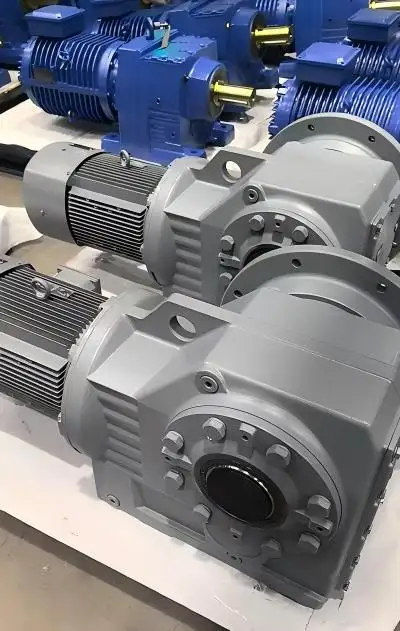
A motor’s stall torque (also called breakdown torque or pull-out torque for induction motors) is the maximum torque it can produce before stalling. This is a momentary value, not a continuous operating point. The relationship between stall torque and rated torque depends on the motor design and cannot be generalized with a fixed multiplier.
A motor’s starting torque (locked-rotor torque) is the torque produced at zero speed (when the motor is starting). This may be higher or lower than rated torque depending on the motor design.
Why This Matters for Gear Selection
If a buyer calculates output torque using the stall torque or starting torque instead of the rated torque, the gearbox selection will be based on a torque value that the motor can only deliver momentarily. The gearbox may be sized for a torque that the motor can never sustain — leading to one of two outcomes:
- The gearbox is oversized for continuous operation: The buyer selects a larger, more expensive gearbox than necessary, because they calculated based on peak torque rather than continuous torque.
- The motor overheats trying to deliver the calculated torque: The motor is asked to deliver torque above its continuous rating, drawing high current and overheating. The gearbox may be mechanically adequate, but the motor fails electrically.
The Correct Approach
Use the motor’s rated torque (the continuous value from the nameplate or data sheet) for the output torque calculation. If the application requires peak torque during startup (to accelerate a high-inertia load, for example), calculate the peak output torque separately and verify that:
- The gearbox rated torque is not exceeded during the peak
- The motor can deliver the peak torque for the duration required without overheating (check the motor’s thermal capacity for the specific duty cycle)
IEC 60034-1 defines the locked-rotor torque (also called starting torque) as the minimum measured torque produced when the rotor is held stationary at all angular positions. This is a test value, not an operating point.
The takeaway: The output torque formula uses rated (continuous) torque, not stall, breakdown, or starting torque. Do not use a momentary starting/peak/stall-related value as the continuous torque basis; use the rated continuous torque specified for the motor. For peak torque events, check both the gearbox mechanical rating and the motor thermal capacity — they are separate limits.
Miscalculation 3: “Efficiency Is a Fixed Number” — It Varies With Ratio, Load, and Speed
The Misconception
Many buyers treat gearbox efficiency as a fixed property — “this series has 95% efficiency” — and apply that number to all ratios and loads. In reality, efficiency varies with:
- Ratio: Higher ratios generally have lower efficiency (more gear meshes, more sliding contact)
- Number of stages: Each additional stage adds another mesh with its own loss
- Load level: Gear mesh efficiency is not constant across the load range — very light loads may have lower efficiency because the fixed friction losses represent a larger percentage of the transmitted power
- Speed: Very low speeds may reduce the splash lubrication effectiveness, increasing friction
- Lubricant type and temperature: Oil viscosity affects the friction coefficient; cold oil increases churning losses, hot oil may reduce the film thickness
- Gear type: Spur and helical gears have higher efficiency than worm gears; planetary gears are typically efficient due to the multiple load paths
Why This Matters
If the efficiency assumption is wrong, the calculated output torque is wrong. A 5% efficiency error on a high-ratio gearbox can change the calculated output torque by enough to push the gearbox past its rated torque — or to make the motor operate outside its efficient range.
Example: A buyer assumes 95% efficiency for a 60:1 three-stage gearbox. The actual efficiency at that ratio and load may be 88%. If the required load torque is 520 N·m, the calculation at 95% efficiency suggests the motor/gearbox combination can deliver approximately 540 N·m — which appears sufficient. At the real 88% efficiency, the combination delivers only approximately 500 N·m, which falls short of the 520 N·m requirement. The motor cannot deliver enough torque for the application — not because the gearbox is overloaded, but because the efficiency error means the available output torque is lower than expected. Separately, the calculated or actual transmitted torque must also be checked against the gearbox rated/allowable torque.
The Correct Approach
Ask the supplier for the efficiency at the specific ratio, number of stages, and load level for your application. If the supplier provides a range (e.g., “88–94% depending on ratio”), use the lower end for torque calculation (conservative) and the middle of the range for energy cost estimation (realistic).
Do not copy efficiency values from a different series, a different manufacturer, or a different ratio — even within the same product family. The efficiency at 10:1 single-stage is not the same as at 60:1 three-stage.
Two Real-World Failure Scenarios
Scenario 1: High Ratio, Inadequate Gearbox Rating
Setup: A buyer needs 400 N·m of output torque. They select a 60:1 ratio gearbox with a 1.1 kW motor. The theoretical output torque is: 7.5 N·m (motor rated torque) × 60 × 0.90 = 405 N·m. The math works.
What happens: The gearbox’s rated output torque for this frame size at 60:1 is only 300 N·m. The gearbox is overloaded by 35%. The gear teeth experience stress beyond their bending and pitting design limits. Within two months, the teeth show surface pitting, and the bearings begin to fail from the overload.
What should have happened: The buyer should have checked the gearbox rated torque in the selection table. If the 60:1 ratio in this frame size is rated for only 300 N·m, the buyer needed either a larger frame size (higher rated torque) or a different ratio/motor combination that stays within the rating.
Scenario 2: Oversized Motor, Wrong Duty Type
Setup: A buyer selects a 5.5 kW motor for an application that actually needs 2.2 kW, because “bigger is safer.” The motor runs at a fraction of its rated load.
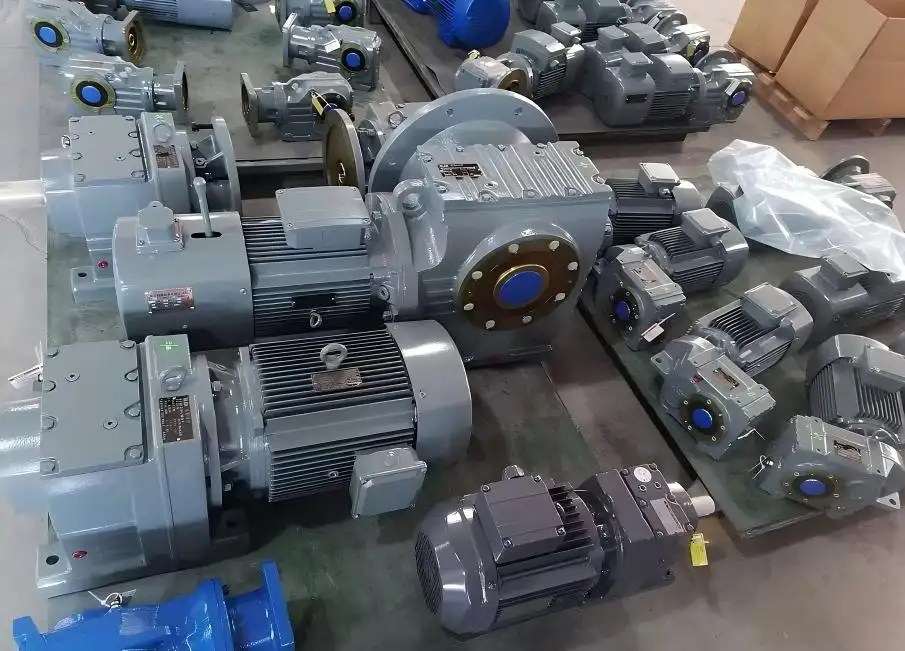
What happens: The motor is oversized for the actual load. It operates at a fraction of its rated load, where its efficiency is lower than at full load (the fixed losses — iron losses, friction — represent a larger percentage of the input power). The buyer pays for a larger motor than necessary, and the motor runs less efficiently than a correctly sized one would. Additionally, the duty cycle may allow a smaller motor to be selected — for intermittent duty, a motor can deliver more power during its “on” period than an S1-rated motor of the same frame size (for how duty cycle affects motor sizing, see our duty cycle selection guide).
What should have happened: The buyer should have calculated the actual required torque and selected a motor that operates near its rated load. The correctly sized motor may be smaller, cheaper, and more efficient than the oversized one.
The Three-Check Framework
Before finalizing a ratio and motor combination, verify three things:
- Gearbox rated torque ≥ calculated output torque — Check the manufacturer’s selection table for the specific model and ratio. The rated torque is the hard mechanical limit.
- Motor rated torque (not stall torque) is used in the calculation — Use the continuous rated value from the nameplate or data sheet. For peak torque events, check both gearbox rating and motor thermal capacity separately.
- Efficiency is specific to the ratio and stages — Ask the supplier for the efficiency at your specific ratio and load. Do not use a generic number from a different product or ratio.
If all three checks pass, the combination is mechanically sound. If any check fails, the selection needs to be adjusted — a different frame size, a different ratio, or a different motor.
Have a load profile with peak and continuous torque? Send the continuous torque, peak torque, duration of peak, and duty cycle. We can verify that both the gearbox mechanical rating and the motor thermal capacity are adequate for the actual operating pattern — not just the average load.
Calculated your ratio and torque but not sure if the gearbox rating matches? Send your motor rated speed and power, target output speed, and load description. We can check the ratio, verify the gearbox rated torque against the calculated output torque, and confirm the efficiency at the specific ratio — so you know the selection is sound before ordering.
Have a load cycle with peak and continuous torque? Send the load profile (continuous torque, peak torque, duration of peak, duty cycle). We can verify that both the gearbox mechanical rating and the motor thermal capacity are adequate for the actual operating pattern — not just the average load.
Share on Social:


Contact Us
In This Article
Right Angle Geared Motor: Matching Electrical Supply, Variable Speed and Braking
Oct 26, 2026
Planning a Bevel Reducer Installation: Turn Shaft Requirements Into a Practical Drive Layout
Oct 26, 2026
Choosing an Overhead Crane Gearbox by Its Hoisting or Travel Function
Oct 26, 2026
Replacing an Industrial Worm Gearbox: What to Keep and What to Reassess
Oct 25, 2026