


 Home /
Bucket Elevator Gearbox Torque Arm Mounting: Benefits for Compact Drive Systems
Right Angle Geared Motor: Matching Electrical Supply, Variable Speed and Braking
Oct 26, 2026
Planning a Bevel Reducer Installation: Turn Shaft Requirements Into a Practical Drive Layout
Oct 26, 2026
Choosing an Overhead Crane Gearbox by Its Hoisting or Travel Function
Oct 26, 2026
Replacing an Industrial Worm Gearbox: What to Keep and What to Reassess
Oct 25, 2026
For cement plants, mining systems, grain handling and other continuous conveying applications, a Bucket Elevator Gearbox has to do more than reduce motor speed. It must transmit high torque, tolerate frequent starting loads and integrate with a head section where installation space is often limited.
From Mingye's engineering perspective, torque-arm mounting is particularly useful when a Bucket Elevator Gearbox needs to be installed directly on the elevator head shaft. However, compact mounting should never be evaluated by gearbox dimensions alone. Reaction torque, shaft fit, structural stiffness, restart load and lubrication all determine whether the arrangement will operate reliably.
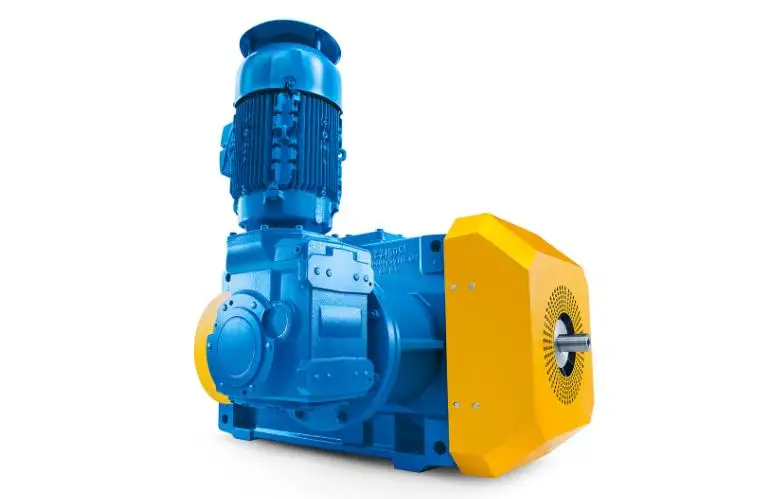
Why Torque Arm Mounting Is Used on a Bucket Elevator Gearbox
A shaft-mounted gearbox develops reaction torque in the opposite direction to the driven shaft.
In a traditional foot-mounted arrangement, this reaction is transmitted through:
Gearbox Housing → Base → Anchor Bolts → Supporting Structure
With torque-arm mounting, the load path becomes:
Gearbox Housing → Torque Arm → Bracket → Elevator Structure
The torque arm therefore does not "support the torque" in isolation. It transfers gearbox housing reaction into the machine structure while preventing the gearbox body from rotating around the head shaft.
A simplified relationship is:
Reaction Force ≈ Reaction Torque / Effective Arm Length
This explains why torque-arm geometry matters. Increasing the effective arm length generally reduces reaction force at the bracket, but arm length cannot be selected independently of available space, structural stiffness and mounting angle.
Critical Torque Arm Design Factors
Engineers should verify:
•Maximum gearbox output torque
•Loaded-start or restart torque
•Effective torque-arm length
•Torque-arm angle
•Bracket stiffness
•Bolt and weld loading
•Structural deflection
•Allowable joint movement
A longer arm is not automatically better. Poor geometry can introduce bending or unwanted constraint even when calculated reaction force appears acceptable.
Loaded Restart Often Governs Bucket Elevator Gearbox Selection
A common selection error is sizing the Bucket Elevator Gearbox only from normal motor power.
Bucket elevators can experience high resistance during:
•Loaded restart
•Material buildup in the boot section
•Emergency stop and restart
•Bucket blockage
•High starting inertia
•Temporary overfeed
Nominal shaft torque can be approximated from:
T = 9550 × P / n
where:
•T = torque in Nm
•P = transmitted power in kW
•n = shaft speed in rpm
This is only the starting point. A practical Bucket Elevator Gearbox selection also requires application factor, peak torque and operating duty.
| Design Input | Why It Matters |
| Continuous torque | Defines normal gearbox loading |
| Starting torque | Affects gears, shaft and torque arm |
| Peak torque | Important during blockage or loaded restart |
| Operating hours | Influences gear and bearing life |
| Starts per hour | Increases transient loading |
| Ambient temperature | Affects thermal capacity |
| Service factor | Provides application-specific load margin |
For torque-arm systems, higher peak output torque also means higher reaction force at the mounting bracket.
Torque Arm Mounting vs. Foot-Mounted Gearbox
Neither mounting method is universally superior. The correct choice depends on drivetrain geometry and structural conditions.
| Engineering Factor | Torque-Arm / Shaft Mount | Foot-Mounted |
| Installation footprint | Compact | Larger base area |
| Head-shaft connection | Direct connection possible | Coupling commonly required |
| Reaction load | Torque arm and bracket | Base and foundation |
| Alignment interfaces | Fewer components | Coupling alignment critical |
| Structural priority | Bracket stiffness | Foundation stiffness |
| Retrofit suitability | Good when shaft geometry permits | Good when existing base remains |
| Maintenance focus | Shaft fit and torque arm | Coupling and base alignment |
For a compact Bucket Elevator Gearbox installation, torque-arm mounting can reduce separate foundation requirements and drivetrain length. Foot mounting may still be preferable where the existing structure provides a rigid gearbox base or where independent shaft alignment is required.
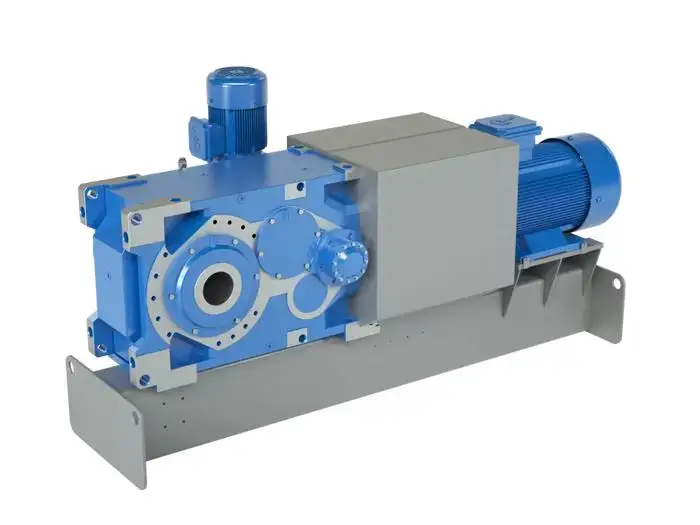
Output Shaft Configuration Is a Major Selection Decision
The output interface directly affects whether a compact drive arrangement can actually be achieved.
Hollow Shaft
A hollow-shaft Bucket Elevator Gearbox can mount directly over the elevator head shaft, reducing overall drivetrain length.
Advantages can include:
•Fewer transmission interfaces
•Reduced coupling space
•Compact head-platform layout
•Simplified shaft-line arrangement
However, head-shaft diameter, tolerance, runout and removal space must still be checked carefully.
Solid Shaft
A solid-shaft gearbox generally requires a coupling or another transmission component. This can provide more separation between gearbox and elevator shaft but requires additional installation length and alignment work.
Keyed Hollow Shaft vs Expansion Disk
Mingye B Series provides both keyed hollow-shaft and expansion-disk configurations.
A keyed connection offers a conventional mechanical interface, while an expansion-disk arrangement can transmit torque through a frictional shaft connection without relying on a traditional key.
The selection should consider:
•Required transmitted torque
•Shaft machining
•Fit tolerance
•Assembly procedure
•Removal requirements
•Maintenance accessibility
Ratio, Head-Shaft Speed and Reaction Load Must Be Calculated Together
A Bucket Elevator Gearbox should be selected from the required elevator operating speed rather than simply choosing a catalog ratio.
The approximate relationship is:
Output Speed = Motor Speed / Gear Ratio
The engineering sequence should therefore be:
Required Bucket Speed → Head-Shaft RPM → Gear Ratio → Output Torque → Peak Torque → Gearbox Size → Torque-Arm Load
This is important because a higher reduction ratio normally produces lower output speed and higher output torque. Higher output torque also increases gearbox housing reaction and therefore the load transmitted through the torque arm.
At Mingye, we recommend evaluating the complete drive system rather than isolating ratio, torque and mounting method as separate decisions.
Mingye B Series for Bucket Elevator Gearbox Applications
Mingye's B Series industrial gearbox provides configurations suitable for heavy-duty material-handling systems where high torque and flexible installation are required.
Key design options include:
•Ratio range: 1.25–450
•1–4 transmission stages
•Cylindrical and spiral bevel precision-ground gears
•Solid output shaft options
•Keyed hollow shaft options
•Hollow shaft with expansion disk
•Horizontal installation
•Vertical installation
•Swinging-base installation
•Torsion-arm / torque-arm installation
These configurations allow a Bucket Elevator Gearbox to be matched to different motor positions, head-shaft arrangements and platform constraints instead of forcing the machine layout around one fixed gearbox configuration.
Installation Quality Directly Affects Gearbox Life
Torque-arm mounting does not eliminate alignment requirements.
The torque arm should never be used to pull a misaligned gearbox into position. Doing so may transfer structural distortion into the gearbox housing, output bearings or head shaft.
Important installation checks include:
•Head-shaft runout
•Shaft and bore fit
•Torque-arm geometry
•Bracket alignment
•Fastener tightening
•Structural deflection
•Correct mounting position
•Lubrication arrangement
Vertical, horizontal and shaft-mounted configurations may require different lubrication provisions. Oil level and lubrication method should therefore follow the gearbox installation documentation for the selected mounting position.
Maintenance Should Include the Complete Reaction System
A Bucket Elevator Gearbox maintenance program should include more than oil changes.
Regular inspections should cover:
•Torque-arm bushings or joints
•Mounting bolts
•Bracket welds
•Hollow-shaft connection
•Abnormal housing movement
•Gearbox vibration
•Bearing temperature
•Oil condition and leakage
Changes in vibration or bearing temperature can indicate misalignment, looseness, shaft movement or lubrication problems before major gearbox damage develops.
Specify the Complete Drive Before Ordering
A reliable Bucket Elevator Gearbox RFQ should include:
•Motor power and speed
•Required head-shaft RPM
•Continuous and peak torque
•Loaded-restart conditions
•Operating hours per day
•Elevator capacity
•Shaft diameter and drawing
•Required mounting orientation
•Available installation envelope
•Preferred shaft connection
•Torque-arm anchor location
•Ambient operating temperature
For compact heavy-duty elevator drives, Mingye's B Series offers multiple gear ratios, output-shaft configurations and mounting arrangements that can be evaluated against the actual machine structure. Providing complete shaft, load and installation data allows Mingye to recommend a Bucket Elevator Gearbox configuration based on the real operating system rather than nominal motor power alone.
FAQs
Q1. Does Mingye offer a Bucket Elevator Gearbox suitable for torque arm mounting?
Yes. Mingye's B Series industrial gearbox supports torsion-arm or torque-arm mounting configurations, making it suitable for evaluating compact shaft-mounted Bucket Elevator Gearbox layouts.
Q2. Which Mingye gearbox series is suitable for heavy-duty bucket elevator applications?
The Mingye B Series is a strong option for heavy-duty material-handling systems because it combines cylindrical and spiral bevel gearing with multiple shaft and mounting configurations.
Q3. What gear ratios are available for Mingye B Series Bucket Elevator Gearbox applications?
The Mingye B Series covers gear ratios from 1.25 to 450, allowing engineers to match motor speed to the required bucket elevator head-shaft speed.
Q4. Can Mingye provide a hollow-shaft Bucket Elevator Gearbox?
Yes. The B Series includes hollow-shaft configurations that can be considered for direct mounting onto a bucket elevator head shaft, subject to shaft dimensions and torque requirements.
Q5. Does Mingye offer expansion-disk connections for Bucket Elevator Gearbox systems?
Yes. Mingye B Series configurations include hollow shafts with expansion disks, providing an alternative to conventional keyed shaft connections.
Share on Social:


Contact Us
In This Article
Right Angle Geared Motor: Matching Electrical Supply, Variable Speed and Braking
Oct 26, 2026
Planning a Bevel Reducer Installation: Turn Shaft Requirements Into a Practical Drive Layout
Oct 26, 2026
Choosing an Overhead Crane Gearbox by Its Hoisting or Travel Function
Oct 26, 2026
Replacing an Industrial Worm Gearbox: What to Keep and What to Reassess
Oct 25, 2026