


 Home /
 Double Shaft Mixer: Compact Gearbox Design For 2026 Energy Standards
Right Angle Geared Motor: Matching Electrical Supply, Variable Speed and Braking
Oct 26, 2026
Planning a Bevel Reducer Installation: Turn Shaft Requirements Into a Practical Drive Layout
Oct 26, 2026
Choosing an Overhead Crane Gearbox by Its Hoisting or Travel Function
Oct 26, 2026
Replacing an Industrial Worm Gearbox: What to Keep and What to Reassess
Oct 25, 2026
The Double Shaft Mixer is essential for the processing of dry mortars, chemicals, ceramics, and battery materials. Procurement teams will require more than a high turnover with the new energy regulations coming into force in 2026. The size of the footprint of the mixer, efficiency, and drivetrain losses will also need to be assessed.
Mingye is opting for a compact gearbox design to reduce energy losses at the transmission level and meet smaller footprint production layouts. This will be their response to upcoming regulations.
Why 2026 Energy Standards Will Influence the Selection of Double Shaft Mixers
The EU and the North American markets have introduced new regulations that restrict the amount of energy that can be lost in continuous mixing equipment. Older or larger gearboxes used with a Double Shaft Mixer can lead to energy losses of around 8% to 12% of the input energy. This is due to friction, misalignment, and poorly designed lubrication channels.
This creates a direct cost issue for customers. Mixers that run 6000 hours per year can result in an enormous annual energy cost savings with even a 5% efficiency improvement.
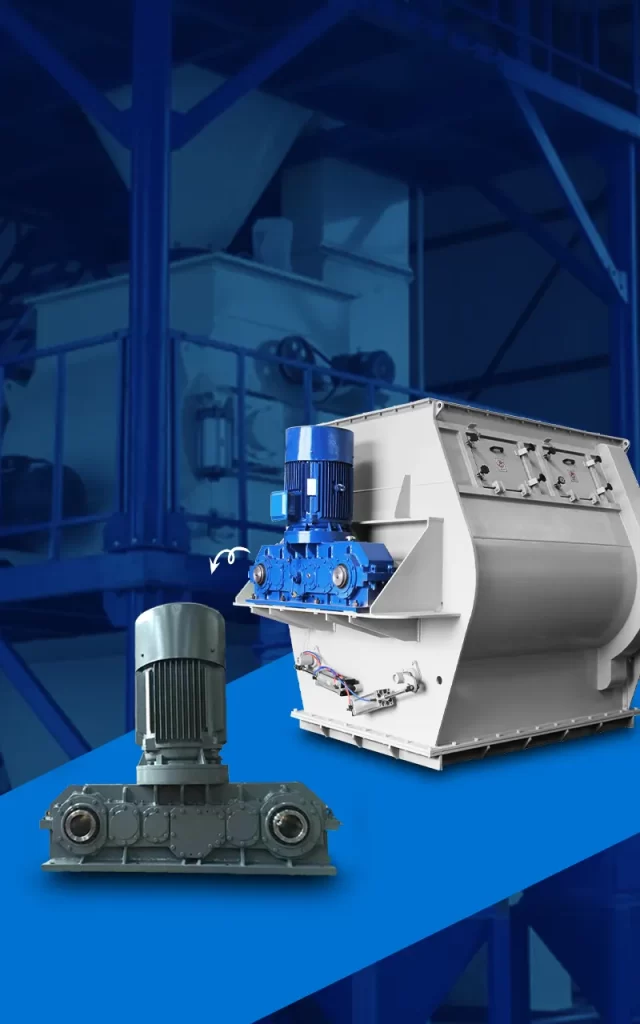
The more cost-effective option is to select a gearbox that is optimized for twin-shaft synchronization rather than relying on an off-the-shelf industrial reducer.
Twin Shaft Paddle Mixer Gearbox: Designed for Reduced Losses
Mingye's Twin Shaft Paddle Mixer Gearbox employs a four-stage gear drive with compact hollow shaft outputs. This directly minimizes the two most significant causes of energy losses in conventional mixers:
•Shorter power transmission path: Fewer intermediate connections which lead to friction points means input energy can reach the mixing shafts faster.
•Lower rotating mass inside the gearbox: Compact housing shrinks oil churning losses; an unseen energy drain from larger reducers.
•Matched torque distribution: Every shaft receives the same rotational input, so the drive system has no need to compensate for any shaft imbalance.
With synchronous shafts, a Double Shaft Mixer maintains paddle shaft clearance to ensure contact with paddles, allowing the motor to handle the load during the hardest part of the mixing cycle.
Savings Potential from a Compact Design and Cost Efficient Fabrication
It is likely that savings will come from the mixer frame's gear box structure. By 2026, there's a market preference for machinery that achieves the same result using a smaller footprint.
For OEMs and plant designers this incorporates significant advantages:
•Space is conserved: The design uses a twin hollow shaft output with no large couplings or plates needed between the gearbox and the mixing chamber.
•Costs are optimized: The total bill of materials for the complete mixing system is lower due to a decrease in the number of machined parts and support system structures.
•Alignment is easier: There is a common reference for the gearbox and Mixer shafts, minimizing field assembly errors that accelerate bearing wear.
For a Double Shaft Mixer intended for use in continuous processing of chemicals or food, these solutions have direct positive impacts on uptime and frequency of service.
Gear Accuracy and Metallurgy for Reliable Performance
A compact gearbox design is pointless, especially in the application of food processing or chemical mixing, if it has not been designed to endure stress. The gearbox has been built to use low-carbon alloy steel that has been subjected to the process of carburizing and quenching. The surface of the gears achieves a hardness of 58-62 HRC whilst the gears are held to accuracy class of 6.
This specification has multiple applications for Double Shaft Mixers:
1. In applications where the materials are highly abrasive, such as with dry mortar, or dry silica: Gear surfaces need to pitted and need to last for at least several years of production.
2. When there are variations in batch weights: Grade 6 maintains consistent density overall, thereby improving the control of closing contact across the range of gaps after the material has been processed.
3. For extended industrial shifts: A combination of materials with hardness and zero tolerance facilitates reduced thermal degradation of lubricants, which protects seals and bearings.
Compared to standard domestic and international reducers in the same power class, this gearbox provides longer service life without requiring oversized safety margins.
Mixing Behavior Under Compact Drive Conditions
When a Double Shaft Mixer operates with a compact, rigid gearbox, the mixing chamber itself benefits. The two shafts reverse rotate relative to each other, driving paddles to move material axially and radially.
At higher linear velocities, powders are lifted into a fluidized or weightless state. This is where cross-mixing efficiency peaks. However, this configuration demands exact shaft timing. If one shaft delays even slightly, the cycles of lifting and falling become desynchronized, leading to dead zones.
The gearbox ensures constant synchronization by means of fixed ratio engangement. With this, the Double Shaft Mixer is able to achieve uniformity even when dealing with materials of uneven moisture or variable particle sizes.
Applications Where Compact Design Clearly Adds Value
The following sectors are the most pronounced for the adoption of compact gearbox configurations of the Double Shaft Mixer in 2026:
•Dry mortar production: Plants are more compact, and with rising prices of energy, even small efficiency improvements are beneficial.
•Battery material mixing: Cleanroom installations are easier with smaller, sealed drivetrain components.
•Chemical and pesticide blending: Reducing oil leaking points improves material purity and safety.
•Food and feed processing: Stainless steel quick disconnects now protect employees during washdown procedures.
In these markets, due to the design of mixers, the gearbox must conform to certain mixer design geometries. The twin hollow shaft output allows a degree of flexibility without the need to reconfigure the entire drive train.
Considerations When Replacing Current Mixers
For existing Double Shaft Mixer Design units, enhancement of compliance with the 2026 energy standards can be achieved by the use of a retrofitted compact gearbox with no additional cost of new mixing vessels. Considerations include:
•Shaft spacing: Gearbox output spacing must be co-aligned with the paddle shaft positions
•Input power: Compact gearboxes can provide the same level of torque as bigger gearboxes, but must be verified
•Mounting positions: Bolt adjustments or hardware may be needed to align with the mixer design.
For replacement assessment, Mingye provides detailed drawings and technical specifications. The goal is to align the gearbox configuration with existing mixer arrangement, process needs, and installation conditions.
Practical Steps For Procurement Teams
When sourcing a Double Shaft Mixer or upgrading an existing unit, request the following technical data:
•Gear accuracy grade and surface hardness certification
•Calculated energy loss at full load operating temperature
•Mounting envelope drawing showing maintenance access clearances
These three items separate a purpose-built mixer gearbox from a repurposed industrial reducer. As 2026 energy standards continue to push toward lower operating costs, the mechanical efficiency of your mixer's drivetrain will matter as much as the motor nameplate rating.
For project-based equipment adaptation or OEM integration, a compact Double Shaft Mixer gearbox represents a practical step toward sustainable, cost-effective production.
FAQ: Double Shaft Mixer Compact Gearbox Design
Q: Is this compact gearbox designed to be added to an existing Double Shaft Mixer?
A: Yes, usually. The twin hollow shaft output can be matched to your Double Shaft Mixer shaft center distance and bolt pattern. We can provide dimensioning in order for you to confirm.
Q: What is a reasonable estimate of energy savings over a standard reducer?
A: In terms of energy savings, you can anticipate a standard range of savings between 5-8%. These savings result from reductions in oil churning losses, a power path of shorter length, and a more uniform torque. Actual savings will be the result of operating hours and densities of material being processed.
Q: What are the maintenance requirements for the compact gearbox?
A: Maintenance requirements include only periodic changes of the gearbox oil. The sealed housings and Grade 6 gears have excellent dimensional stability, avoiding wear. Therefore, no special inspection maintenance tools are required.
Q: What industries benefit the most from this compact design?
A: This is most beneficial across dry mortar, most battery materials, specialty chemicals, food processing, and feed production. It is particularly beneficial where space is an issue as well as applications and mixing which is of a continuous nature.
Q: What is the process to confirm gearbox integration with my mixer?
A: Provide shaft spacing, input power requirements, and available space for mounting. Mingye will analyze with their existing dimensional drawings and tech specs.
Share on Social:


Contact Us
In This Article
Right Angle Geared Motor: Matching Electrical Supply, Variable Speed and Braking
Oct 26, 2026
Planning a Bevel Reducer Installation: Turn Shaft Requirements Into a Practical Drive Layout
Oct 26, 2026
Choosing an Overhead Crane Gearbox by Its Hoisting or Travel Function
Oct 26, 2026
Replacing an Industrial Worm Gearbox: What to Keep and What to Reassess
Oct 25, 2026